
Scar treatment in Birmingham
Specialist assessment and treatment for surgical, injury, burn, acne, keloid and hypertrophic scars
At Midland Skin we offer consultant-led scar assessment and treatment for adults and children in Birmingham, Solihull, Coventry, Wolverhampton, Worcester and the Midlands.


Quick Facts about scar treatment

Best for
Any scar, any cause
Appointment
Initial scar assessment
Treatment
Laser, injections, surgery

Sessions
Usually a course
Consultant
Dermatologist or surgeon

Price
See below
Which type of scar do you have?
Most scars fall into one of the groups below. Choose the one that fits best to read about treatment, or book an initial scar assessment if you are not sure.

Scars after surgery or injury
3 Treatments

Raised, itchy or growing scars
3 Treatments

Acne scars
4 Treatments

Other scars we treat
5 Treatments

Not sure, or more than one type?
1 Treatments
Not sure what type of scar you have?
You do not need to work this out before you book. Many scars have more than one feature at the same time — raised in one part, red or dark in another, tethered or indented elsewhere — and the cause, the site and the age of the scar all change which treatments are sensible. Not every raised scar is a keloid, and occasionally a lump that has been assumed to be a scar turns out to be something else that needs a different approach.
The initial scar assessment establishes what you have, what is realistically treatable and which treatments are worth considering.
Which appointment should I book?
Initial scar assessment — for scars from surgery, injury, burns, piercings, chickenpox or self-harm; keloid and hypertrophic scars, including keloids caused by acne; stretch marks; and any scar you are unsure about. Adults and children are seen.
Initial acne scar assessment — for the pitted, rolling or boxcar scarring left by acne, and for a mixed picture of pitted and keloid acne scarring. This is a separate appointment with its own preparation, and is booked from the acne scar treatment page. If you still have active acne, this needs to be controlled first and a separate acne consultation is required.
Your initial scar assessment
Your assessment is with a consultant dermatologist or consultant surgeon who treats scars regularly. No referral is needed.
Your consultant asks how and when the scar formed, what it is doing now — itching, pain, tightness, growth or colour change — what has already been tried, how you have healed in the past and whether you have a tendency to scar. Your skin type, medical history and medications are also reviewed, as these affect which treatments are safe for you.
The scar is examined under good lighting, at rest and on movement, and gently stretched and felt to judge how thick, tethered or deep it is. Clinical photographs are taken as a baseline, so that your response to treatment can be measured rather than guessed at.
You leave knowing what type of scar you have and what can realistically be achieved, with a written treatment plan and costing. A copy of the clinic letter is sent to you and your GP.
Treatment is not carried out at the initial assessment. Laser and surgical treatments are booked at a separate appointment after a cooling-off period of at least two weeks, once you have had time to consider the plan. There is no obligation to proceed.

Scarlett Greenwood

How scars are treated at Midland Skin
Scars are treated according to what is wrong with them rather than what caused them. Most scars have more than one problem, and most need a combination of treatments given as a course. Which combination is recommended depends on your assessment.
Redness. Vascular lasers target the fine blood vessels that keep a scar pink or red, and can also ease itching and discomfort in newer scars.
Dark marks or pale patches. Pigment lasers and prescription creams can reduce darkening. Loss of pigment is harder to treat, though fractional lasers can help some pale scars blend in.
Thickened, lumpy or uneven texture. Fractional ablative and non-ablative lasers create microscopic channels that prompt the scar to remodel and soften. For resistant scars, medication can be applied through these channels to reach deeper into the scar tissue.
Raised keloid and hypertrophic scars. Injections into the scar, cryotherapy, silicone and compression, and — for selected scars such as ear-lobe keloids — surgical removal combined with other treatments to reduce the chance of the scar returning. Read more on our keloid scar treatment page.
Indented, pitted or tethered scars. Subcision releases the bands pulling a scar down, TCA CROSS and fractional resurfacing rebuild the base of pitted scars, and fillers or biostimulators can restore lost volume beneath selected scars.
Tight scars and contractures. Fractional laser can soften and release scars that feel tight or restrict movement, particularly across a joint.
Scars that need revising. Where the width, shape or position of a facial scar is the main problem, surgical scar revision may be considered for selected scars. The new scar is then treated early with laser or injections to help it settle well.
Cosmetic camouflage. Specialist camouflage creams and powders are colour-matched to your skin and are more opaque, longer-lasting and more water-resistant than ordinary make-up. They do not change the scar, but they can make it far less noticeable within minutes, with no downtime, on any skin tone. Camouflage is worth considering alongside treatment, while a scar matures, for scars that treatment cannot fully improve — pale scars in particular — and for anyone who would rather not have a procedure at all. We do not currently provide a camouflage service at Midland Skin, but we will tell you at your assessment if it is likely to help. In England, Changing Faces offers free online guidance, product advice and a support line, the Skin Camouflage Network lists accredited practitioners across the UK, and some camouflage products can be prescribed on the NHS by your GP for scarring.
Because vascular, pigment, fractional ablative and non-ablative lasers, injection treatments, cryotherapy and surgery are all available under one roof, the plan can change as your scar changes rather than being limited to a single technique.
When is the right time to be assessed?
Fresh surgical or injury scars — earlier than most people expect. Treatment can start within weeks of suture removal or once the wound has healed, and early treatment can soften redness, reduce thickening and help prevent abnormal pigmentation. If you have had skin surgery with us, this is usually discussed at your post-operative review.
Keloids — rarely settle on their own and can keep growing for months or years, so assessment is worthwhile as soon as a scar is raised, itchy or spreading beyond the original wound.
Acne scars — once the acne itself is under control. Treating scars on inflamed skin risks further scarring.
Older scars — it is never too late. Established scars, including those many years old, can still improve with combination treatment.
Treatment pathway
Initial scar assessment
Your scar is examined and photographed, and your symptoms, previous treatment and healing history are reviewed. You are told what type of scar you have and what can realistically be achieved.
Written plan and costing
Suitable treatments are recommended, with alternatives, likely benefit, risks, downtime, aftercare and fees. Treatment is not carried out at this appointment. Laser and surgery follow a cooling-off period of at least two weeks.
Treatment course
Sessions take place at separate appointments, usually several weeks apart. Most scars are treated with a combination of treatments over a course of months.
Review at each session
Before each treatment, your response is compared with your baseline photographs and the plan is continued, adjusted or stopped as the scar changes.
What to expect from treatment
It is really important to have realistic expectations before embarking upon scar treatments.
Scar treatment improves a scar. It does not remove it, and a treated scar remains visible. The aim is a scar that is flatter, softer, closer in colour to the surrounding skin and less noticeable — and, where a scar is itchy, sore or tight, more comfortable.
Improvement is gradual. Most scars need a course of treatment over several months, and the skin continues to remodel for months after the last session, so the final result is not seen straight away.
Responses vary between people and between scars. Some scars improve considerably, some only a little, and no guarantee can be given. Keloids in particular can recur after a good result, and ongoing measures such as silicone, compression or occasional maintenance treatment are often part of long-term control.
In skin of colour there is a higher chance of the treated area darkening temporarily after laser treatment. This affects which devices and settings are chosen and how far apart sessions are spaced, and strict sun protection is essential. All treatments carry risks — including redness, swelling, bruising, crusting, pigment change, infection and, occasionally, worsening of the scar — and these are explained for your specific plan before you consent.
Other scars we treat
Scars in children. Burn, injury and surgical scars in children are assessed and treated at Midland Skin. Treatment is planned around the child’s age, the site of the scar and what they can comfortably tolerate.
Chickenpox scars. These small, pitted scars behave like atrophic acne scars and are treated with the same techniques — TCA CROSS, subcision and fractional resurfacing.
Scars from self-harm. We see many people with these scars, and assessment is discreet and without judgement. Treatment with fractional and vascular lasers aims to soften their texture and blend their colour so they are less noticeable. They cannot be removed completely.
Stretch marks. Stretch marks are a form of scar. Vascular lasers can reduce the redness of newer stretch marks and fractional lasers can improve the texture of older ones. Improvement rather than clearance is the realistic aim.
Your initial scar assessment: FAQs
Should I send photographs when I book?
You may be asked to supply photographs as they will help us allocate your appointment to the most appropriate consultant for your needs. They do not replace examination or face to face assessment.
Who will assess me?
A consultant dermatologist or consultant surgeon with expertise in scar treatment. Your appointment is allocated according to the type of scar and whether you are an adult or a child. The consultant who assesses you prepares your plan, and the clinician carrying out each treatment is confirmed when it is booked.
What should I bring?
The date and details of the surgery or injury, any operation notes or clinic letters you have, a list of creams, silicone or other treatments you have tried, and any photographs showing how the scar has changed over time.
Will I have treatment at my first appointment?
No. The initial scar assessment is for examination, diagnosis and planning. Laser and surgical treatments are booked separately, usually after a cooling-off period of at least two weeks, and other treatments are arranged once your plan has been agreed.
Is the assessment fee deducted from the cost of treatment?
No. The fee pays for the consultant’s time in examining your scar, assessing suitability and preparing your plan, whether or not treatment is recommended. As such it is a stand alone service in its own right.
Your consultant may advise against treatment when that is the right advice, and you can decide not to go ahead without feeling you need a procedure to make “use of the fee”.
Book in with us
Ready to get started? Book a consultation with our team at Midland Skin. Friendly, expert advice tailored to you.
Fees
Scar consultations Show pricing
Book ConsultationTreatment fees depend on your plan. They are listed on each treatment page and confirmed in your written costing.
Initial scar assessment
For keloid, hypertrophic, surgical, burn, self-harm or injury scars. Up to 25 minutes
Initial acne scar assessment
A separate acne assessment is required for those who also have active acne. Up to 25 minutes
Review consultation
Standard, up to 20 minutes
Extended review consultation
If more time is required, up to 30 minutes
Scar treatment Show pricing
Book ConsultationTreatment fees depend on your plan. They are listed on each treatment page and confirmed in your written costing.
Steroid injection
Steroid + chemotherapy injection
Laser treatment for scars
Surgical scar revision
Scarlett Greenwood
References used for this article
- Seago M, Shumaker PR, Spring LK, et al. Laser Treatment of Traumatic Scars and Contractures: 2020 International Consensus Recommendations. Lasers Surg Med. 2020;52(2):96–116. doi:10.1002/lsm.23201
- Walsh LA, Wu E, Pontes D, et al. Keloid treatments: an evidence-based systematic review of recent advances. Syst Rev. 2023;12:42. doi:10.1186/s13643-023-02192-7
- Edriss M, Monconduit R, St Claire K, Akers KG, Mehregan D. Treatment of self-harm scars: a scoping review. Dermatol Surg. 2022;48(8):809–814. doi:10.1097/DSS.0000000000003499
- Wu TJ, Huang YL, Kang YN, Chen KH, Chen C. Comparing energy-based devices for striae improvement: a systematic review and network meta-analysis of randomized controlled trials. Dermatol Surg. 2024;50(10):931–938. doi:10.1097/DSS.0000000000004252
About the Author
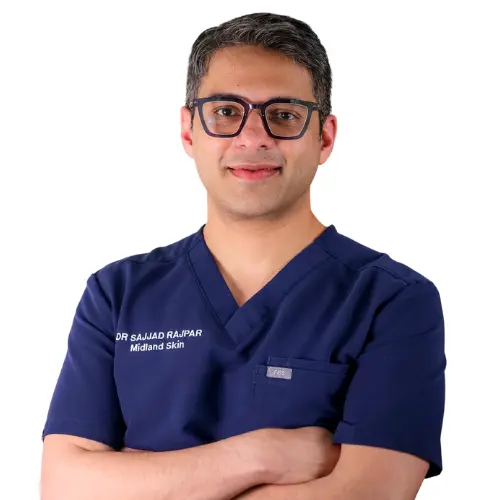
This page has been written and/or medically reviewed by Dr Sajjad Rajpar, Consultant Dermatologist and Medical Director of Midland Skin, Birmingham.
Dr Rajpar is on the GMC Specialist Register in Dermatology and has over 20 years’ experience in clinical dermatology. He provides clinical oversight to ensure the information on this page is accurate, balanced and consistent with current dermatology practice.
Dr Sajjad Rajpar
Date last updated: 28th Sep 2026
Book in with us
Expert, consultant led care in dermatology, skin surgery, eyelid surgery, lasers and aesthetics.
Disclaimer
The content on this website is provided for general information only. It is not, and must not be treated as, medical advice, a diagnosis, or a recommendation for any particular treatment. We make reasonable efforts to keep information accurate and up to date, but medicine and technology change, and content may not reflect the most current evidence, guidance, product information, or individual practice. You should not rely on this website to make decisions about your health or treatment. Always seek personalised advice from an appropriately qualified healthcare professional. Any examples, images, testimonials, and outcome descriptions are illustrative only. Results vary between individuals and no outcome can be guaranteed.


