
Fungal Acne consultations with a Dermatologist
Our Dermatologists will be able to advise you on the best treatments suitable for fungal acne
At Midland Skin we offer Fungal Acne consultations with a Dermatologist for patients in Birmingham, Solihull, Coventry, Wolverhampton, Worcester and the Midlands.


What is fungal acne?
Fungal acne is spots caused by Malassezia (formerly known as Pityrosporum). Malassezia are yeasts that are naturally found on everyone’s skin.
Malassezia yeasts can grow in hair follicles, and cause inflammation of hair follicles. This causes spots to develop and this is referred to as fungal acne. Spots may have a white head of pus, just the same as in acne.
The medical name for fungal acne is Malassezia folliculitis. Folliculitis means inflammation of hair follicles.
Quick facts about Fungal acne [TO UPDATE]
- You need three 45 minute treatments – one every 3 to 4 weeks
- The results get better with time and at one year there is an average reduction in inflammatory spots of 97% according to clinical studies
- There are no harmful side effects
- The treatment is safe in all skin tones and all year round
- You do not need to take long-term tablets or creams
- There can be short-lived purges which can be managed with medications
How do I know if I have fungal acne?
Fungal can look very much like usual acne. And so, it can be confusing at times. There are some clues though.
In fungal acne, the spots are red bumps (papules) or pustules (white heads) of a similar size, usually between 1 to 2 mm. They occur in waves and they can be pretty itchy – much more itchy that usual acne spots. Fungal acne can occur anywhere on the body but common locations are:
- Forehead, temples and frontal hair line
- Upper chest
- Upper and mid back
In contrast, in usual acne there are closed comedones (skin coloured bumps), open comedones (blackheads), nodules (red lumps), cysts, and pustules (spots with a pus filled top). Spots can be of varying sizes too.

Scarlett Greenwood

The picture may not be as straight forward
The picture is not always clear cut as fungal acne can be present at the same time as usual acne. Fungal acne may also cause closed comedones especially on the forehead.
What are the triggers to fungal acne?
Fungal acne is usually more of a problem in the summer but can occur for no particular reason at any time of the year. However, there are certain triggers:
- Having very greasy skin
- Hot weather that causes sweating
- Wearing tight fitting clothes
- Sweating a lot while you exercise
- Using too much sunblock, moisturisers and make up that block hair follicles
- Having antibiotics for treating acne
What can I do to reduce the chance of getting fungal acne?
- Avoid very hot environments that make you sweat
- Wear loose fitting clothes
- Avoid putting very heavy layers of creams or make up on your face
Book in with us
Ready to get started? Book a consultation with our team at Midland Skin. Friendly, expert advice tailored to you.
How is fungal acne diagnosed?
It can usually be diagnosed from the history and appearance by a Dermatologist. Additional tests may be required such as a scrape test where the pus from a spot is looked at under the miscroscope to determine whether there are yeast spores or bacterial elements. Very rarely a skin biopsy is required, which shows yeast with the follicles.
How is fungal acne treated?
Fungal acne is treated with addressing any obvious trigger factors and with antifungal creams, antifungal washes and antifungal tablets.
There is a tendency for fungal acne to come back and so maintenance treatment can be required.
Do you treat fungal acne?
We offer diagnosis and treatment for fungal acne. We also treat those who may be suffering from both acne and fungal acne concurrently.
PRICING EXAMPLE LINK
References used for this article
Further information on dermatitis can be found here:
About the Author
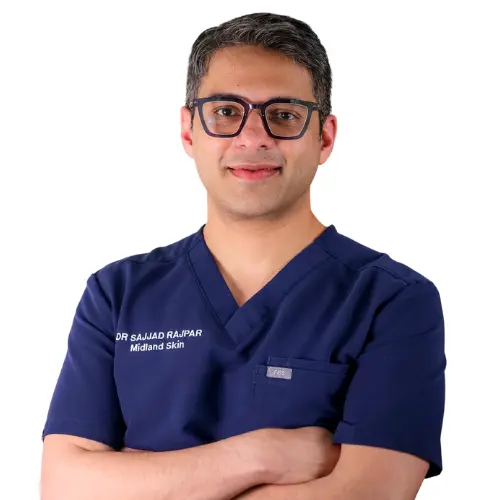
This page has been written and/or medically reviewed by Dr Sajjad Rajpar, Consultant Dermatologist and Medical Director of Midland Skin, Birmingham.
Dr Rajpar is on the GMC Specialist Register in Dermatology and has over 20 years’ experience in clinical dermatology. He provides clinical oversight to ensure the information on this page is accurate, balanced and consistent with current dermatology practice.
Dr Sajjad Rajpar
Date last updated: 9th Mar 2026
Book in with us
Expert, consultant led care in dermatology, skin surgery, eyelid surgery, lasers and aesthetics.
Disclaimer
The content on this website is provided for general information only. It is not, and must not be treated as, medical advice, a diagnosis, or a recommendation for any particular treatment. We make reasonable efforts to keep information accurate and up to date, but medicine and technology change, and content may not reflect the most current evidence, guidance, product information, or individual practice. You should not rely on this website to make decisions about your health or treatment. Always seek personalised advice from an appropriately qualified healthcare professional. Any examples, images, testimonials, and outcome descriptions are illustrative only. Results vary between individuals and no outcome can be guaranteed.


