
Female Pattern Hair Loss consultations with a Dermatologist
Hereditary hair loss in women is much more common than most people would think.
At Midland Skin we offer female pattern hair loss consultations with a Dermatologist for patients in Birmingham, Solihull, Coventry, Wolverhampton, Worcester and the Midlands.


What is Female Pattern Hair Loss?
Hereditary hair loss in women is much more common than most people would think. It is estimated that up to 40% of women will be affected by female pattern hair loss at some point in their lives. The term androgenetic alopecia, which is widely used for male pattern hair loss, should be avoided in women as the disorder is not always clearly driven by androgens.
While several male role models with balding exist in the media, there are none for women. Hair loss in women significantly affects their quality of life, confidence, relationships and many other aspects.
Quick facts about Female Pattern Hair Loss[TO UPDATE]
- You need three 45 minute treatments – one every 3 to 4 weeks
- The results get better with time and at one year there is an average reduction in inflammatory spots of 97% according to clinical studies
- There are no harmful side effects
- The treatment is safe in all skin tones and all year round
- You do not need to take long-term tablets or creams
- There can be short-lived purges which can be managed with medications
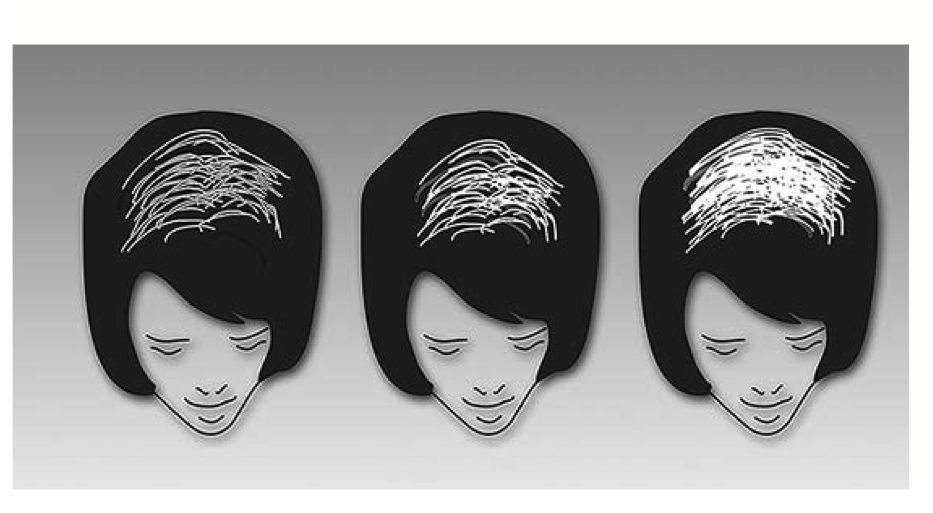
Ludwig staging of female pattern hair loss
In most cases thinning is noticed in the mid scalp area, such that parting the hair centrally reveals more and more scalp as shown in the diagram below. Typically the hair line is spared and does not recede backwards as it does with men.
The good news is that complete or almost complete hair loss occurs in less than 1% of women.
Miniaturisation
As in male pattern hair loss, terminal hairs become progressively thinner and shorter with each cycle such. Eventually the hairs become fine vellus hairs which are barely visible. This leads to the perceptible thinning. Usually 50% of the hairs will have become miniaturised before thinning is appreciable.

Scarlett Greenwood

Treatment
Options for treatment include:
Minoxidil. This lotion or foam can be obtained at any pharmacy and has been shown to slow down the process of female pattern hair loss in about 40% of users. Minoxidil needs to be continued indefinitely for the effect to be maintained.
Oral minoxidil is a highly effective option we specialise in for female pattern hair loss.
Spironolactone is also another medical solution for hair loss that we offer.
Camouflage. Virtually every woman with hair loss will have tried to hide the problem. This may be with a hairstyle that is less revealing, a powder-based camouflage spray or a hair system such as a wig or a more customised product.
Hair Transplantation. Women make up an increasing share of patients undergoing hair transplantation. This can be a very successful method of restoring hair. A good candidate for hair transplantation will have mild or moderate hair loss, good donor hair density, and enough elasticity in the scalp. We do not offer hair transplantation.
PRICING EXAMPLE LINK
References used for this article
Further information on dermatitis can be found here:
About the Author
This page has been written and/or medically reviewed by Dr Sajjad Rajpar, Consultant Dermatologist and Medical Director of Midland Skin, Birmingham.
Dr Rajpar is on the GMC Specialist Register in Dermatology and has over 20 years’ experience in clinical dermatology. He provides clinical oversight to ensure the information on this page is accurate, balanced and consistent with current dermatology practice.
Dr Sajjad Rajpar
Date last updated: 9th Mar 2026

Book in with us
Expert, consultant led care in dermatology, skin surgery, eyelid surgery, lasers and aesthetics.
Disclaimer
The content on this website is provided for general information only. It is not, and must not be treated as, medical advice, a diagnosis, or a recommendation for any particular treatment. We make reasonable efforts to keep information accurate and up to date, but medicine and technology change, and content may not reflect the most current evidence, guidance, product information, or individual practice. You should not rely on this website to make decisions about your health or treatment. Always seek personalised advice from an appropriately qualified healthcare professional. Any examples, images, testimonials, and outcome descriptions are illustrative only. Results vary between individuals and no outcome can be guaranteed.


