
Milia removal in Birmingham
Safe, quick removal of milia available as a same-day procedure
At Midland Skin we offer milia treatment for patients in Birmingham, Solihull, Coventry, Wolverhampton, Worcester and the Midlands.


Quick Facts about Milia Removal

Best for
Milia on face and eyelids
Anaesthetic
Local anaesthetic

Duration
10 mins

Recovery
3-4 days
Consultant
Dermatologist
Price
See below
What are milia?
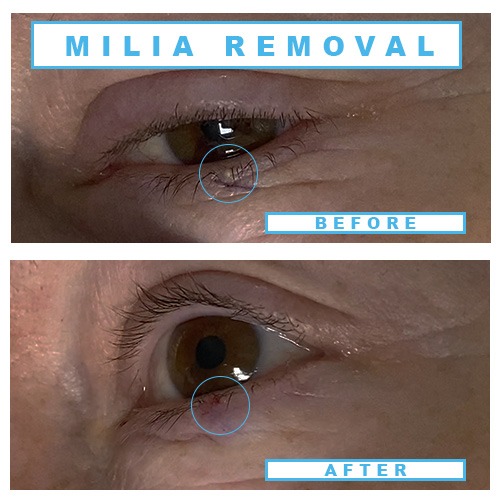
A milium (plural: milia) is a tiny, firm white spot that forms just under the surface of the skin. Milia measure 1 to 2mm in diameter and feel like a small grain beneath the skin. They may occur as a single lesion or in clusters of five, ten or more. Milia are benign but are commonly treated because they are visible and do not resolve on their own.
How do I know if I have milia?
Milia are very firm or hard, shiny white spots that measure 1 or 2mm in diameter. They are most commonly found on:
- Eyelids and under the eyes
- Along the eyelashes
- Cheeks
- Around the lips
- Elsewhere on the face
Lesions that may be confused with milia
Milia are sometimes mistaken for other skin lesions. Key differences to be aware of:
- Cysts – larger than 2mm and deeper in the skin; if the lesion is bigger than a milium, it is likely to be a cyst.
- Comedones – blocked pores, often associated with acne-prone skin.
- Sebaceous gland hyperplasia – enlarged oil glands that appear as slightly yellowish, donut-shaped bumps, most commonly on the nose, forehead and cheeks.
- Fordyce spots – small yellowish-white sebaceous glands visible on the skin surface; sometimes giving a “plucked chicken skin” appearance. This is common under the eyes and on the lips.
- Syringomas – small flesh-coloured bumps caused by overgrowth of sweat duct tissue, typically clustered around the lower eyelids.
If you are uncertain about your lesion, a consultation with a Consultant Dermatologist will confirm the diagnosis.
How are milia treated?
Milia can be extracted in a small procedure. The skin is cleansed and a small local anaesthetic injection is placed to numb the area. The skin over the milia is then incised and the milia is removed. Stitches are not required.
The procedure takes 5 to 10 minutes.
The procedure takes 5 to 10 minutes. A pin-prick wound results, which scabs over and heals within 3 to 4 days. No dressing is required; the wound can be kept moist with Vaseline applied three times daily. You can return to an office-based job immediately.
Treatment Pathway for Milia Removal
Initial Assessment
You meet your Consultant Dermatologist to confirm the diagnosis, discuss the procedure, and plan treatment. For straightforward clinically typical milia, treatment can usually take place at the same appointment as part of our same-day procedure service.
Milia Removal
The area is cleansed and numbed with a small local anaesthetic injection. Each milium is incised and removed. The procedure takes 5 to 10 minutes and no stitches are required.
Aftercare
You leave the same day with a small pin-prick wound at each site. Keep the area clean and apply Vaseline three times daily. The wounds heal within 3 to 4 days and you can return to work immediately.

Scarlett Greenwood

What is the difference between a milia and a cyst?
Milia are small — 1 to 2mm in diameter — and appear bright white because they sit very close to the skin surface. Any lesion that is larger or deeper than this is not a milium. Further information about cysts is available here.
Can I remove milia at home or use home remedies for milia?
Home removal of milia is not recommended. Milia cannot be squeezed out; unlike blackheads, they have no opening onto the skin surface. Attempting to do so risks inflammation, infection and scarring. Removal requires a small incision, which should be performed by a trained professional.
Can I prevent milia from coming back?
The cause of milia is not always clear. Over-exfoliation and the use of abrasive scrubs may increase the likelihood of new milia forming, so a gentle skincare routine is advisable.
What is the cost for milia removal?
Please check our fees page for the latest prices for milia removal. Prices for milia are based on the number of lesions. There is a price for 1-3 lesions, 4-7 lesions or more than 7 lesions.
Fees for milia removal
Milia removal Show pricing
Book ConsultationMilia removal 1-3 lesions
Milia removal 4-7 lesions
Milia removal is available as a same-day consultation and procedure for eligible lesions.
About the Author
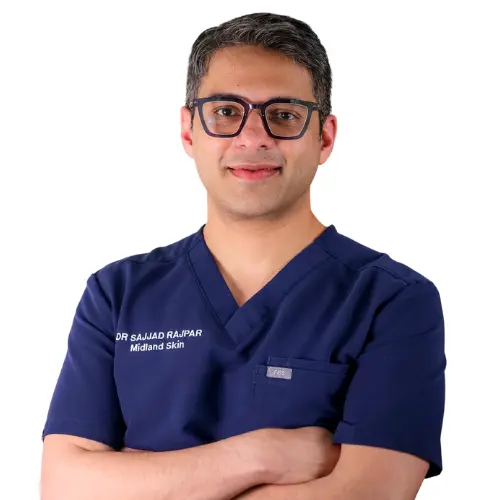
This page has been written and/or medically reviewed by Dr Sajjad Rajpar, Consultant Dermatologist and Medical Director of Midland Skin, Birmingham.
Dr Rajpar is on the GMC Specialist Register in Dermatology and has over 20 years’ experience in clinical dermatology. He provides clinical oversight to ensure the information on this page is accurate, balanced and consistent with current dermatology practice.
Dr Sajjad Rajpar
Date last updated: 16th Jun 2026
Book in with us
Expert, consultant led care in dermatology, skin surgery, eyelid surgery, lasers and aesthetics.
Disclaimer
The content on this website is provided for general information only. It is not, and must not be treated as, medical advice, a diagnosis, or a recommendation for any particular treatment. We make reasonable efforts to keep information accurate and up to date, but medicine and technology change, and content may not reflect the most current evidence, guidance, product information, or individual practice. You should not rely on this website to make decisions about your health or treatment. Always seek personalised advice from an appropriately qualified healthcare professional. Any examples, images, testimonials, and outcome descriptions are illustrative only. Results vary between individuals and no outcome can be guaranteed.


