
Alopecia Areata
At Midland Skin we offer Alopecia Areata consultations with a Dermatologist for patients in Birmingham, Solihull, Coventry, Wolverhampton, Worcester and the Midlands.

Alopecia Areata
Alopecia areata is a form of hair loss that affects up to 1.7% of people at some point in their lives. It occurs as a result of the immune system ‘fighting’ hair follicles, and preventing them from producing hair. The hair loss can be quite sudden and abrupt.
Quick facts about Alopecia Areata [TO UPDATE]
- You need three 45 minute treatments – one every 3 to 4 weeks
- The results get better with time and at one year there is an average reduction in inflammatory spots of 97% according to clinical studies
- There are no harmful side effects
- The treatment is safe in all skin tones and all year round
- You do not need to take long-term tablets or creams
- There can be short-lived purges which can be managed with medications
Features of Alopecia Areata
The most common way alopecia areata presents is by causing discrete circular areas of hair loss.
Usually, patches of hair loss affect the scalp or beard area but they can affect any area of the body.
The hair loss is sudden and can occur overnight. The remaining skin is smooth though openings of the hair follicles can be seen. The eyebrows and eyelashes can also be affected.
Progression of Alopecia Areata
It is important to understand the likely outlook for the different types of alopecia areata.
Fortunately, most people with patch-type alopecia areata will develop spontaneous regrowth at some time.
Regrowth can be patchy and white at the outset. Steroid creams or injections can help bring this about sooner.
Individuals with ophiasis, totalis or universal alopecia areata have a poorer prognosis and hair regrowth is less certain, even with treatment.

Scarlett Greenwood

Types of Alopecia Areata
- Totalis. This is when the whole scalp is affected
- Ophiasis. This is when there is a ‘band’ of hair loss several centimetres wide at the hair line.
- Universalis. This is when the whole body is affected
- Patches. This is the most common type by far, and causes discrete patches of hair loss. Patches develop suddenly and can expand out wards. Fortunately, 60-80% of patches regrow spontaneously with in 1 year.
- Diffuse. This type of alopecia areata causes generalised thinning of the hair globally. Sometimes it picks out dark hairs only, leaving behind grey hairs. This can explain why some people have been known to ‘go grey over night’.
Treatments
There are no licensed treatments for alopecia areata in the UK. The treatments that we offer for alopecia aerata are:
Steroid creams and scalp applications
These are applied to the bald patches, usually twice a day, for a limited time.
Steroid injections
These can be used on the scalp and brows, and are the most effective approach for small patches of hair loss that are no more than one third of the scalp surface area. Injections should be carried out by a dermatologist. Find out more about steroid injections for hair loss. Costs are provided on the fees page.
Steroid injections for alopecia areata are our most popular treatment for this condition.
Contact sensitisation treatment
This involves making the patient allergic to a substance (usually a chemical called diphencyprone) and then applying very weak strengths of this chemical to the bald patches, usually once a week to maintain a mild inflammation. Side effects of possible itching, blistering and enlarged glands in the neck can be troublesome. Loss of skin colour (depigmentation) may develop, so it is used cautiously in those with dark skin. This treatment is only available in specialised centres with careful clinical supervision. Approximate costs are £250-£300 per month – please check availability if you are interested in this treatment before arranging an appointment.
Oral medication
Medications that dampen the immune system are used for alopecia areata in some instances. Examples of oral treatments available for alopecia areata include Ciclosporin and Methotrexate. Approximate costs are £200-450 per month (varies depending on weight and blood test requirements).
JAK 2 inhibitors
Baricitinib and Ritlecitinib are approved by the FDA in America for the treatment of Alopecia areata and can be prescribed by our Clinicians. Approximate costs are £1200-1450 per month.
PRICING EXAMPLE LINK
References used for this article
Support groups and further information
A lot of individuals with alopecia aerate find it beneficial to join a support group and to meet up with others who have the same problem.
The following links may be of benefit:
About the Author
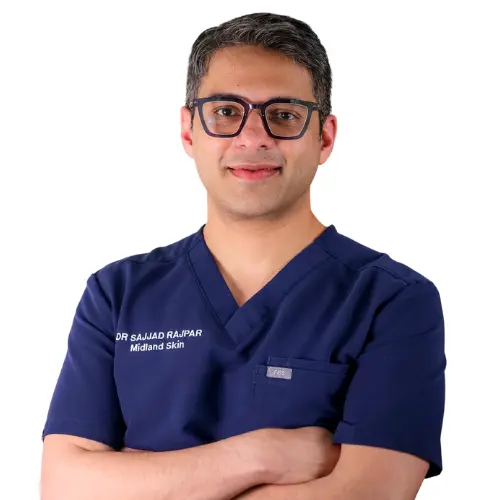
This page has been written and/or medically reviewed by Dr Sajjad Rajpar, Consultant Dermatologist and Medical Director of Midland Skin, Birmingham.
Dr Rajpar is on the GMC Specialist Register in Dermatology and has over 20 years’ experience in clinical dermatology. He provides clinical oversight to ensure the information on this page is accurate, balanced and consistent with current dermatology practice.
Dr Sajjad Rajpar
Date last updated: 9th Mar 2026
Book in with us
Expert, consultant led care in dermatology, skin surgery, eyelid surgery, lasers and aesthetics.
Disclaimer
The content on this website is provided for general information only. It is not, and must not be treated as, medical advice, a diagnosis, or a recommendation for any particular treatment. We make reasonable efforts to keep information accurate and up to date, but medicine and technology change, and content may not reflect the most current evidence, guidance, product information, or individual practice. You should not rely on this website to make decisions about your health or treatment. Always seek personalised advice from an appropriately qualified healthcare professional. Any examples, images, testimonials, and outcome descriptions are illustrative only. Results vary between individuals and no outcome can be guaranteed.


