
Chalazion Treatment in Birmingham
Specialist assessment and treatment for persistent or troublesome chalazia by oculoplastic surgeons


What is a chalazion?
A chalazion, sometimes called a meibomian cyst, is a lump on the eyelid caused by blockage of one of the small oil-producing meibomian glands.
A chalazion may initially be red, swollen or tender, but often becomes a firm and relatively painless lump. Many settle naturally over several months and do not require surgery.
If a chalazion persists, repeatedly becomes inflamed, causes discomfort, affects vision or is simply not resolving, it can be removed.
Quick Facts about Chalazion Treatment

Best for
Persistent chalazion
Anaesthetic
Local anaesthetic

Duration
15–20 minutes
Recovery
Bruising & swelling for 2-7 days
Consultant
Oculoplastic surgeon
Follow-up
4–6 weeks
When should I see a specialist about a chalazion?
You do not necessarily need treatment simply because you have a chalazion. Many improve with warm compresses, massage and time.
An assessment may be worthwhile if:
- the lump has persisted despite conservative treatment
- it remains prominent or troublesome
- it repeatedly becomes swollen or inflamed
- it is uncomfortable
- its size is affecting your vision
- you have had repeated chalazia
- a lump keeps returning in the same place
- you are unsure whether the lump is actually a chalazion
At Midland Skin, your eyelid is assessed by an oculoplastic surgeon. This is important because treatment is not simply about removing a lump: your surgeon will first confirm the likely diagnosis and consider the position of the lesion, eyelid anatomy, function and appearance before recommending treatment that is appropriate for your concern.
Is a chalazion the same as a stye?
No. Although both cause eyelid lumps, they are different conditions.
A chalazion develops when an oil gland within the eyelid becomes blocked. Once the initial inflammation has settled, it is often relatively painless.
A stye (hordeolum) is usually an acute inflammation or infection affecting a gland or eyelash follicle and is more likely to be red, tender and painful.
If the diagnosis is uncertain, examination of the eyelid can usually distinguish between them.

Scarlett Greenwood

Book in with us
Ready to get started? Book a consultation with our team at Midland Skin. Friendly, expert advice tailored to you.
What are the treatment options for a chalazion?
Warm compresses and massage
Many chalazia resolve without surgery. Warm compresses followed by gentle massage can help soften the contents of the blocked gland and encourage it to drain naturally.
For a recent chalazion, your surgeon may therefore recommend continuing conservative treatment rather than proceeding immediately to surgery.
Treatment of underlying eyelid inflammation
Some people are prone to recurrent chalazia because of conditions such as blepharitis, meibomian gland dysfunction or rosacea.
Where this is contributing to the problem, treating the underlying eyelid inflammation may help reduce further episodes.
Antibiotics do not usually make a chalazion disappear. They may occasionally be prescribed where there is associated infection or another eyelid condition requiring treatment.
Incision and curettage
For a persistent or troublesome chalazion, your oculoplastic surgeon may recommend a minor procedure called incision and curettage.
This is the principal surgical treatment we offer for chalazia.
Steroid injection
In selected case, steroid injection can be considered. Steroid injection is also sometimes required after surgery for post operative management of chalazion.
Your Chalazion Treatment Pathway
Oculoplastic Assessment
Your oculoplastic surgeon examines the eyelid, reviews the history of the lump and confirms whether it appears consistent with a chalazion. You will discuss whether treatment is necessary and the options available to you.
Treatment Plan
Your surgeon may advise further conservative treatment if the chalazion is likely to settle naturally. If it is persistent or troublesome, incision and curettage may be recommended.
Chalazion Removal Procedure
Incision and curettage is carried out under local anaesthetic and you go home the same day.
Follow-up Consultation
A follow-up consultation is arranged 4–6 weeks after the procedure. Your surgeon will assess how the eyelid has healed, whether the chalazion has resolved satisfactorily and whether any further treatment or preventative measures are required.
What happens during chalazion surgery?
Chalazion surgery is a relatively short procedure performed under local anaesthetic.
Local anaesthetic is injected into the eyelid, and anaesthetic eye drops are placed in the eye. The injection stings briefly, but once the anaesthetic has taken effect you should not feel pain during the procedure, although you may still be aware of pressure or movement.
In most cases, the eyelid is gently turned over and a small incision is made on its inner surface. The contents of the chalazion and associated inflammatory material are then removed using a procedure known as curettage.
Because the incision is usually made from inside the eyelid, there is normally no external skin incision or external incision scar.
An ointment and eye pad may be applied afterwards. You are able to go home on the same day.
On the day: what to expect FAQs
How should I prepare for my chalazion procedure?
You can normally eat and drink as usual before a procedure performed under local anaesthetic unless we specifically advise you otherwise.
Please tell us about:
- medicines you take, particularly medicines which affect bleeding
- medication allergies
- previous reactions to local anaesthetic
- previous eyelid or eye surgery
- any changes in the chalazion since your assessment
Do not stop prescribed medication unless your surgeon or the clinician responsible for that medication has specifically advised you to do so.
Will chalazion surgery hurt?
The local anaesthetic injection stings for a few moments. Once the eyelid is numb, you should not feel pain during the procedure, although pressure and movement can still be felt. Some mild discomfort may develop once the local anaesthetic wears off.
How long does the procedure take?
The procedure itself is usually completed within 15-20 minutes, although you should allow longer for your appointment so that there is sufficient time for preparation, consent, treatment and discharge.
Will I need stitches?
Usually not. Most chalazia are approached through a small incision on the inside of the eyelid and stitches are not normally required. Your surgeon will explain if a different approach is needed in your particular case.
Will I have an eye patch?
An eye pad or pressure dressing may be placed over the treated eye to help reduce bleeding and swelling. You will be told how long to leave this in place before you go home.
Can I drive after chalazion surgery?
Do not plan to drive yourself home after your chalazion procedure.
You should not drive yourself home following the procedure.
Your eye may be padded following treatment and ointment, swelling or the procedure itself can temporarily affect your vision.
Please arrange appropriate transport home before attending your procedure appointment.
Once any eye pad has been removed, you should only resume driving when your vision is completely clear, you are not significantly light-sensitive and you are confident that you can drive safely.
Ointment used around the eye can also temporarily blur vision.
Your surgeon will give you individual advice where necessary.
Will I need any further treatment after surgery?
In some cases, steroid injections into the operated area are required after chalazion surgery to reduce inflammation. Your doctor will discuss this with you at your review appointment.
After surgery: repair and recovery FAQs
What should I expect after chalazion surgery?
Some swelling, bruising and tenderness of the eyelid is normal following treatment.
The eyelid may initially look more swollen than it did before the procedure. This does not mean that the chalazion has returned or that treatment has been unsuccessful.
The swelling and bruising usually improve progressively over the following days, although some discolouration or a residual lump can take longer to disappear completely.
You will be given specific aftercare instructions following your procedure.
Can I go back to work?
This depends partly on your work and partly on the amount of swelling and bruising you develop.
Many people feel well enough for light activities relatively quickly, but the eyelid can remain visibly bruised or swollen for several days.
If your work involves driving, physical exertion, dusty environments or activities where clear binocular vision is particularly important, you may need longer.
What are the risks of chalazion surgery?
Incision and curettage is a commonly performed minor eyelid procedure, but no surgical procedure is completely without risk.
Possible problems include:
- pain or discomfort
- bruising and swelling
- bleeding
- infection
- a residual lump while inflammation settles
- incomplete resolution
- recurrence of the chalazion
- development of another chalazion
- a change in the contour or appearance of the eyelid
- persistent scar tissue
More significant complications are uncommon. Your surgeon will discuss the risks relevant to your particular eyelid and procedure before treatment.
Will there be a scar?
Most chalazia are treated through an incision on the inside of the eyelid, so there is usually no external skin incision.
Occasionally the position or nature of a lesion may require a different approach. If this applies to you, your surgeon will discuss it before treatment.
Can a chalazion come back after surgery?
Yes.
Incision and curettage treats the existing chalazion, but it cannot completely remove your tendency to develop blocked meibomian glands.
Some people are more prone to chalazia, particularly if they have blepharitis, meibomian gland dysfunction or rosacea.
Where appropriate, your surgeon may recommend warm compresses, eyelid care or treatment of an underlying eyelid condition to help reduce the likelihood of further episodes.
What if my eyelid lump isn’t a chalazion?
Most eyelid lumps that appear clinically to be chalazia are benign. However, not every eyelid lump is a chalazion.
This is one reason why your eyelid is assessed before a procedure is recommended.
Particular attention is required where a lump:
- has an unusual appearance
- repeatedly returns in exactly the same position
- does not behave as expected
- bleeds or ulcerates
- is associated with loss or distortion of eyelashes
- remains despite previous treatment
If your surgeon is not satisfied that the lesion represents a straightforward chalazion, they may recommend further investigation, biopsy or a different treatment rather than routine incision and curettage.
Why choose Midland Skin for chalazion treatment?
Chalazion assessment and treatment at Midland Skin is provided within our specialist oculoplastic service.
An oculoplastic surgeon specialises in conditions and surgery involving the eyelids and tissues around the eyes.
The aim of your assessment is therefore not simply to arrange removal. It is to:
- establish whether the lump is actually a chalazion
- decide whether treatment is necessary
- consider conservative treatment where appropriate
- plan treatment around the anatomy and function of the eyelid
- identify lesions that may require a different approach or further investigation
- provide appropriate follow-up after surgery
Book in with us
Ready to get started? Book a consultation with our team at Midland Skin. Friendly, expert advice tailored to you.
Fees for chalazion removal
Chalazion removal surgery Show pricing
Book ConsultationInitial oculoplastic assessment
Chalazion removal (first) + follow up consultation
References used for this article
- Park JK, Vyas C, Dagi Glass LR. Chalazia: A Scoping Review to Identify the Evidence Behind Treatments. Ophthalmic Plast Reconstr Surg. 2025;41(2):134–142. doi:10.1097/IOP.0000000000002840.
- Tashbayev B, Chen X, Utheim TP. Chalazion Treatment: A Concise Review of Clinical Trials. Current Eye Research. 2024;49(2):109–118. doi:10.1080/02713683.2023.2279014.
- Alsoudi AF, Ton L, Ashraf DC, et al. Efficacy of Care and Antibiotic Use for Chalazia and Hordeola. Eye & Contact Lens. 2022;48(4):162–168. doi:10.1097/ICL.0000000000000859.
About the Author
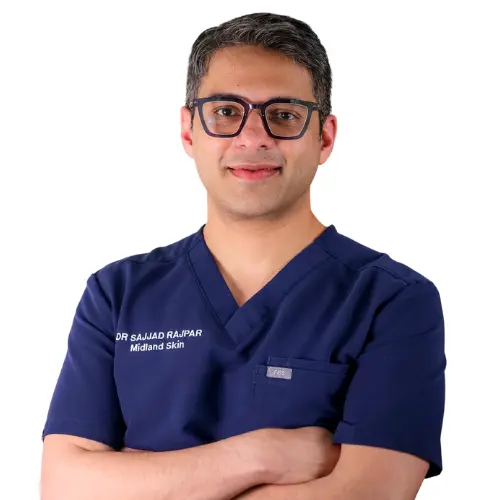
This page has been written and/or medically reviewed by Dr Sajjad Rajpar, Consultant Dermatologist and Medical Director of Midland Skin, Birmingham.
Dr Rajpar is on the GMC Specialist Register in Dermatology and has over 20 years’ experience in clinical dermatology. He provides clinical oversight to ensure the information on this page is accurate, balanced and consistent with current dermatology practice.
Dr Sajjad Rajpar
Date last updated: 24th Aug 2026
Book in with us
Expert, consultant led care in dermatology, skin surgery, eyelid surgery, lasers and aesthetics.
Disclaimer
The content on this website is provided for general information only. It is not, and must not be treated as, medical advice, a diagnosis, or a recommendation for any particular treatment. We make reasonable efforts to keep information accurate and up to date, but medicine and technology change, and content may not reflect the most current evidence, guidance, product information, or individual practice. You should not rely on this website to make decisions about your health or treatment. Always seek personalised advice from an appropriately qualified healthcare professional. Any examples, images, testimonials, and outcome descriptions are illustrative only. Results vary between individuals and no outcome can be guaranteed.


