
Laser thread vein and spider naevus removal
We offer treatments for thread veins and spider naevus
At Midland Skin we offer Laser thread vein and spider naevus removal treatment for patients in Birmingham, Solihull, Coventry, Wolverhampton, Worcester and the Midlands.

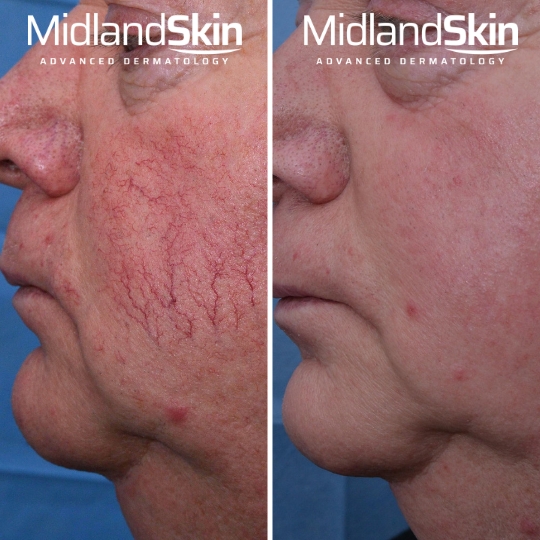
Laser thread vein and spider naevus removal in Birmingham
Quick facts about Laser thread vein and spider naevus removal treatment [TO UPDATE]
- You need three 45 minute treatments – one every 3 to 4 weeks
- The results get better with time and at one year there is an average reduction in inflammatory spots of 97% according to clinical studies
- There are no harmful side effects
- The treatment is safe in all skin tones and all year round
- You do not need to take long-term tablets or creams
- There can be short-lived purges which can be managed with medications
What are facial thread veins and broken capillaries?
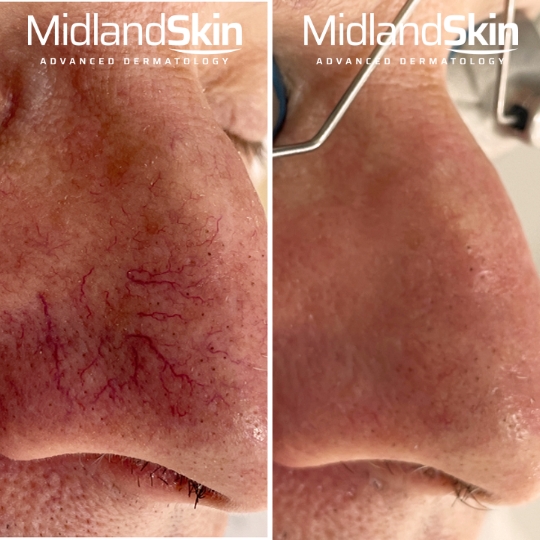
Facial thread veins are sometimes called spider veins, broken capillaries or telangiectasias. They are little blood vessels under the skin that have become visible on the face, nose and around the mouth.
Blood vessels which are under 0.2mm in diameter usually look red. Some people call these broken capillaries. Sometimes a network of vessels has formed. Sometimes the vessels are so small that it’s hard to make each one out and the area just looks like a red or purple patch.
Blood vessels which are more than 0.2mm in diameter usually look dark red, blue or purple. Some people call these thread veins.
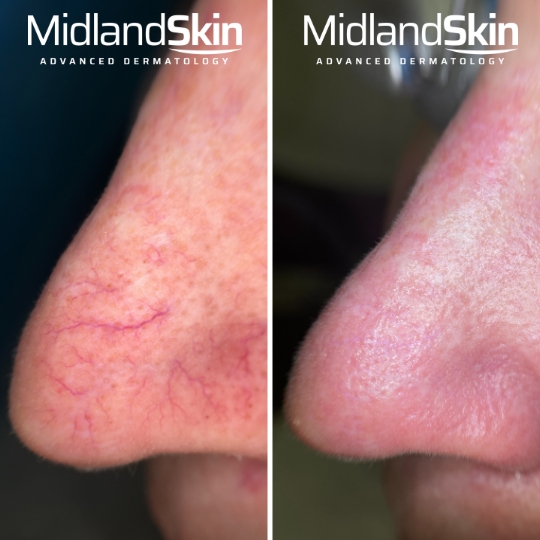
Thread veins and broken capillaries can look like:
- straight lines – usually on the side of the nose
- like a network, where the lines interconnect
- like a tree and its finer branches

Scarlett Greenwood

Why do facial thread veins and broken capillaries occur?
The skin has thousands of tiny blood vessels running through it. The blood vessels are so small they can’t normally be seen. Collagen supports the blood vessels in the skin, and if there is not enough collagen, tiny blood vessels become distended. Because of a drop in collagen, facial thread veins are a common sign of ageing of the skin. In fact, anything that breaks collagen down can give rise to thread veins on the face including too much sun exposure and smoking.
As the sun is an important cause of collagen loss, people with fairer skin have a greater chance of having more facial thread veins.
Facial thread veins are not always age-related and can occur in younger people too.
Other causes of facial thread veins are:
- After an acne spot or boil – the inflammation stimulates new blood vessels
- Early acne scarring – a new acne scar may be red or purple because of dilated capillaries around the hair follicles.
- From exfoliating too much – excessive microdermabrasion and use of scrubs may cause thread veins to appear
- Around a scar – either an accidental scar or an operation site – the bodies healing process
- From using topical steroids on the face for a long period
- From having radiotherapy
- Certain hereditary and genetic conditions like hereditary haemorrhagic telangiectasias
- Too much oestrogen – high levels of oestrogen, such as during pregnancy, can cause blood vessels to stretch
- Where do thread veins and broken capillaries occur?
The common places for thread veins and broken capillaries to occur are on the nose and cheeks. The sides of the nose, and where the nose meets the cheeks is a very common area. Broken capillaries and thread veins can occur anywhere on the face, neck and décolleté.
Having facial thread veins does not automatically mean the person has rosacea. Most people with thread veins do not have rosacea. However, most rosacea sufferers will have some thread veins. Other features like flushing, redness of the face, and inflammatory spots need to be present to make a diagnosis of rosacea.
Book in with us
Ready to get started? Book a consultation with our team at Midland Skin. Friendly, expert advice tailored to you.
What can I do to prevent thread veins?
Thread veins can be prevented by good sun protection and avoiding smoking. Some thread veins will still occur, especially if you are fair skinned.
What can help clear thread veins and broken capillaries?
Thread veins, broken capillaries, and spider naevus can be treated with the following at Midland Skin and your doctor will advise you which treatments are suitable:
- Vascular laser – a laser that produces light that is absorbed by blood vessels such as the 532nm or 1064nm lasers
- Broadband Light – a form of intense pulse light that produces light of multiple colours
- Radiofrequency A fine probe is inserted in the tiny vessels and a gentle radiofrequency current is passed. This causes the blood vessel to disappear.
Benefits of thread vein treatment
Laser treatment is very effective at clearing thread veins from the nose, the side of the nose, the cheeks and the upper lips. It is also effective at clearing away spider naevus lesions. In total, about 50-70% of lesions will clear with one treatment and another 20-30% with a second treatment. 2-4 treatments will therefore reduce the lesions by 90% on average.
Risks of thread vein treatment
The treatment feels like a quick pinch. The area will become red immediately. Occasionally tiny scabs can form. If the lesion being treated is substantial, a small depression can result. A scar can form though this is unusual.
Thread veins do have the tendency to come back. Either the same thread veins can return or a new one can develop. Maintenance treatments are therefore required, sometimes 6 or 12 months after the first treatment, or longer.
Ashley Cooper
Spider Naevus
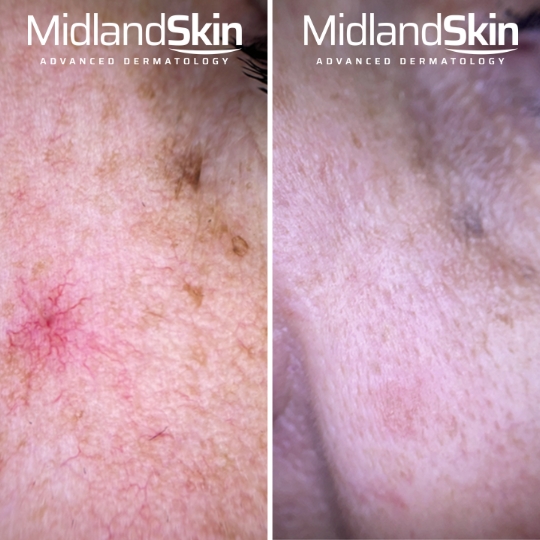
A spider naevus is a small red lesion caused by a dilated central blood vessel, often with fine vessels radiating from it, giving a spider-like appearance. Spider naevi can develop at any age, including during childhood and pregnancy. They are most commonly found on the face, but also occur on the chest and arms.
The plural of spider naevus is spider naevi, so this is the correct term when more than one lesion is present.
Why do spider naevi develop?
A spider naevus often develops in children and young adults who are well, though they can occur at any stage of life. Usually no cause is found but spider naevis can develop with hormonal changes, liver disease and sun damage.
How can laser treatment help spider naevi?
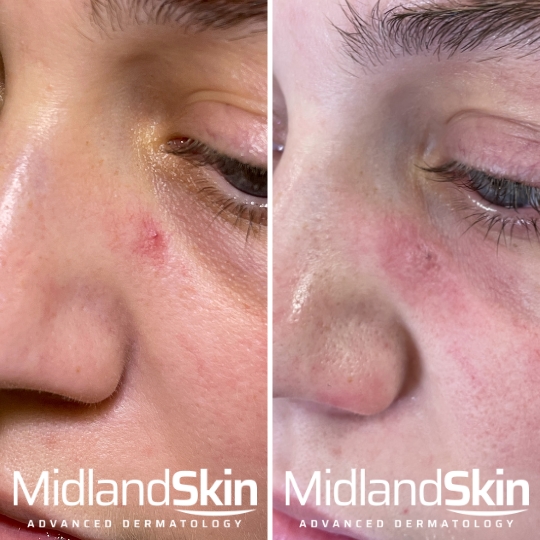
Laser treatment is a safe and effective way to remove spider naevi with minimal discomfort and downtime. At Midland Skin, we use advanced vascular lasers including the Cutera Excel V+, which targets blood vessels without damaging the surrounding skin.
The laser works by delivering a specific wavelength of light which is absorbed by the red blood cells within the vessel. This causes the vessel to seal up and be gradually reabsorbed by the body. In most cases, the central red dot and the radiating vessels fade or disappear completely after treatment. One to three treatments can be required and over 95% of lesions will clear.
PRICING EXAMPLE LINK
References used for this article
About the Author
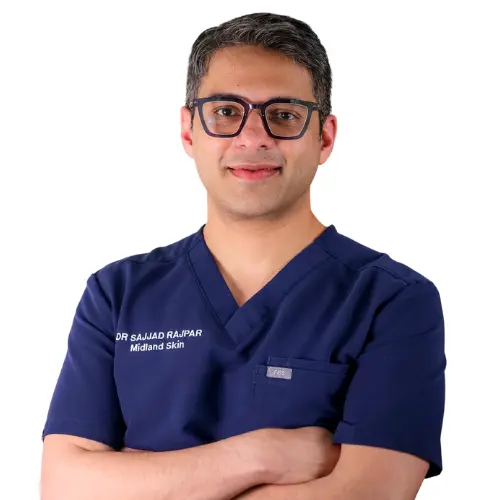
This page has been written and/or medically reviewed by Dr Sajjad Rajpar, Consultant Dermatologist and Medical Director of Midland Skin, Birmingham.
Dr Rajpar is on the GMC Specialist Register in Dermatology and has over 20 years’ experience in clinical dermatology. He provides clinical oversight to ensure the information on this page is accurate, balanced and consistent with current dermatology practice.
Dr Sajjad Rajpar
Date last updated: 6th Mar 2026
Book in with us
Expert, consultant led care in dermatology, skin surgery, eyelid surgery, lasers and aesthetics.
Disclaimer
The content on this website is provided for general information only. It is not, and must not be treated as, medical advice, a diagnosis, or a recommendation for any particular treatment. We make reasonable efforts to keep information accurate and up to date, but medicine and technology change, and content may not reflect the most current evidence, guidance, product information, or individual practice. You should not rely on this website to make decisions about your health or treatment. Always seek personalised advice from an appropriately qualified healthcare professional. Any examples, images, testimonials, and outcome descriptions are illustrative only. Results vary between individuals and no outcome can be guaranteed.


