
Skin Cancer consultations with a Dermatologist
At Midland Skin we offer Skin Cancer consultations with a Dermatologist for patients in Birmingham, Solihull, Coventry, Wolverhampton, Worcester and the Midlands.


What is skin cancer?
Skin cancers are growths on the skin that usually develop on sun-exposed areas such as the face, arms and back. If they are left untreated, skin cancers can enlarge, ulcerate and spread. Fortunately, most skin cancers are curable if they are identified early and treated appropriately.
Quick facts about Skin Cancer [TO UPDATE]
- You need three 45 minute treatments – one every 3 to 4 weeks
- The results get better with time and at one year there is an average reduction in inflammatory spots of 97% according to clinical studies
- There are no harmful side effects
- The treatment is safe in all skin tones and all year round
- You do not need to take long-term tablets or creams
- There can be short-lived purges which can be managed with medications
Why choose Midland Skin for skin cancer screening and treatment?
Our team of dermatologists, and surgeons, are very experienced at identifying and treating skin cancers. We offer a range of services including Mohs surgery, a specialist form of skin caner surgery for more complex facial tumours as part of a multidisciplinary team.
Our specialists offer the full range of services including skin and mole checks and mole dermoscopy to detect skin cancers early, through to comprehensive management of skin cancers including surgery, the highly specialised Mohs micrographic surgery and topical treatments.

Scarlett Greenwood

Types of skin cancer
There are three common types of skin cancer – basal cell carcinoma, squamous cell carcinoma and melanoma.
What should I do if I want to be checked for skin cancer?
If you feel you are at risk of skin cancer or have a lesion that you are worried about, then please arrange to see one of our Dermatologists for a skin check – a comprehensive head to to examination by an expert. Skin cancers can be diagnosed by their appearance by a specialist. If there is any doubt, a biopsy may be obtained.
What do skin cancers look like?
Skin cancers can have many different appearances. Melanomas are irregular looking brown moles, while squamous cell carcinomas and basal cell carcinomas present as red lumps or ulcers.
Book in with us
Ready to get started? Book a consultation with our team at Midland Skin. Friendly, expert advice tailored to you.
What can I do to minimise my risk of skin cancer?
If you are at high risk of skin cancer, then it is sensible to protect yourself against the sun. Simply put – Don’t Tan, Don’t Burn. This does not mean you can not enjoy outdoor activities. In fact, you should be able to continue to do most things. The precautions you should take are:
- Cover up! Protect the skin with clothing, including a hat, T-shirt and UV protective sunglasses.
- Avoid strong sunlight. Spend time in the shade when it’s sunny particularly between 11 am and 3 pm.
- Use a ’high protection’ sunscreen of at least SPF30 which also has high UVA protection and make sure you apply it generously and frequently when in the sun, preferably every 2-3 hours.
- Sunscreens should not be used as an alternative to clothing or shade – rather they offer additional protection. No sunscreen will provide 100% protection.
- Keep babies and young children out of direct sunlight
- Don’t use sun beds
- Check your skin for changes once a month. A friend or family member can help you with this particularly with checking your back. If anything on your skin is changing, or if you are suspicious or worried about anything, go to your doctor and have it looked at.
More information about sun protection can be found at the Cancer Research UK Sun Smart website.
What causes skin cancer?
90% of skin cancer is caused by excessive exposure to ultraviolent light (UV).
This can occur while sun bathing on holidays but it is important to remember that day to day outdoor activities at home such as walking and gardening also lead to UV exposure.
Excessive exposure to UV light also cause premature ageing of the skin. This presents as sun spots, lines and wrinkles, and telangiectasias.
Scarlett Greenwood
Who is at risk of skin cancer?
Skin cancer can occur in any one, but they are more likely to affect those who have one or more of the following characteristics :
- Fair skin
- Blue or green eyes
- Red or blond hair
- Previous sun burns
- Tendency to sun burn
- Excessive sun exposure and sun bed use
- Family history of skin cancer
- Individuals taking immune suppressive medications
How are skin cancers treated?
The following treatments are provided by our Consultants.
Topical therapies – anti-cancer creams such as Efudix cream and Imiquimod can be used under specialist guidance
Curettage – scraping superficial growths
Mohs micrographic surgery – a specialised technique for excising facial skin cancers, that are complex, difficult to see clearly or agressive
Excision – surgically removing skin cancers and a safety margin of normal skin
Screening for other skin cancers and pre-cancerous growths
PRICING EXAMPLE LINK
References used for this article
Further information on dermatitis can be found here:
About the Author
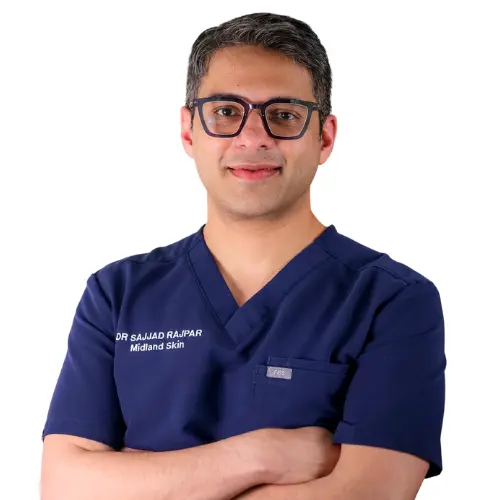
This page has been written and/or medically reviewed by Dr Sajjad Rajpar, Consultant Dermatologist and Medical Director of Midland Skin, Birmingham.
Dr Rajpar is on the GMC Specialist Register in Dermatology and has over 20 years’ experience in clinical dermatology. He provides clinical oversight to ensure the information on this page is accurate, balanced and consistent with current dermatology practice.
Dr Sajjad Rajpar
Date last updated: 9th Mar 2026
Book in with us
Expert, consultant led care in dermatology, skin surgery, eyelid surgery, lasers and aesthetics.
Disclaimer
The content on this website is provided for general information only. It is not, and must not be treated as, medical advice, a diagnosis, or a recommendation for any particular treatment. We make reasonable efforts to keep information accurate and up to date, but medicine and technology change, and content may not reflect the most current evidence, guidance, product information, or individual practice. You should not rely on this website to make decisions about your health or treatment. Always seek personalised advice from an appropriately qualified healthcare professional. Any examples, images, testimonials, and outcome descriptions are illustrative only. Results vary between individuals and no outcome can be guaranteed.


