
Sebaceous gland hyperplasia removal
Our expert doctors offer sebaceous gland hyperplasia removal in Birmingham and Solihull
At Midland Skin we offer Sebaceous gland hyperplasia removal for patients in Birmingham, Solihull, Coventry, Wolverhampton, Worcester and the Midlands.


Sebaceous gland hyperplasia removal in Birmingham and Solihull
If you’re looking for sebaceous gland hyperplasia removal near Birmingham or Solihull, you may want to consider radiofrequency treatment with a specialist dermatologist. This procedure typically takes 30 minutes. With a short healing time of 5-7 days, it’s a quick and effective way to address this common skin condition.
Based in Birmingham, we offer sebaceous gland hyperplasia removal to all those in the vicinity, including Solihull, Wolverhampton, Walsall, Sutton Coldfield, Stratford and the West Midlands.
Quick facts about Sebaceous gland hyperplasia removal [TO UPDATE]
- You need three 45 minute treatments – one every 3 to 4 weeks
- The results get better with time and at one year there is an average reduction in inflammatory spots of 97% according to clinical studies
- There are no harmful side effects
- The treatment is safe in all skin tones and all year round
- You do not need to take long-term tablets or creams
- There can be short-lived purges which can be managed with medications
What is a sebaceous gland hyperplasia?
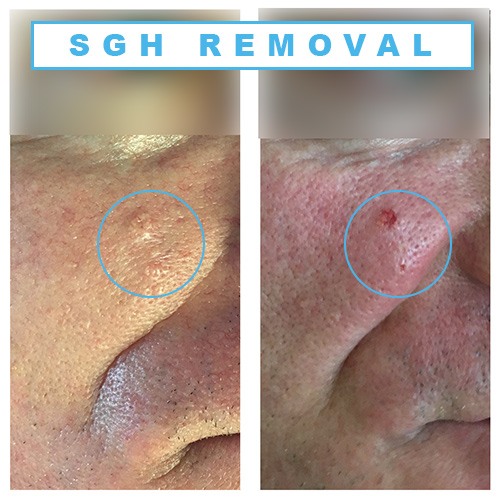
Sebaceous gland hyperplasia look like tiny yellow or white bumps on the skin. They can be easier to see if the skin is stretched and side lighting is used.
Sebaceous gland hyperplasia is an over growth of the sebaceous glands surrounding a hair follicle. These glands produce a greasy secretion called sebum. When sebaceous glands overgrow, they create a raised shiny yellow bump around hair follicles.
Each sebaceous gland hyperplasia bump may look like it has a tiny crater in the middle. This is usually the hair follicle from which the hyperplasia has occurred.
Sebaceous gland hyperplasia spots may also have prominent thread veins visible over them.
Some people may only have one or two sebaceous gland hyperplasia lesions but others can have tens, or several tens.
As sebaceous gland cells contain a lot of fat they are yellow in colour.

Scarlett Greenwood

Are sebaceous gland hyperplasia cancerous?
No, sebaceous gland hyperplasia lesions are entirely benign. They can occasionally be confused with some forms of skin cancers when they become very large, but an expert is usually able to identify them.
Who does sebaceous gland hyperplasia removal?
Sebaceous gland hyperplasia removal is carried out by a Dermatologist.
When should sebaceous gland hyperplasia be removed?
There are many reasons why you might want to have a sebaceous gland hyperplasia removed. Some common reasons that people choose to have a sebaceous gland hyperplasia removal are:
- You do not like how the sebaceous gland hyperplasia looks.
- The sebaceous gland hyperplasia has grown and has become very obvious and prominent
- You are prone to developing many sebaceous gland hyperplasia lesions
Sebaceous gland hyperplasia are much simpler to remove when they are smaller. Our advice for those with many leions is to have regular treatments to keep the numbers under control, and to treat lesions when they have just developed and they are at their smallest.
Will a sebaceous gland hyperplasia lesion go away on its own?
Once sebaceous gland hyperplasia has developed, it will not go away on its own. This is because a sebaceous gland hyperplasia lesion is a collection of sebaceous gland cells (sebocytes).
Can a sebaceous gland hyperplasia lesion be squeezed?
While it is very tempting, sebaceous gland hyperplasia can not be squeezed and emptied.
Sebaceous gland hyperplasia removal on the face
Most sebaceous gland hyperplasia lesions occur on the face. The common sites are the forehead, cheek, under the eyes, on the nose and the chin.
Book in with us
Ready to get started? Book a consultation with our team at Midland Skin. Friendly, expert advice tailored to you.
Sometimes sebaceous gland hyperplasia lesions may look like these other skin growths:
- Comedones – these are white, do not have a central crater or thread veins, and occur as part of acne. Treatment of comedones is with hyfrecation.
- Milia – These are bright white and very firm. They are also smooth and do not have a crater
- Moles – Mature moles or intradermal naevus can be confused with sebaceous gland hyperplasia
- Basal cell carcinoma – sebaceous gland hyperplasia may look similar in some instances to a sebaceous gland hyperplasia
What happens during sebaceous gland hyperplasia removal ?
Lesions can be injected with a small amount of local anaesthetic to numb the skin. A very fine needle is inserted into the lesion, and a radiofrequency probe is applied. The procedure may need to be repeated a few times.
There is a short-lived pinch-like sensation that is only momentary.
A very superficial graze results. This is covered with Vaseline, and will scab over and heal over a period of a few days. A dressing is not required.
As the sebaceous glands can be quite deep within the skin, the component of the sebaceous gland hyperplasia that is raised above the skin and causing the bump is treated. This reduces the chance of a scar forming however, it does mean that lesions can grow back.
Larger lesions are treated by alternative methods including shave excision.
Occasionally laser treatment is also used.
You will be advised on the treatments that may be suitable for you at your initial consultation.
Can sebaceous gland hyperplasia be removed with a cream?
The following treatments are not successful for sebaceous gland hyperplasia:
- Vitamin C serums
- Nicotinamide cream
Ashley Cooper
Medical treatment for sebaceous gland hyperplasia
Isotretinoin is an oral medication that can shrink sebaceous gland hyperplasia. A 3 to 12-month course may be provided required and there may be recurrence of sebaceous gland hyperplasia once the treatment is finished.
Home treatments for sebaceous gland hyperplasia
It is very tempting to treat sebaceous gland hyperplasia at home. However, the following treatments do not work:
- Facials
- AHA and BHA washes or masks
- Chemical peels
- Comedone extraction
How does the skin heal following radiofrequency sebaceous gland hyperplasia removal?
A small scab will develop in the treated area, which will go after 5-7 days (longer for larger lesions). You will be asked to apply Vaseline twice a day. Small lesions usually heal without a trace. Larger lesions may heal with a slight scar that may be very slightly paler, and sometimes this is slightly indented. It is advisable to treat sebaceous gland hyperplasia when the lesions are small, but larger lesions can be treated.
What is the aftercare and recovery following a sebaceous gland hyperplasia removal?
We ask you to avoid heavy exercise or anything strenuous for the rest of the day. The areas that have been treated need to be kept clean and dry. You can cleanse them once or twice a day with water and a cotton pad. People can usually return to an office job straight away.
What are the risks of having a sebaceous gland hyperplasia removal procedure?
Larger lesions may leave a light scar or, unusually, an indentation. Larger lesions may require two or sometimes three treatments. As the sebaceous glands are quite deep, the base of the glands may not be removed in order to minimise the risk of scarring. Consequently, some lesions will grow back out over a period of years, and they can easily be treated again.
PRICING EXAMPLE LINK
What are the costs for sebaceous gland hyperplasia removal?
Fees for sebaceous gland hyperplasia removals and consultations can be found here.
References used for this article
About the Author
This page has been written and/or medically reviewed by Dr Sajjad Rajpar, Consultant Dermatologist and Medical Director of Midland Skin, Birmingham.
Dr Rajpar is on the GMC Specialist Register in Dermatology and has over 20 years’ experience in clinical dermatology. He provides clinical oversight to ensure the information on this page is accurate, balanced and consistent with current dermatology practice.
Dr Sajjad Rajpar
Date last updated: 9th Mar 2026
Book in with us
Expert, consultant led care in dermatology, skin surgery, eyelid surgery, lasers and aesthetics.
Disclaimer
The content on this website is provided for general information only. It is not, and must not be treated as, medical advice, a diagnosis, or a recommendation for any particular treatment. We make reasonable efforts to keep information accurate and up to date, but medicine and technology change, and content may not reflect the most current evidence, guidance, product information, or individual practice. You should not rely on this website to make decisions about your health or treatment. Always seek personalised advice from an appropriately qualified healthcare professional. Any examples, images, testimonials, and outcome descriptions are illustrative only. Results vary between individuals and no outcome can be guaranteed.


