
Cyst removal
Consultant-led cyst assessment and removal in Birmingham and Solihull
At Midland Skin we assess and surgically remove cysts for patients in Birmingham, Solihull, Coventry, Wolverhampton, Worcester and the wider Midlands. Removal is carried out under local anaesthetic, usually taking 20 to 60 minutes, once a specialist has examined the lump and agreed the right technique with you.


Quick Facts about cyst removal

Best for
Cysts on face, scalp, body

Anaesthetic
Local anaesthetic

Duration
20-60 minutes

Recovery
Desk work next day

Performed by
Consultant surgeon

Price
See below
What is a cyst?
A cyst feels like a lump or bump under the skin. Most skin cysts are small sacs that fill with keratin, the protein that makes up the surface of the skin. The contents are a white, cheesy material that often has an odour.
Cysts form when cells from the surface of the skin end up in the deeper layers, where they create a small sac. As those cells continue to shed, the sac fills and slowly enlarges over months or years. A blocked hair follicle can have the same effect.
A cyst does not have a head like a spot, but often has a punctum. This is a tiny dark dot marking the opening of the sac.
Names you may hear
- Epidermoid cysts – the most common type. These occur anywhere on the body.
- Pilar cysts – occur on the scalp. They often run in families and it is common to have several.
- Sebaceous cysts – the everyday name for epidermoid and pilar cysts. Strictly it is a misnomer, since these cysts contain keratin rather than sebum, but the term remains in common use.
- Milia – very small, superficial cysts, usually on the face.
- Acne cysts – deep inflamed lesions in areas affected by acne. These are not true cysts and are normally treated with medical therapies rather than surgery.

When is cyst removal worth considering?
Cysts are not dangerous, and a small settled cyst can be left alone if it is not bothering you. Removal is worth considering when a cyst is causing a practical or cosmetic problem, or when it is likely to keep causing trouble.
- You do not like how it looks – particularly on the face or another visible area
- It has grown or become prominent – cysts enlarge slowly and do not resolve on their own
- It catches or rubs – on a hairbrush, razor, collar, strap or jewellery
- It is tender, itchy or in an awkward area – including the scalp, neck, back and genital skin
- It has flared before – redness, swelling and pain mean the cyst has ruptured beneath the skin
- It has leaked or discharged – a ruptured cyst usually settles, then refills
- You have more than one – several cysts can often be removed in the same session
- You are not certain the lump is a cyst – other lumps can look and feel very similar
Once a cyst has developed it will not go away on its own, because the sac has to be physically removed. Cysts are simpler to remove when they are smaller and have never been inflamed. As a cyst enlarges or repeatedly flares, removal becomes more involved and the scar is usually longer.

Dale Peters

Cyst removal by site
Facial cyst removal
Facial cysts are common, and appearance matters most here. Incisions are planned along skin tension lines and the smallest technique that will reliably clear the sac is chosen. Milia, which are very small superficial cysts, can usually be removed without a visible scar.
Scalp and head cyst removal
Scalp cysts are usually pilar cysts. They frequently run in families and it is common to have several. They can normally be removed with minimal disturbance to the surrounding hair follicles, and more than one can often be treated in the same session.
Cyst removal on the body
Cysts on the neck, back, chest, arms and legs are removed using the same techniques. Cysts on the back are often larger by the time they are treated.
Genital skin
Cysts on the scrotum and other genital skin are common and can be removed. These are assessed and treated discreetly.
Mike Sutcliffe
Your first step: a cyst removal consultation
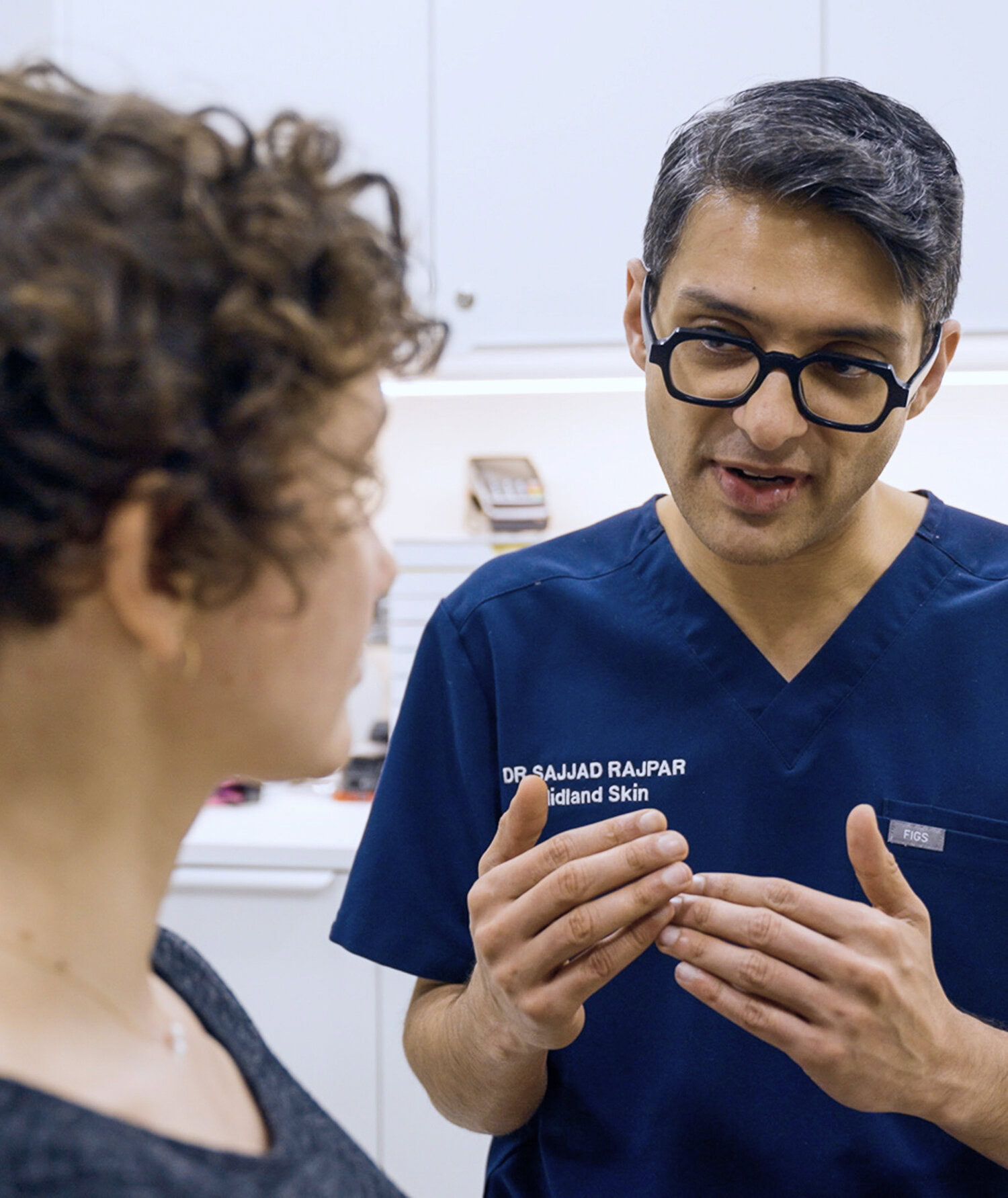
Your treatment begins with a specialist skin surgery consultation, where the lump is evaluated by a Consultant Dermatologist or Consultant Surgeon experienced in surgical procedures. This is where the diagnosis is confirmed, the right removal technique is chosen for the site and the scar, and the benefits and risks are discussed in detail.
Skin cysts are benign. They are not skin cancer, and malignant change within a cyst, while described in the medical literature, is very rare. The reason the lump is examined first is that several other things can look and feel like a cyst. Lipomas, enlarged lymph nodes, other benign growths and, occasionally, a skin cancer can all present as a lump under the skin. Where the diagnosis is not clear-cut, an ultrasound scan or another test may be arranged before surgery is planned.
A consultation is required before surgery, and is particularly important if you have more than one cyst, a complex or recurrent cyst, a cyst that has been inflamed or infected, or a cyst in a prominent facial area.
At the consultation you will be given an accurate price for any procedure you go on to have. There is no obligation to proceed with surgery.
Treatment pathway for cyst removal
Skin surgery consultation
You meet a consultant who examines the lump, confirms whether it is a cyst and discusses what you want to achieve.
Plan and quote
Suitability, the removal technique, the likely scar and the risks are discussed, and you are given an exact price. There is no obligation to proceed.
Cyst removal
The procedure is carried out under local anaesthetic, usually taking 20 to 60 minutes. Tissue removed is sent for histology.
Wound check and review
Stitches are removed at 7 to 10 days where needed, healing is checked and your histology result is discussed.
Book in with us
Ready to get started? Book a consultation with our team at Midland Skin. Friendly, expert advice tailored to you.
How cyst removal is carried out
A cyst behaves like a small balloon under the skin. Pricking it and squeezing out the contents is not enough, because the sac simply refills. Successful removal means taking out the whole sac.
The area is numbed with local anaesthetic injections, an opening is made over the cyst, and the sac is peeled out from beneath the skin. The skin is then closed with stitches, which may be absorbable or removed 7 to 10 days later. Where the opening is very small, stitches may not be needed at all. You are awake throughout.
Tissue removed is sent for histological examination, so the diagnosis is confirmed under the microscope. This is included in the cost of your procedure.

Which removal technique is used?
Three techniques are used. Which one suits you is decided at your consultation, based on the size of the cyst, where it is, and whether it has been inflamed before.
Minimal incision or punch removal
An opening of a few millimetres is made, the contents are expressed, and the sac is drawn out through the opening. This leaves the shortest scar and suits smaller cysts that have never been inflamed, particularly on the face. Because the sac comes out through a narrow opening, there is a slightly greater chance of a fragment being left behind.
Standard excision
An incision roughly the length of the cyst is made and the sac is removed intact. This gives the most reliable clearance and leaves a scar about the length of the cyst, or slightly longer.
Wider excision
Used where a cyst has ruptured, been repeatedly inflamed, is scarred from previous episodes, or has returned after earlier surgery. In these cases the sac is fragmented and stuck to the surrounding tissue, so a margin of skin around it is removed. The scar is longer, sometimes around three times the length of the cyst.
Inflamed, painful and ruptured cysts
If a cyst becomes red, swollen and painful, it has usually ruptured beneath the skin. The keratin leaks into the surrounding tissue and provokes an intense inflammatory reaction. This is often mistaken for infection, and a genuine infection can develop on top of it.
Removing a cyst while it is acutely inflamed is not normally the right approach. The sac loses its integrity, the tissue planes become indistinct, and the chance of leaving cyst wall behind rises. It is usually better to settle the inflammation first, with an injection into the lesion, antibiotics, or drainage where a collection has formed, and to remove the cyst once the area has quietened down, typically several weeks later.
Draining a cyst relieves the pressure but leaves the sac in place, so the problem returns. If you want the cyst gone permanently, the sac still has to come out.
Scarring, recurrence and risks
Every method of cyst removal leaves a scar. The length depends on the technique: a few millimetres for minimal incision or punch removal, roughly the length of the cyst for a standard excision, and longer where a wider excision is needed. Scars are pink or red at first and settle over several months. The final appearance cannot be guaranteed, and scars on the chest, shoulders and upper back are more prone to thickening.
Cysts can come back, and the reason is almost always the same: a fragment of the sac left behind.
A randomised comparison of minimal excision against standard elliptical excision in 356 people with uninflamed cysts found recurrence of 2.8% and 3.3% respectively, with no significant difference between the two, but shorter wounds and shorter procedures in the minimal excision group. A large series using the punch technique reported recurrence of 3.6% on record review and 8.3% among patients who responded to a follow-up survey, with higher rates for cysts on the back and ear.
These are modest-sized studies with variable follow-up, and they deliberately excluded cysts that had ruptured, become inflamed or recurred, so they are a reasonable guide rather than a promise. In practice, the risk of recurrence is higher where a cyst has previously ruptured or been inflamed. If a cyst does return, it can be removed again.
Other risks are those of any minor skin surgery: bleeding, bruising, and a small risk of wound infection. These are uncommon and are discussed with you before you consent.

On the day: what to expect FAQs
Who will carry out my procedure?
Your cyst removal is carried out by a Consultant Dermatologist or Consultant Surgeon experienced in skin surgery. You meet them at your consultation, so you know who will be treating you.
Do I need to do anything before my appointment?
Eat normally, there is no need to fast. Wear comfortable clothing that does not have to be pulled over your head if the cyst is on the face, scalp or neck.
If you take warfarin, a DOAC, clopidogrel or another blood-thinning medicine, please tell us in advance. These are usually continued for minor skin surgery, but we need to know beforehand.
For scalp cysts it helps to wash your hair on the morning of your procedure, as you will need to keep the area dry afterwards.
Will it hurt?
The area is numbed with local anaesthetic. The injections sting for a few seconds. After that you will feel pressure and movement but not pain. You stay awake throughout and can talk to the team, and more anaesthetic is added if you feel anything sharp.
How long will I be at the clinic?
Allow about an hour for a single cyst, and longer if several are being removed. The procedure itself takes 20 to 60 minutes, with time either side for consent, numbing and dressings.
Can I drive home, and can someone come with me?
You can normally drive yourself home, as only local anaesthetic is used. You are welcome to bring someone with you.
After the procedure: recovery and aftercare FAQs
Will I have a dressing, and can I shower?
Yes. A splash-proof dressing is applied so you can shower normally. Keep the area dry otherwise and follow the written aftercare you are given.
When do stitches come out?
Stitches are usually removed 7 to 10 days after surgery, sooner on the face. Some stitches are absorbable and do not need removing, and where the opening was very small there may be no stitches at all. You will be told which applies to you.
How long does the wound take to heal?
Stitched wounds heal over about 10 to 14 days. Wounds left open to heal, usually where a larger cavity remains, take 2 to 3 weeks and sometimes longer.
When can I go back to work?
Most people return to a desk-based job the next day. If your work is physical or involves heavy lifting, allow longer and discuss it with your surgeon.
When can I exercise or swim?
Wait 14 days before swimming, water sports, exercise where you will sweat or that rubs against the healing wound, heavy lifting and stretching, and saunas or steam rooms.
When will I get my histology result, and what if I am worried about the wound?
Your result is discussed with you at your wound check. Please contact the clinic if you have increasing pain, spreading redness, or discharge after the first day or two.
Book in with us
Ready to get started? Book a consultation with our team at Midland Skin. Friendly, expert advice tailored to you.
Fees for cyst removal
Cyst removal Show pricing
Book ConsultationInitial surgical assessment
Cyst removal – Face/Head/Neck less than 2cm
Cyst removal – Face/Head/Neck 2-3cm
Cyst removal – Face/Head/Neck 3-4cm
Cyst removal – Body less than 2cm
Cyst removal – Body 2-4cm
Cyst removal – Body 4-6cm
Review consultation
Standard, up to 20 minutes
Martyn Parker
References used for this article
- Alijanpour A, Alijanpour K, Alijanpour K. Comparison of the surgical outcomes of minimal excision and elliptical excision techniques in treating epidermal inclusion cysts: a prospective randomized study. Shiraz E-Med J. 2018;19(3):e55936. doi:10.5812/semj.55936.
- Mehrabi D, Leonhardt JM, Brodell RT. Removal of keratinous and pilar cysts with the punch incision technique: analysis of surgical outcomes. Dermatol Surg. 2002;28(8):673–677. doi:10.1046/j.1524-4725.2002.02020.x.
- Lee HE, Yang CH, Chen CH, Hong HS, Kuan YZ. Comparison of the surgical outcomes of punch incision and elliptical excision in treating epidermal inclusion cysts: a prospective, randomized study. Dermatol Surg. 2006;32(4):520–525. doi:10.1111/j.1524-4725.2006.32105.x.
About the Author
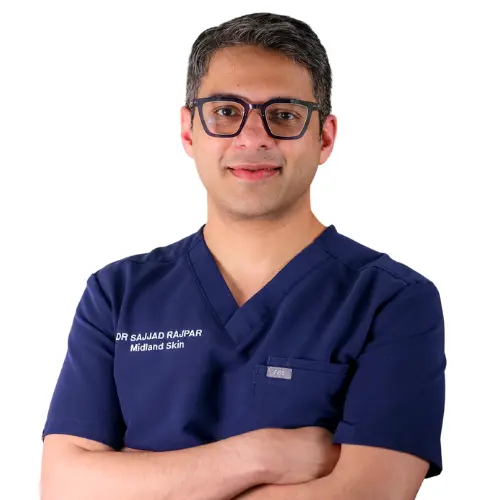
This page has been written and/or medically reviewed by Dr Sajjad Rajpar, Consultant Dermatologist and Medical Director of Midland Skin, Birmingham.
Dr Rajpar is on the GMC Specialist Register in Dermatology and has over 20 years’ experience in clinical dermatology. He provides clinical oversight to ensure the information on this page is accurate, balanced and consistent with current dermatology practice.
Dr Sajjad Rajpar
Date last updated: 28th Sep 2026
Book in with us
Expert, consultant led care in dermatology, skin surgery, eyelid surgery, lasers and aesthetics.
Disclaimer
The content on this website is provided for general information only. It is not, and must not be treated as, medical advice, a diagnosis, or a recommendation for any particular treatment. We make reasonable efforts to keep information accurate and up to date, but medicine and technology change, and content may not reflect the most current evidence, guidance, product information, or individual practice. You should not rely on this website to make decisions about your health or treatment. Always seek personalised advice from an appropriately qualified healthcare professional. Any examples, images, testimonials, and outcome descriptions are illustrative only. Results vary between individuals and no outcome can be guaranteed.


