
Xanthelasma treatment in Birmingham
Specialist assessment with surgery or TCA selected according to the size, depth and position of your xanthelasma


Quick Facts about Xanthelasma Treatment

Best for
Eyelid xanthelasma

Treatments
Surgery or TCA
Anaesthetic
Local anaesthetic where required

Recovery
Visible healing usually 1–2 weeks

Sessions
One or more, depending on treatment
Specialist
Oculoplastic surgeon
What is xanthelasma?
Xanthelasma are soft or slightly raised yellow lesions that usually develop around the inner corners of the upper or lower eyelids. They contain deposits of cholesterol.
Many people seek treatment because they dislike their appearance. The most appropriate way to remove them depends on their size, thickness, depth and position on the eyelid, as well as your eyelid anatomy, skin type and whether they have been treated before.
At Midland Skin, treatment may involve surgical excision or trichloroacetic acid (TCA). There is no single technique that is best for every xanthelasma, which is why treatment is planned after specialist assessment.
Xanthelasma can occur even when cholesterol levels are normal. However, because they can be associated with abnormal blood lipids, we may recommend that you arrange a lipid profile with your GP if this has not been checked recently. Treating the eyelid plaques does not treat an underlying cholesterol problem.
When is specialist assessment worthwhile?
A specialist assessment may be worthwhile if:
- the appearance of xanthelasma is bothering you and you are considering removal
- you want to understand whether surgery or TCA is most suitable
- the plaques are large, thick or affecting more than one eyelid
- the xanthelasma is close to the eyelid margin or inner corner of the eye
- the xanthelasma has returned after previous treatment
- you are particularly concerned about scarring, pigmentation or the position of the eyelid
- you are unsure whether the lesion is actually xanthelasma
Assessment is also an opportunity to decide that no treatment is preferable. Because treatment takes place on delicate eyelid skin, the likely improvement needs to be balanced against the possibility of scarring, pigment change, incomplete clearance, recurrence and, with more extensive surgery, changes in eyelid position.
Which xanthelasma treatment is likely to suit me?
The treatment recommended depends mainly on how large, thick and deep the plaques are, where they sit on the eyelid, your skin type and the amount of surrounding eyelid skin available.
Surgical excision
Surgery may be particularly suitable for localised, thicker or deeper xanthelasma, including some lesions that have returned after previous treatment.
For some patients, the xanthelasma can be removed under local anaesthetic and the skin closed with fine stitches.
Where there is also excess eyelid skin, xanthelasma removal can sometimes be incorporated into a blepharoplasty (eyelid lift) procedure.
For larger or more difficult lesions, removing the xanthelasma may leave insufficient skin for a simple closure or may place tension on the eyelid. In these circumstances, an additional eyelid procedure such as lid tightening may be required to maintain a safe eyelid position. Occasionally it may be safer to limit or stage treatment rather than attempt complete removal in one operation.
The trade-off with surgery is that it produces a scar. The surgical plan therefore depends not only on the xanthelasma itself, but also on your individual eyelid anatomy and the amount of skin that can safely be removed.
TCA treatment
Trichloroacetic acid (TCA) is carefully applied to the xanthelasma to produce a controlled and deep chemical peel on the lesion.
It may be considered for selected smaller or more superficial plaques and does not involve cutting the skin. However, the depth of treatment is less predictable than surgical removal and repeated sessions may be needed.
Pigment change is an important consideration, particularly in darker skin types, and xanthelasma can recur after treatment. TCA should therefore not automatically be viewed as a better option simply because it is less invasive.
The recommended option is decided with you after examination. Sometimes the safest or most realistic plan is staged treatment rather than attempting to remove everything in one procedure.

Scarlett Greenwood

Treatment Pathway for Xanthelasma
Initial assessment
Your eyelids are examined by a specialist oculoplastic surgeon, to determine whether the lesions are consistent with xanthelasma and to assess their size, thickness, depth and position.
We also consider your eyelid anatomy, previous treatments, skin type, medical history, medication and any previous problems with scarring or pigmentation
Personalised treatment plan
Where treatment is suitable, you receive an individual care plan explaining the proposed procedure, the intended benefits, limitations, recovery, risks, follow-up and costs. Treatment is arranged for a separate date after you have had time to consider the information.
Xanthelasma treatment
The procedure performed will depend on the option agreed following your assessment. Surgery is usually a one off treatment while TCA treatment is repeated at regular intervals.
Review consultation
A follow-up 4–6 weeks after surgery to check healing and discuss scar care.
What does xanthelasma treatment involve?
Surgical removal
The eyelid is numbed with local anaesthetic and the xanthelasma is carefully excised.
For smaller lesions, the wound may simply be closed with fine stitches. Where more skin needs to be removed, the operation may need to be planned differently to avoid excessive tension or a change in eyelid position.
In selected patients, xanthelasma removal can be incorporated into a blepharoplasty. Larger excisions may sometimes require an additional procedure such as eyelid tightening.
The exact approach is planned following examination of both the xanthelasma and your eyelid anatomy.
TCA treatment
TCA is applied carefully and precisely to the xanthelasma. The treated skin develops a controlled reaction and then heals over the following 7 to 10 days.
More than one treatment is usually required. Further treatment is only considered after the skin has healed sufficiently.
How successful is xanthelasma treatment?
Both surgery and TCA can improve xanthelasma.
Surgical excision generally provides the most predictable removal, particularly for thicker or deeper lesions. In a 2026 randomised trial of patients with limited xanthelasma, complete clearance at 12 weeks was achieved in all surgically treated eyelids, compared with 22% of eyelids treated with TCA. The study only included relatively limited xanthelasma and follow-up was short, so these results should not be applied to every patient or used to predict long-term recurrence.
Longer-term published results are more variable. A systematic review of 49 studies involving 1,329 patients found that the surgical studies collectively reported recurrence rates of less than 5%. Some larger lesions required blepharoplasty, skin grafts or local flaps as part of their reconstruction.
TCA can produce substantial improvement without surgery, but treatment is less predictable and several applications may be required. In the same systematic review, more than 75% clearance was achieved in 83% of patients treated with TCA, with an overall reported recurrence rate of approximately 17%. Pigment change was relatively common.
A more recent 2024 study of 80% TCA found visible improvement in 97% of treated patients, but recurrence was subsequently reported by approximately 25%.
These figures come from studies using different strengths of TCA, different surgical techniques and different lengths of follow-up. They therefore provide a guide rather than a guarantee of an individual result.
Recurrence can occur after either treatment, and new xanthelasma can also develop elsewhere on the eyelids. Treatment is therefore aimed at improving the xanthelasma that is present rather than preventing xanthelasma permanently.
Xanthelasma treatment FAQs
Who will perform my treatment?
Your treatment will be performed by an appropriately trained specialist clinician, usually an oculoplastic surgeon.
How many treatment sessions will I need?
Surgical excision is usually carried out as a single procedure. However, extensive xanthelasma may occasionally need staged treatment or additional eyelid surgery where complete removal in one procedure would place excessive tension on the eyelid.
TCA often requires more than one treatment. The number of applications depends on the thickness and response of the xanthelasma. Further TCA is only considered once the treated skin has healed sufficiently, usually after a minimum of 6-8 weeks.
What are the benefits and risks of TCA?
The main advantage of TCA is that treatment does not involve cutting the eyelid or surgical stitches. It may therefore be useful for selected smaller or more superficial xanthelasma.
The disadvantages are that treatment depth is less predictable than surgical excision, several sessions may be required and complete clearance cannot be guaranteed.
Possible risks include:
- stinging or discomfort during treatment
- redness and crusting while the skin heals
- lighter or darker pigmentation
- incomplete clearance
- recurrence
- scarring which can pull the eyelid up or down, and changes in skin texture
Changes in pigmentation are an important consideration, particularly in darker skin types.
What are the benefits and risks of surgery?
The main advantage of surgical excision is that it allows the xanthelasma to be physically removed and usually provides more predictable clearance than TCA. It is particularly useful for thicker or deeper lesions.
For some patients this is a relatively straightforward excision. Where there is excess eyelid skin, removal can sometimes be incorporated into a blepharoplasty. Larger or more difficult lesions may require additional procedures, such as eyelid tightening, to maintain a safe eyelid position.
Surgery will leave a scar. Other possible risks include:
- bruising and swelling
- bleeding
- infection
- delayed healing
- asymmetry
- changes in pigmentation
- incomplete removal or recurrence
- changes in eyelid position
The risk of eyelid malposition becomes more important when larger amounts of eyelid skin need to be removed. This is why the surgical plan depends on both the xanthelasma and your individual eyelid anatomy.
Can I drive home after treatment?
Please do not plan to drive yourself home after xanthelasma treatment.
Treatment around the eyelids can cause swelling, watering and temporary visual disturbance, and ointment or dressings may also interfere with your vision.
We recommend arranging for someone to collect you or using alternative transport home.
When can I go back to work?
This depends on the treatment performed and how visible you are comfortable being while the eyelids heal.
You may feel physically well enough to carry out desk-based work within a few days. However, swelling, bruising, redness, crusting or stitches may remain visible.
As a practical guide, it is sensible to allow approximately 7–14 days of cosmetic downtime, particularly after surgery or if you work face-to-face with other people.
More extensive eyelid surgery may require longer. Your clinician will give you more specific advice once the exact procedure has been planned.
Book in with us
Ready to get started? Book a consultation with our team at Midland Skin. Friendly, expert advice tailored to you.
Why choose Midland Skin for xanthelasma treatment?
Xanthelasma is usually harmless, but it occurs in a cosmetically important and anatomically delicate area.
The benefit of specialist assessment is not simply having the plaque removed. It is deciding whether it should be treated, how much can safely be removed and which treatment offers the most appropriate balance between improvement and risk.
At Midland Skin we can consider:
- surgical removal
- TCA treatment
- removal as part of a blepharoplasty where appropriate
- additional eyelid procedures where required to maintain eyelid position
- the option of no treatment where the likely benefit does not justify the risks
- treatment planning based on the individual xanthelasma and eyelid anatomy
- appropriate aftercare and review
This allows the treatment plan to be based on your eyelids and your xanthelasma rather than applying the same technique to every patient.
Fees for xanthelasma treatment
Xanthelasma treatment Show pricing
Book ConsultationInitial oculoplastic assessment
Xanthelasma excision
TCA Cross (1-9 lesions)
References used for this article
- Malekzadeh H, Ormseth B, Janis JE. A Practical Review of the Management of Xanthelasma Palpebrarum. Plast Reconstr Surg Glob Open. 2023;11(5).
- Kumar S, Kumari R, Behera G, et al. Efficacy and safety of surgical excision vs. 70% trichloroacetic acid topical application in xanthelasma palpebrarum: a split-face randomized clinical trial. Clin Exp Dermatol. 2026;51(8):1385–1393.
- Sapra S, Tran JVH, Gurm H, Eleuterio M. Treatment of Xanthelasma Palpebrarum Using Trichloroacetic Acid 80%. J Clin Aesthet Dermatol. 2024;17(11):17–22.
- Chang HC, Sung CW, Lin MH. Serum lipids and risk of atherosclerosis in xanthelasma palpebrarum: a systematic review and meta-analysis. J Am Acad Dermatol. 2020;82(3):596–605.
About the Author
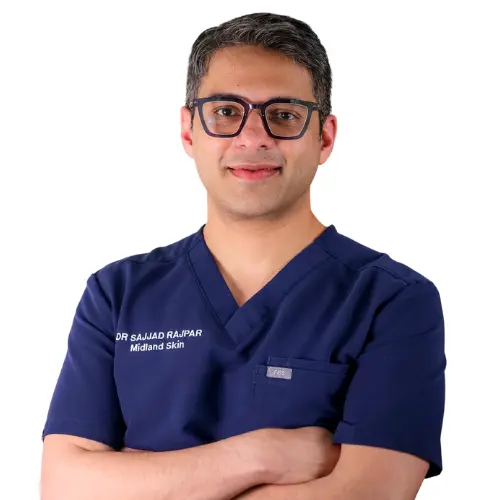
This page has been written and/or medically reviewed by Dr Sajjad Rajpar, Consultant Dermatologist and Medical Director of Midland Skin, Birmingham.
Dr Rajpar is on the GMC Specialist Register in Dermatology and has over 20 years’ experience in clinical dermatology. He provides clinical oversight to ensure the information on this page is accurate, balanced and consistent with current dermatology practice.
Dr Sajjad Rajpar
Date last updated: 23rd Aug 2026
Book in with us
Expert, consultant led care in dermatology, skin surgery, eyelid surgery, lasers and aesthetics.
Disclaimer
The content on this website is provided for general information only. It is not, and must not be treated as, medical advice, a diagnosis, or a recommendation for any particular treatment. We make reasonable efforts to keep information accurate and up to date, but medicine and technology change, and content may not reflect the most current evidence, guidance, product information, or individual practice. You should not rely on this website to make decisions about your health or treatment. Always seek personalised advice from an appropriately qualified healthcare professional. Any examples, images, testimonials, and outcome descriptions are illustrative only. Results vary between individuals and no outcome can be guaranteed.


