
Seborrhoeic Warts consultations with a Dermatologist
At Midland Skin we offer Seborrhoeic Warts consultations with a Dermatologist for patients in Birmingham, Solihull, Coventry, Wolverhampton, Worcester and the Midlands.


What is a seborrhoeic wart / seborrhoeic keratosis?
Seborrhoeic warts are also known as seborrhoeic keratoses or senile warts. They are harmless growths on the skin which are very common in those over 40.
We specialise in removal of seborrhoeic warts and seborrhoeic keratoses
Quick facts about Seborrhoeic Warts [TO UPDATE]
- You need three 45 minute treatments – one every 3 to 4 weeks
- The results get better with time and at one year there is an average reduction in inflammatory spots of 97% according to clinical studies
- There are no harmful side effects
- The treatment is safe in all skin tones and all year round
- You do not need to take long-term tablets or creams
- There can be short-lived purges which can be managed with medications
What causes a seborrhoeic wart / seborrhoeic keratosis?
They are benign growths due to a build up of ordinary skin cells. They are strongly age-related. They usually start to appear after the age of 40 years, and most elderly people will have at least a few seborrhoeic warts: some will have large numbers. They are not infectious and do not become malignant.
What do seborrhoeic warts look like?
Small flat seborrhoeic warts can often be seen in middle age, and they become more raised and larger as the years go by. Their size varies from less than one centimetre to several centimetres across. Seborrhoeic warts have a rough surface, and range in colour from a light brown to almost black. They give the impression that they are stuck onto the surface of the skin. Some look like small pigmented skin tags.
Seborrhoeic warts occur most often on the trunk but are also common on the head and neck. Their numbers vary: one person may have just one seborrhoeic wart; others have hundreds of them. Once present, they usually stay, and new ones often appear over the years.
Are seborrhoeic warts hereditary?
Seborrhoeic warts can run in families and this suggests a genetic basis for them. Many families will have a tendency to develop seborrhoiec keratoses especially on their body.

Scarlett Greenwood

What are the symptoms of seborrhoeic warts?
Seborrhoeic warts are harmless, but can be a considerable nuisance. They can itch, become inflamed, and catch on clothing. Many people dislike the look of them, particularly when they come up on the face.
Seborrhoeic keratoses and Dermatosis papulosa nigra on the face
In certain individuals, especially those of Asian or African hertiage, seborrhoeic keratoses appear as small dark brown or black spots. They can occur over the face and neck. This is known as Dermatosis papulosa nigra.
Seborrhoeic keratoses on the trunk
Seborrhoeic keratoses can occur on the trunk especially on the back, chest and under the breasts as well as the waist line. Some people may have hundreds of lesions.
Book in with us
Ready to get started? Book a consultation with our team at Midland Skin. Friendly, expert advice tailored to you.
Are seborrhoeic keratoses caused by sun exposure?
Seborrhoiec keratoses are not thought to be caused directly by sun exposure. They are very common with age and can run in families.
How are seborrhoeic warts diagnosed?
Seborrhoeic keratoses can usually be diagnosed from their appearance by an experienced Doctor. If there is doubt over the diagnosis, then a biospy is required so that the seborrhoeic wart can be looked at under the microscope.
Can seborrhoeic warts be treated?
Yes, we offer seborrhoeic wart removal which is one of our most common procedures.
PRICING EXAMPLE LINK
References used for this article
Further information on dermatitis can be found here:
About the Author
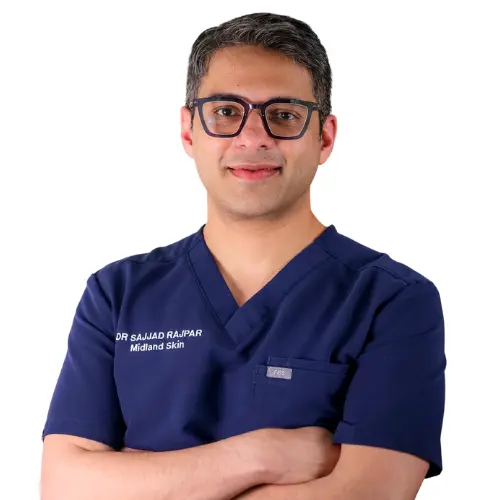
This page has been written and/or medically reviewed by Dr Sajjad Rajpar, Consultant Dermatologist and Medical Director of Midland Skin, Birmingham.
Dr Rajpar is on the GMC Specialist Register in Dermatology and has over 20 years’ experience in clinical dermatology. He provides clinical oversight to ensure the information on this page is accurate, balanced and consistent with current dermatology practice.
Dr Sajjad Rajpar
Date last updated: 9th Mar 2026
Book in with us
Expert, consultant led care in dermatology, skin surgery, eyelid surgery, lasers and aesthetics.
Disclaimer
The content on this website is provided for general information only. It is not, and must not be treated as, medical advice, a diagnosis, or a recommendation for any particular treatment. We make reasonable efforts to keep information accurate and up to date, but medicine and technology change, and content may not reflect the most current evidence, guidance, product information, or individual practice. You should not rely on this website to make decisions about your health or treatment. Always seek personalised advice from an appropriately qualified healthcare professional. Any examples, images, testimonials, and outcome descriptions are illustrative only. Results vary between individuals and no outcome can be guaranteed.


