
Why is my face red?
Key points
- Facial redness can be temporary (flushing) or persistent, and can occur with or without a rash
- Rosacea – the most common cause of persistent redness, flushing and thread veins
- Dermatitis, allergy and acne – redness is often part of another skin condition
- Steroid creams – prolonged use on the face can cause redness that flares when they are stopped
- Not always the skin – menopause, medications, anxiety and, rarely, blood or hormone disorders can cause flushing
- More than one cause is often present at the same time
Common causes of a red face
Facial redness can occur for several reasons. Sometimes the redness is temporary, in the form of a flush. In other instances the redness can be persistent. Redness can be a result of inflammation or occur by itself.
In skin of colour, redness may look violet, brown or grey rather than pink, and is easily missed.
A dermatologist can help you understand the causes of your facial redness and suggest ways in which to control it.
Here we explore some of the common causes of redness.
Dermatitis
Dermatitis is another word for eczema. Redness is a common complaint in those with eczema. There may be dry skin, itch and pigmentation as well. Sometimes the redness is in patches, but at other times the redness can cover the whole face.
Seborrhoeic dermatitis can affect the forehead, eyebrows and smile lines, usually with fine flaking. It is easily mistaken for rosacea and the two can occur together. Atopic dermatitis can affect any part of the face.
Allergies
A red face can be a sign of allergies. Sometimes there is swelling as well. Allergic reactions can occur to everyday products like fragrances and skin care products like make-up and serums. Sometimes the sun can trigger an allergic reaction and cause a red face. Your dermatologist will advise on patch testing or other allergy tests if they think you may have a facial allergy.
Rosacea
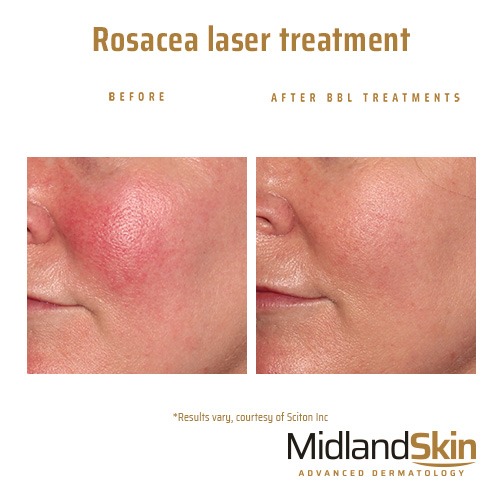
Rosacea is probably the most common cause of facial redness, flushing and thread veins. However, the exact reason why rosacea causes redness is not known.
Prescription creams and tablets mainly treat the spots of rosacea. The persistent background redness and thread veins usually respond better to vascular lasers, broadband light (BBL) and Laser Genesis, which we offer at Midland Skin.
Acne
Acne causes red spots. When the spots settle, they can leave a red blemish. This is known as post-inflammatory erythema. Vascular laser treatment can help reduce this sort of redness once the acne itself is under control.
Genetics
Some families have a bit more colour in their skin tone than others. This is not necessarily a disorder. Broadband light and laser treatment can help control this.
Physiological redness
It’s normal to be red when you are very hot or anxious or after having a few glasses of an alcoholic beverage. This is known as physiological flushing. This is the body’s normal way of reacting to changes in temperature or when a vasodilating substance like alcohol is ingested.
Sun damage
Long term sun exposure can break down collagen, which causes thread veins and redness. Daily sun protection helps prevent this from worsening.
Steroid withdrawal
Some people who have used steroid creams on the face for prolonged periods find that their face becomes red, hot or burning when they try to stop. Paradoxically, using more steroid temporarily controls the redness, which makes it hard to stop.
The MHRA issued safety advice on topical steroid withdrawal reactions in 2021. These reactions are uncommon and are mainly linked to frequent, long-term use of moderate or potent steroids. Steroid creams on the face can also trigger perioral dermatitis. If you think you have steroid withdrawal, you should seek advice from a dermatologist sooner rather than later.
Hormonal imbalances
A red face can be a sign of hormonal imbalances. The most common hormonal cause of flushing is probably menopause. Here, a woman becomes deficient in oestrogen, and the blood vessels subsequently dilate without warning. However, other hormonal imbalances can also cause flushing, such as thyroid hormone disturbance and adrenal hormone disturbance. Flushing that comes with palpitations, sweating, diarrhoea or wheeze should therefore be investigated by your doctor.
Anxiety
Anxiety is a common cause of facial redness. However, managing anxiety can help control physical symptoms. Anxiety management can be done with a psychologist, medication, or often both.
Blood abnormalities
It is important to note that facial redness and flushing can rarely be a sign of blood abnormalities. A full blood count can show if there are too many red blood cells (polycythaemia) causing this.
Autoimmune conditions
Less commonly, redness across the cheeks and bridge of the nose can be a sign of lupus, particularly if it worsens in sunlight or comes with joint pain, tiredness or mouth ulcers. Blood tests and occasionally a skin biopsy are used to check for this and other rarer inflammatory conditions.
Medications
Certain medications can cause facial redness and flushing. These include medicines used for blood pressure, pain control and angina control, and high-dose niacin (nicotinic acid, a form of vitamin B3). Nicotinamide, the form of vitamin B3 sometimes recommended to reduce skin cancer risk, does not usually cause flushing. Do not stop a prescribed medication without speaking to your doctor.
Combinations
Redness can arise from more than one condition being present simultaneously. For example, an individual may have acne, rosacea and seborrhoeic dermatitis altogether.
When should I see a dermatologist about facial redness?
Most causes of facial redness are treatable, but the right treatment depends on the cause. A consultant dermatologist assessment is worthwhile if:
- Redness is persistent – it has lasted more than a few weeks or keeps returning
- The cause is unclear – you are not sure whether it is rosacea, dermatitis, acne or a combination
- Treatment has not worked – creams from the pharmacy or GP have not helped, or the redness returns when they stop
- Steroid creams are involved – you have used steroid creams on the face for a prolonged period
- You have thread veins or flushing – and want to know whether laser or light treatment is suitable
- There are other symptoms – flushing with palpitations, sweating, diarrhoea, joint pain or swelling, which may need investigation
What happens at Midland Skin?
Your first appointment is an initial dermatology assessment with a consultant dermatologist, who examines your skin and asks about your symptoms, skincare, cosmetics, medications and any steroid creams you have used. Where more than one condition is present, each is identified.
Most causes of facial redness are diagnosed from the history and examination. Patch testing, blood tests or occasionally a skin biopsy are only arranged where they would change the diagnosis or treatment.
Treatment depends on the cause and is individualised. It may include skincare changes, prescription creams or tablets, or vascular laser or broadband light for persistent redness and thread veins. A review consultation is required to assess your response and decide whether treatment should be continued, changed or stopped.
Summary
There are various causes of a red face. It can be helpful to see a Dermatologist to learn what redness and flushing could be caused by and to identify if more than one cause is present.
References used for this article
- Hampton PJ, Berth-Jones J, Duarte Williamson CE, et al. British Association of Dermatologists guidelines for the management of people with rosacea 2021. Br J Dermatol. 2021;185(4):725–735. doi:10.1111/bjd.20485.
- Medicines and Healthcare products Regulatory Agency. Topical corticosteroids: information on the risk of topical steroid withdrawal reactions. Drug Safety Update. September 2021;15(2):2–5.
About the Author
This page has been written and/or medically reviewed by Dr Sajjad Rajpar, Consultant Dermatologist and Medical Director of Midland Skin, Birmingham.
Dr Rajpar is on the GMC Specialist Register in Dermatology and has over 20 years’ experience in clinical dermatology. He provides clinical oversight to ensure the information on this page is accurate, balanced and consistent with current dermatology practice.
Dr Sajjad Rajpar
Published: 11th Apr 2023
Date last updated: 28th Sep 2026

Book in with us
Expert, consultant led care in dermatology, skin surgery, eyelid surgery, lasers and aesthetics.


