
Pigmentation Laser Programme & Laser Toning
A programme for hyperpigmentation, tailored to your skin type and pigmentation cause
Midland Skin offers a consultant-led laser programme for hyperpigmentation, serving patients in Birmingham, Solihull, Coventry, Wolverhampton, Worcester and the Midlands.


Quick Facts about the Laser Toning

Best for
Melasma, post inflammatory hyperpigmentation

Sessions
5-10

Duration
15-30 mins

Recovery
Immediately

Provider
Aesthetic practitioner

Price
See below
Laser Toning & Pigmentation Programme
Hyperpigmentation is one of the most common reasons people seek laser treatment. It simply means there is too much pigment in the skin.
Treating pigmentation safely and effectively requires two things:
- Understanding the cause of your pigmentation
- Assessing your skin phototype (your natural skin colour), as this guides which lasers are safest and most suitable
At Midland Skin, all pigmentation concerns begin with a consultation. We assess the cause and type of pigmentation, then offer a treatment plan tailored to your skin. If laser is appropriate, we will recommend a pigmentation laser programme.
Common Causes of Hyperpigmentation
There are several types of pigmentation we may treat with laser therapy:
- Melasma – often hormonally driven and seen on the cheeks, forehead or upper lip
- Post-inflammatory hyperpigmentation (PIH) – dark patches that occur after any form of injury or inflammation, such as after acne, an insect bite, or surgery. Pigmentation after acne is a form of post inflammatory hyperpigmentation and one of the most common concerns we treat.
- Sun damage – including sun spots and general solar bronzing, where the overall skin tone darkens and becomes more dull
- Mixed pigmentation – many people have more than one type, such as melasma combined with PIH
- General skin aging – laser treatment for hyperpigmentation may also be recommended for general rejuvenation or maintenance of a brighter, clearer complexion
Laser Treatments for Pigmentation
At Midland Skin, we use a range of laser technologies to target different types and depths of pigmentation safely. The choice of technology depends on the cause of your pigmentation and your skin phototype.
- Laser Toning (more details below) – for melasma, post-inflammatory hyperpigmentation and sun damage. Safe for all skin phototypes including darker skin, and also improves skin texture and brightness over time. Safe for skin types 1–6.
- BBL (BroadBand Light) – a versatile treatment that reduces sun-induced pigmentation, evens out tone, and enhances overall skin brightness. Safe for skin types 1–4.
- 3D Miracle – combines gentle resurfacing and brightening to lift superficial pigmentation and boost glow. Safe for skin types 1–6.
- Fractional Laser (e.g. Halo) – reaches deeper pigment while also improving skin quality, pore appearance, and early signs of ageing. Safe for skin types 1–5.
- Fully Ablative Laser – clears stubborn surface pigmentation by removing the topmost layers of skin. Safe for skin types 1–2.
Treatment Pathway for Laser Toning
Initial Assessment
You meet your Consultant Dermatologist to assess the type and cause of your pigmentation and determine your skin phototype. A treatment plan is discussed and agreed with you. Oral and cream medications may be prescribed.
Treatment Programme
Laser sessions are carried out at intervals appropriate to your chosen treatment. For laser toning, sessions are typically spaced three weeks apart. For BBL or fractional laser treatments, intervals differ and will be confirmed at consultation.
Review
Progress is assessed at intervals during the programme and at its conclusion. Adjustments to the plan, or addition of combination treatments, are made as needed.
Maintenance
Some patients require periodic maintenance treatments and ongoing photoprotection to sustain results, particularly for melasma.

Scarlett Greenwood

Laser Toning in Detail
What Is Laser Toning?
Laser toning uses a low-energy, large spot Q-switched 1064 nm Nd:YAG laser. It’s especially helpful for:
- Melasma
- Post-inflammatory pigmentation
- Dull or uneven skin tone and early signs of ageing
How Laser Toning Works
Laser toning clears pigment in a gradual, non-destructive way. It works by:
- Breaking up pigment low-energy nanosecond laser pulses create mild photo-acoustic shockwaves that fragment mature pigment granules without harming surrounding cells. Over time, the pigment is naturally cleared and melanin production is reduced.
- Improving skin quality: The laser pulses stimulate the upper dermis, increasing collagen-building signals like TGF-β and heat-shock proteins, which can improve skin quality.
What Is Happening Under the Skin?
Biopsy and microscopy studies show:
- Melanosomes (pigment granules) are broken down into “ghost” granules without harming healthy cells
- Melanocytes (pigment cells) stay intact but reduce their activity significantly
- Keratinocytes (skin cells) contain less pigment after several treatments, with no damage to cell structure
- Dermis shows no scarring or collagen damage; instead, pigment is gradually absorbed by immune cells
Combination Treatments
Laser toning often works best as part of a broader plan. We may recommend:
- Laser Genesis – adds deeper heating for collagen stimulation; performed before the toning pass in the same session
- BBL – targets redness and sun damage; often performed two weeks before laser toning
- 3D Miracle – gently smooths the skin and boosts clarity Fractional laser (e.g. Halo) – improves texture and pigment at multiple skin depths
- Topicals or oral medications – used alongside laser to optimise results and reduce relapse
Risks and Limitations
- Results vary and cannot be guaranteed – the treatment may not work for everyone
- Some patients will require maintenance treatments, for example every 6 or 12 months
- Pigment can recur, especially with sun exposure or hormonal triggers
- Post-inflammatory hyperpigmentation is a recognised, if uncommon, adverse effect – this means the skin becomes darker because of the laser treatment
- Mottled white patches (hypopigmentation) occur rarely but may be permanent
Preparing for Treatment and What to Expect on the Day: FAQs
Am I suitable for laser toning?
Laser toning is safe for all skin phototypes, including darker skin (Fitzpatrick types 1–6). Suitability depends on the cause and type of your pigmentation. A consultation with a Consultant Dermatologist is required before treatment begins, to assess your phototype, confirm the diagnosis, and recommend the most appropriate laser.
Do I need a consultation before starting?
Yes. All pigmentation concerns at Midland Skin begin with a consultation. We assess the cause and type of your pigmentation and your skin phototype before recommending any treatment. This is particularly important for pigmentation, as different causes respond differently to laser and some conditions require dermatoscopic assessment before treatment proceeds. Laser is not recommended for all types of hyperpigmentation.
How many sessions of laser toning will I need?
Laser toning typically requires 5–10 sessions, spaced three weeks apart. The exact number depends on your response to treatment. Laser toning is a gradual, cumulative treatment; results develop over the course of the programme as melanin-producing cells progressively reduce their activity. Some patients with melasma will also require periodic maintenance treatments after the initial programme.
What should I do before my session?
Arrive without make-up applied. Do not attend with an active tan; sun-tanning during the treatment course increases the risk of adverse effects and reduces efficacy. Avoid deliberate sun exposure and apply a broad-spectrum SPF 50 sunscreen daily throughout the treatment period.
Does laser toning it hurt?
Laser toning is a very easy treatment to undergo. No anaesthetic is needed. You will feel a light prickling or tapping sensation and mild warmth during the session. A cooling device may be used. Redness typically settles within a few hours
How long does a session take?
Each session takes approximately 15 minutes. Treatment is performed by our aesthetic practitioners.
What will my skin look like immediately after laser toning?
Some redness and mild warmth are normal immediately after treatment. These settle within a few hours. You can apply SPF or make-up straight after your session.
Book in with us
Ready to get started? Book a consultation with our team at Midland Skin. Friendly, expert advice tailored to you.
References used for this article
- Mun JY, Jeong SY, Kim JH, Han SS, Kim IH. A low fluence Q-switched Nd:YAG laser modifies the 3D structure of melanocyte and ultrastructure of melanosome by subcellular-selective photothermolysis. J Electron Microsc (Tokyo). 2011;60(1):11–18.
- Kim JE, Chang SE, Yeo UC, Haw S, Kim IH. Histopathological study of the treatment of melasma lesions using a low-fluence Q-switched 1064-nm neodymium:yttrium-aluminium-garnet laser. Clin Exp Dermatol. 2013;38:167–171.
- Sarkar R, Arora P, Garg KV, Sonthalia S, Gokhale N. Melasma update. Indian Dermatol Online J. 2014;5(4):426–435.
Or, if you specifically want Kang HY: Kang HY. Melasma update. 2009, but not the 2014 Dermatol Ther (Heidelb) citation. - Cho SB, Kim JS, Kim MJ. Melasma treatment in Korean women using a 1064-nm Q-switched Nd:YAG laser with low pulse energy. Clin Exp Dermatol. 2009;34(8):e847–e850.
- Passeron T. Long-lasting effect of vascular targeted therapy of melasma. J Am Acad Dermatol. 2013;69(3):e141–e142.
About the Author
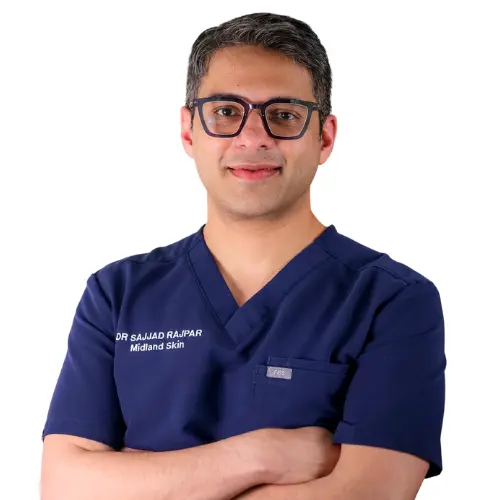
This page has been written and/or medically reviewed by Dr Sajjad Rajpar, Consultant Dermatologist and Medical Director of Midland Skin, Birmingham.
Dr Rajpar is on the GMC Specialist Register in Dermatology and has over 20 years’ experience in clinical dermatology. He provides clinical oversight to ensure the information on this page is accurate, balanced and consistent with current dermatology practice.
Dr Sajjad Rajpar
Date last updated: 16th Jun 2026
Book in with us
Expert, consultant led care in dermatology, skin surgery, eyelid surgery, lasers and aesthetics.
Disclaimer
The content on this website is provided for general information only. It is not, and must not be treated as, medical advice, a diagnosis, or a recommendation for any particular treatment. We make reasonable efforts to keep information accurate and up to date, but medicine and technology change, and content may not reflect the most current evidence, guidance, product information, or individual practice. You should not rely on this website to make decisions about your health or treatment. Always seek personalised advice from an appropriately qualified healthcare professional. Any examples, images, testimonials, and outcome descriptions are illustrative only. Results vary between individuals and no outcome can be guaranteed.


