
Skin Tag Removal
Our expert doctors offer same day skin tag removal in Birmingham and Solihull
At Midland Skin we offer skin tag removal treatment for patients in Birmingham, Solihull, Coventry, Wolverhampton, Worcester and the Midlands.


Skin tag removal in Birmingham and Solihull
Skin tags are a common problem that almost half the population have. Skin tags can be removed safely and effectively in Birmingham.
Skin tag removal is a straightforward procedure that can be carried out on the face or other parts of the body while you are awake.
Quick facts about skin tag removal [TO UPDATE]
- You need three 45 minute treatments – one every 3 to 4 weeks
- The results get better with time and at one year there is an average reduction in inflammatory spots of 97% according to clinical studies
- There are no harmful side effects
- The treatment is safe in all skin tones and all year round
- You do not need to take long-term tablets or creams
- There can be short-lived purges which can be managed with medications
Where do skin tags occur?
Skin tags are fleshy projections of skin that can be found anywhere in the body. Skin tag removal is requested most often for skin tags located in the following areas:
- eyelids
- face
- neck
- under arms
- under the breast
- on the trunk
- in the groin, genitals
- on the thighs
- on the arms and legs
What is a skin tag?
A skin tag is a tiny bulge or bump of extra skin on a pedicle. A skin tag can be tiny, and from 1-2 mm in length, to over 3 or 4cm in length.
The medical name for a skin tag is acrochordon and fibroepithelial polyp.
Skin tags my be skin coloured, though sometimes they can be pink or dark. They are usually smooth on their surface. Sometimes they look a bit flaccid and wrinkled.
Some people may only have one or two skin tags while others are prone to developing tens or even hundreds.

Scarlett Greenwood

Are skin tags cancerous?
No, skin tags are entirely benign.
Who does skin tag removal?
Skin tag removal is usually carried out by a Dermatologist.
When should skin tags be removed?
There are many reasons why you might want to have a skin tags removed. Some common reasons that people choose to have a skin tag removal are:
- You do not like how the skin tags look.
- The skin tags have grown and become very obvious and prominent
- You are prone to developing many skin tags and you want to keep them under control
- The skin tags catch on jewellery or clothing
- The skin tags cause itching and irritation
Will a skin tag go away on its own?
Once a skin tag has developed, it will not go away on its own.
Skin tags on the eyelids
Skin tags can be found anywhere on the body. We specialise in treating delicate areas such as the eyelids.
Skin tags on the groin, genitals, perianal area and perineum
We also specialise in treating skin tags in delicate areas. More information on skin tag removal in the genital area can be found here.
Sometimes skin tags may look like:
- Comedones – these are white, do not have a central crater or thread veins, and occur as part of acne. Treatment of comedones is with hyfrecation.
- Moles – Mature moles or intradermal naevius can be confused with skin tags. We offer mole removal too.
- Warts and seborrhoeic keratosis. Warts are usually rough and have an irregular surface. We offer wart and seborroheoic keratosis removal too.
Book in with us
Ready to get started? Book a consultation with our team at Midland Skin. Friendly, expert advice tailored to you.
What happens during skin tag removal?
Two methods are used for removal of skin tags.
- Snip excision. They skin tag is snipped off using sterile scissors. The wound is then cauterised.
- Cautery. The skin tag is focally burnt off using electrosurgery with a very fine tip.
A local anaesthetic injection is used. This is not required if the skin tag is very small.
A very superficial wound results. This is covered with Vaseline, and will scab over and heal over a period of a few days usually between 5 to 7 days. A dressing is not required unless it is in an area that is prone to rubbing or chaffing in which case a dressing is used to protect the skin until it has healed.
Skin tags do not recur once they have been treated. A small change in texture and skin colour may be noted on close up examination at the location from which the skin tag was removed.
How does the skin heal following skin tag removal?
A small scab will develop in the treated area which will go after 5 days. You will be asked to apply vaseline four times a day. Small lesions usually heal without a trace. Larger lesions may heal with a slight scar that may be very slightly paler. It is advisable to treat skin tags when the lesions are small as the healing is simpler and quicker though skin tags of any size can be removed.
What is the aftercare and recovery following a skin tag removal?
We ask you to avoid heavy exercise or anything strenuous for the rest of the day. The areas that have been treated need to be kept clean and dry. You can cleanse them once or twice a day with water and a cotton pad. People can usually return to an office job straight away. Wounds in areas that are prone to rubbing or chaffing are covered with a splash proof dressing.
What are the risks of having a skin tag removal procedure?
This is generally a very safe procedure with a high level of satisfaction. Larger lesions may leave a light scar or mild indentation.
How many skin tags can be treated in one session?
A number can be treated per session, usually up to 7.
Other skin lesions
Our clinic also offers removal of genital skin tags, moles, cysts, warts, seborrhoeic keratoses, sebaceous gland hyperplasia and milia.
PRICING EXAMPLE LINK
What are the costs for skin tag removal?
The price per session is based on the number of lesions and complexity.
The price will vary depending on the size and complexity of the skin tags and can only be confirmed once you have been assessed.
References used for this article
About the Author
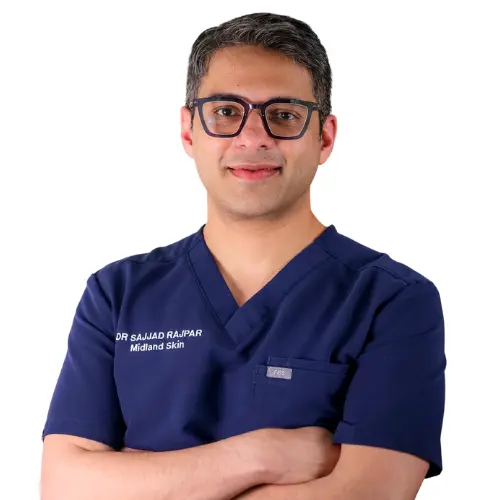
This page has been written and/or medically reviewed by Dr Sajjad Rajpar, Consultant Dermatologist and Medical Director of Midland Skin, Birmingham.
Dr Rajpar is on the GMC Specialist Register in Dermatology and has over 20 years’ experience in clinical dermatology. He provides clinical oversight to ensure the information on this page is accurate, balanced and consistent with current dermatology practice.
Dr Sajjad Rajpar
Date last updated: 9th Mar 2026
Book in with us
Expert, consultant led care in dermatology, skin surgery, eyelid surgery, lasers and aesthetics.
Disclaimer
The content on this website is provided for general information only. It is not, and must not be treated as, medical advice, a diagnosis, or a recommendation for any particular treatment. We make reasonable efforts to keep information accurate and up to date, but medicine and technology change, and content may not reflect the most current evidence, guidance, product information, or individual practice. You should not rely on this website to make decisions about your health or treatment. Always seek personalised advice from an appropriately qualified healthcare professional. Any examples, images, testimonials, and outcome descriptions are illustrative only. Results vary between individuals and no outcome can be guaranteed.


