
TCA Cross for acne scars
TCA Cross is a specialist technique for acne scars.
At Midland Skin we offer TCA Cross for acne scars treatment for patients in Birmingham, Solihull, Coventry, Wolverhampton, Worcester and the Midlands.


TCA Cross for acne scars in Birmingham and Solihull
Midland Skin has a selection of lasers that can improve hyTCA CROSS (Trichloroacetic Acid Chemical Reconstruction of Skin Scars) is a precise chemical treatment used to improve acne scars. A small amount of TCA is carefully applied to individual scars to stimulate collagen production and make them appear less deep over time.
TCA Cross works best for ice pick scars and boxcar scars. TCA may work for other types of acne scars as well.
At our Birmingham clinic, we provide TCA CROSS treatment for patients from Solihull and across the West Midlands, often as part of a combined acne scar treatment plan that may also include subcision, laser resurfacing, or other advanced techniques.
Quick facts about TCA Cross for acne scars [TO UPDATE]
- You need three 45 minute treatments – one every 3 to 4 weeks
- The results get better with time and at one year there is an average reduction in inflammatory spots of 97% according to clinical studies
- There are no harmful side effects
- The treatment is safe in all skin tones and all year round
- You do not need to take long-term tablets or creams
- There can be short-lived purges which can be managed with medications
What does TCA Cross stand for?
TCA stands for TrichlorAcetic Acid and CROSS stands for Chemical Reconstruction Of ScarS.
What is TCA Cross used for?
TCA Cross treatment is most commonly used for acne scars that are deep. The benefit of TCA Cross is that the liquid is able to reach the very bottom of the scar where it can have an effect.
The types of acne scar which are treated with TCA Cross include:
- Ice pick scars
- Boxcar scars
TCA Cross may form part of an acne scarring treatment plan.

Scarlett Greenwood

What happens during a TCA Cross treatment?
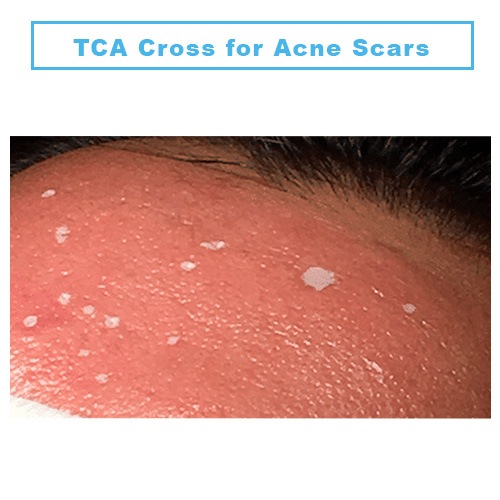
Treatment will involve the skin being cleansed and the TCA being placed in the scars. The stages that will follow are:
- Frosting. The skin will go white. This is because the TCA has reacted with the proteins in the skin. Frosting lasts for about 30 minutes.
- Redness. When the frosting disappears, the skin will become red.
- Scabbing. A scab will form within 1 or 2 days. This will cover the redness and lasts for 3 to 7 days.
- Redness for 7 to 28 days. Once the scab separates, the skin will be red. The redness will gradually fade over a month (sometimes two).
Looking after your skin after TCA Cross
- Your skin may become sensitive and it is best to use a very gentle lotion, such as Cetaphil lotion, as a cleanser twice per day.
- The scabs need to be moisturised four times a day. Either apply Vaseline or Aquaphor ointment to the scabs for times a day.
- Let the scabs separate naturally. Do not pick them. They will separate as soon as the skin below has healed.
- You can wear make-up from day 3 onwards.
- It is important to protect your skin from the sun as the sun can cause pigmentation in the healing areas. We ask you to avoid tanning for 2 weeks before treatment until 2 months after your final treatment. If you do develop pigmentation, you may need a skin-lightening treatment from your doctor.
What are the benefits of TCA Cross?
TCA Cross is a very successful treatment for the right type of acne scars. About 75% of patients receiving this form of treatment feel their results are good or excellent.
Research also supports TCA Cross as being both safe and effective for acne scars.
A Korean medical report showed that 94% of people receiving 100% TCA had a good response. Complications were not reported.
An Egyptian study showed that 100% TCA improved scars by 75%. 4 sessions were given.
Book in with us
Ready to get started? Book a consultation with our team at Midland Skin. Friendly, expert advice tailored to you.
How does TCA Cross work?
Studies show that TCA Cross causes damage to the epidermis and dermis in the area of the scar. The body then heals the injury to lay down more type I collagen and elastic fibres. This raises the depths of the scar.
What are the risks of TCA Cross?
As with any medical treatment, there are some risks of treatment as well:
- Redness can persist for several months
- Post-inflammatory hyperpigmentation can occur. This is when there is a darkening to the skin that has been treated
- Rarely post-inflammatory can rarely occur This is when there is lightning to the skin which has been treated.
- Scars can widen
- Scars can look worse
- There may be no results or very minimal results
- Infections can occur
How many treatments are required?
Between 4 to 6 treatments are usually required. A treatment is carried out every 4 to 6 weeks. Results may not start being apparent until the second or third treatment.
Can all skin types be treated?
We offer treatment to skin type I to V patients (white to Indian skin tones). TCA Cross has been found to be safe in published reports from Brazil, Egypt, Korea, and India.
Combining TCA with other treatments
TCA Cross may be combined with other skincare treatments which can include subcision, surgical excision of scars, and laser resurfacing.
PRICING EXAMPLE LINK
References used for this article
About the Author
This page has been written and/or medically reviewed by Dr Sajjad Rajpar, Consultant Dermatologist and Medical Director of Midland Skin, Birmingham.
Dr Rajpar is on the GMC Specialist Register in Dermatology and has over 20 years’ experience in clinical dermatology. He provides clinical oversight to ensure the information on this page is accurate, balanced and consistent with current dermatology practice.
Dr Sajjad Rajpar
Date last updated: 9th Mar 2026

Book in with us
Expert, consultant led care in dermatology, skin surgery, eyelid surgery, lasers and aesthetics.
Disclaimer
The content on this website is provided for general information only. It is not, and must not be treated as, medical advice, a diagnosis, or a recommendation for any particular treatment. We make reasonable efforts to keep information accurate and up to date, but medicine and technology change, and content may not reflect the most current evidence, guidance, product information, or individual practice. You should not rely on this website to make decisions about your health or treatment. Always seek personalised advice from an appropriately qualified healthcare professional. Any examples, images, testimonials, and outcome descriptions are illustrative only. Results vary between individuals and no outcome can be guaranteed.


