
Laser treatment in Birmingham
Consultant-led assessment and treatment for redness, thread veins, vascular lesions, pigmentation, sun damage, lines, wrinkles, skin texture and skin lesions
At Midland Skin we offer consultant-led laser treatment for patients in Birmingham, Solihull, Coventry, Wolverhampton, Worcester and the Midlands.

Quick Facts about laser treatment

Best for
Redness, pigment, wrinkles, lesions
Appointment
Initial laser assessment
Treatment
Laser

Sessions
Single or a course
Provider
Consultant-led
Price
See below
What would you like to treat?
Most laser enquiries fall into one of the groups below. Choose the one that fits best to read about treatment, or book an initial laser assessment if you are not sure — your consultant will recommend the right treatment for you.

Redness, rosacea and thread veins
3 Treatments

Pigmentation, sun spots and melasma
3 Treatments

Lines, wrinkles and sun-damaged skin
4 Treatments

Moles, syringomas and other skin lesions
3 Treatments
Other laser services
4 Treatments
Your initial laser assessment
Your assessment is with a consultant who plans and carries out laser treatment regularly. No referral is needed.
Your consultant asks what you would like to improve and how it affects you, how long it has been there and how it has changed, what you have already tried, and how your skin has reacted to sun, injury and any previous laser, IPL or peel treatments. Your skin type, medical history and medications are reviewed, together with recent sun exposure, cold sores and any tendency to scar or develop dark marks, because all of these affect which treatments are safe for you and when they can be done.
The skin is examined under good lighting and magnification, and the diagnosis is confirmed before any treatment is planned. Pigmented spots are checked with a dermatoscope to make sure they are benign, facial redness is assessed for rosacea and the conditions that mimic it, and lines and texture are assessed for the depth of treatment they need. Clinical photographs are taken as a baseline, so that your response to treatment can be measured rather than guessed at.
You leave knowing whether laser treatment is suitable, which treatment is recommended and why, the alternatives — including prescription treatment or no treatment — the likely number of sessions, downtime, risks and what can realistically be achieved, with a written treatment plan and costing. A copy of the clinic letter is sent to you and your GP.
Treatment is not carried out at the initial assessment. Laser treatments are booked at a separate appointment after a cooling-off period of at least two weeks, once you have had time to consider the plan. A test patch is sometimes planned first, particularly in darker skin types. There is no obligation to proceed.

Scarlett Greenwood

Laser treatments at Midland Skin
Treatment is chosen by what is wrong with the skin and how deep it sits, not by which machine happens to be available. Blood vessels, pigment and water in the skin each absorb different wavelengths, which is why no single laser treats everything, and why many plans use more than one.
Redness, flushing and visible vessels. Vascular lasers target the fine blood vessels behind persistent facial redness and rosacea, thread veins, spider naevi, venous lakes, cherry angiomas and port wine stains. Treatment is usually a course of three to five sessions about a month apart. Read more on our rosacea, redness and thread veins page.
Sun spots, freckling, melasma and dark marks. Pigment lasers target melanin. Sun spots and freckles are treated with a short course of pigment laser, and melasma and the dark marks left after acne or inflammation with low-energy laser toning, a 1064 nm Q-switched laser, over a longer course; laser toning is one of the safer options for darker skin when used carefully. Melasma is controlled rather than cured: laser is one part of a plan that usually includes strict sun protection and prescription creams, and pigment can return, particularly after sun exposure. Read more on our laser pigmentation toning page.
Lines, wrinkles and sun-damaged skin — laser resurfacing. Resurfacing lasers remove or heat controlled columns of skin so that it heals smoother, with new collagen. The deeper the treatment, the greater the change and the longer the recovery. Fully ablative CO2 and erbium resurfacing gives the largest change to deep lines and heavy sun damage in a single treatment, with around seven to ten days before new skin has formed and redness that settles over weeks to months. Fractional CO2, erbium and 2910 nm resurfacing treats a fraction of the skin at a time, with around five to nine days of recovery, as one treatment or a short course. Halo, a hybrid fractional laser, gives a lighter result with less downtime over two treatments. Read more on our fully ablative resurfacing, fractional laser resurfacing and Halo pages. 1064 MDF Spectra treatment is an alternative to fractional resurfacing.
Rhinophyma. Ablative laser is used to reshape the thickened skin of the nose that can develop in long-standing rosacea. Read more on our rhinophyma page.
Moles, syringomas and other benign skin lesions. Ablative laser can remove or flatten benign lesions such as syringomas and raised moles with precision, leaving a small wound that heals over one to two weeks and may leave a pale mark. Syringomas often need more than one treatment and can come back. A lesion is only treated with laser once it has been examined and confirmed as benign; if there is any doubt, it is removed surgically so that it can be examined under the microscope. Read more on our laser mole removal page.
Scars, acne and skin tightening. Vascular, pigment and fractional lasers are central to scar treatment, and light-based treatments are used for acne and acne scarring, but these are planned at their own assessments. Injectable treatments are assessed at the initial laser assessment and can be combined with laser where appropriate. Sofwave ultrasound skin tightening is assessed by our aesthetic practitioners.
Because vascular, pigment, fractional and fully ablative lasers are all available under one roof, your plan can combine devices, or change as your skin responds, rather than being limited to what one machine can do. And because your consultant is a dermatologist, prescription treatment can be used alongside laser — or instead of it, where that is the better answer.
Who is laser treatment suitable for?
Laser treatment may be worth considering for:
- Facial redness, flushing or rosacea – that persists despite skincare or prescription treatment
- Thread veins, spider naevi, venous lakes or port wine stains – vascular lesions that creams cannot help
- Sun spots, freckling and blotchy sun damage – on the face, neck, chest, arms or hands
- Melasma or dark marks after acne or inflammation – as part of a plan with sun protection and prescription creams
- Fine lines, crepey skin, enlarged pores or uneven texture – where a lighter resurfacing treatment or a course is preferred
- Deeper lines and heavily sun-damaged skin – where a single, deeper resurfacing treatment is appropriate
- Rhinophyma – thickening of the nose in long-standing rosacea
- Moles, syringomas and other benign skin lesions – where laser removal is preferred and the lesion has been confirmed as benign
- Skin of colour – laser can be safe and effective in darker skin when the device and settings are chosen for your skin type
Treatment pathway
Initial laser assessment
Your skin is examined and photographed, and your concern, skin type, sun exposure, medications and previous treatments are reviewed. The diagnosis is confirmed and you are told whether laser treatment is suitable and what can realistically be achieved.
Care plan
The recommended treatment is explained with alternatives, likely number of sessions, downtime, aftercare, risks and fees. Treatment is not carried out at this appointment. Laser treatments follow a cooling-off period.
Treatment
Sessions take place at separate appointments. Vascular and pigment laser treatments are usually a course about a month apart; resurfacing is a single treatment or a short course. Numbing cream, local anaesthetic or sedation is used depending on the treatment.
Review
Before each session in a course, your response is checked. At the end of the planned course, a review consultation may be arranged to decide whether treatment should be continued, adjusted or stopped.
What to expect from laser treatment
It is important to have realistic expectations before starting laser treatment.
Laser treatments improve the skin; they do not make it perfect. The aim is skin that is less red, more even in colour and smoother in texture. Results build over a course, and after resurfacing the skin continues to remodel for several months, so the final result is not seen straight away.
Some problems are controlled rather than cured. Rosacea and thread veins can return over time as new vessels form, melasma commonly comes back, particularly after sun exposure, and sun damage continues to accumulate if the skin is not protected. Maintenance sessions are often part of long-term control, and this is discussed at your assessment.
Downtime ranges from none to a week or more. Vascular and pigment laser treatments usually cause redness, swelling or darkening of treated spots for a few hours to a few days. Fractional resurfacing needs around five to nine days of healing, and fully ablative resurfacing around seven to ten days before new skin has formed, with redness that fades over the following weeks to months.
All treatments carry risks — redness, swelling, bruising, crusting, blistering, temporary or occasionally lasting change in pigment, infection including cold sore reactivation after resurfacing and, rarely, scarring — and these are explained for your specific plan before you consent. Sun protection before and after treatment is essential, and treatment is postponed if the skin is tanned.
Laser treatment in skin of colour
Many of our patients have skin of colour. Laser treatment can be safe and effective in darker skin, but the margin for error is smaller: the pigment in the skin absorbs laser energy too, so the wrong device or setting can cause darkening or, less often, lightening of the treated area. Longer-wavelength vascular and pigment lasers and conservative fractional settings are chosen for your skin type, sessions are spaced further apart where needed, a test patch may be done first, and strict sun protection is essential. Some treatments, including deeper resurfacing, may not be suitable for darker skin types, and an alternative is recommended instead.
Your initial laser assessment: FAQs
Should I send photographs when I book?
Not unless requested. All initial laser assessments are with a consultant, so photographs are not needed to allocate your appointment. If you are unsure which appointment to book, our team can advise.
Who will assess me?
A consultant dermatologist or surgeon who plans and carries out or supervises laser treatment. The consultant who assesses you prepares your plan, and the clinician carrying out each treatment is confirmed when it is booked. Some treatments in your plan may be delivered by our laser therapists under the consultant’s direction.
How should I prepare for the assessment?
Come with the area free of make-up and fake tan if you can, and bring a list of your skincare, medications and any previous laser, IPL, peel or prescription treatments, with dates. Photographs showing how the problem has changed over time are helpful. Avoid deliberate sun exposure in the weeks before, as a tan can delay treatment.
Will I have treatment at my first appointment?
No. The initial laser assessment is for examination, diagnosis and planning. Laser treatments are booked separately after a cooling-off period of at least two weeks. A test patch is sometimes arranged before a full treatment.
Is the assessment fee deducted from the cost of treatment?
No. The fee pays for the consultant’s time in examining your skin, assessing suitability and preparing your plan, whether or not treatment is recommended. As such it is a stand alone service in its own right.
Your consultant may advise against treatment when that is the right advice, and you can decide not to go ahead.
Book in with us
Ready to get started? Book a consultation with our team at Midland Skin. Friendly, expert advice tailored to you.
Fees
Consultations Show pricing
Book ConsultationTreatment fees depend on your plan. They are listed on each treatment page and confirmed in your written costing.
Initial laser assessment with a consultant
Up to 25 minutes
Review consultation
Standard, up to 20 minutes
Scarlett Greenwood
References used for this article
- Nguyen L, Sorbe C, Seeber N, Schneider SW, Herberger K. Laser and energy-based devices for treating rosacea – a systematic review and network meta-analysis. J Dtsch Dermatol Ges. 2026;24(1):24–32. doi:10.1111/ddg.15961
- Sales AFS, Pandolfo IL, de Almeida Cruz M, et al. Intense pulsed light on skin rejuvenation: a systematic review. Arch Dermatol Res. 2022;314(9):823–838. doi:10.1007/s00403-021-02283-2
- Lee YS, Lee YJ, Lee JM, Han TY, Lee JH, Choi JE. The low-fluence Q-switched Nd:YAG laser treatment for melasma: a systematic review. Medicina (Kaunas). 2022;58(7):936. doi:10.3390/medicina58070936
- Dreifus EM, Burke OM, Alexis AF, Dover JS, Eber AE. Laser and energy-based device use in skin of color: a clinical review of safety, efficacy, and best practices. J Am Acad Dermatol. 2026 Aug 27. doi:10.1016/j.jaad.2026.08.077 (online ahead of print)
About the Author
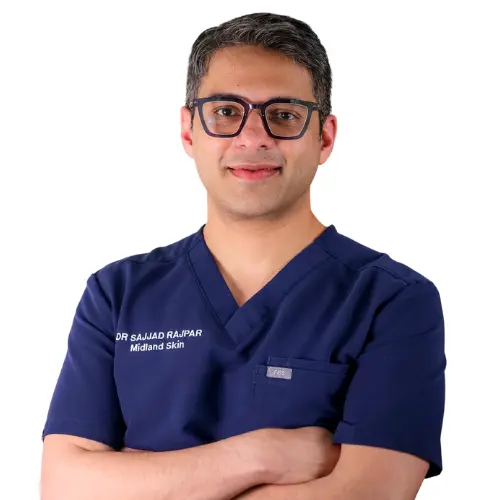
This page has been written and/or medically reviewed by Dr Sajjad Rajpar, Consultant Dermatologist and Medical Director of Midland Skin, Birmingham.
Dr Rajpar is on the GMC Specialist Register in Dermatology and has over 20 years’ experience in clinical dermatology. He provides clinical oversight to ensure the information on this page is accurate, balanced and consistent with current dermatology practice.
Dr Sajjad Rajpar
Date last updated: 30th Sep 2026
Book in with us
Expert, consultant led care in dermatology, skin surgery, eyelid surgery, lasers and aesthetics.
Disclaimer
The content on this website is provided for general information only. It is not, and must not be treated as, medical advice, a diagnosis, or a recommendation for any particular treatment. We make reasonable efforts to keep information accurate and up to date, but medicine and technology change, and content may not reflect the most current evidence, guidance, product information, or individual practice. You should not rely on this website to make decisions about your health or treatment. Always seek personalised advice from an appropriately qualified healthcare professional. Any examples, images, testimonials, and outcome descriptions are illustrative only. Results vary between individuals and no outcome can be guaranteed.


