
Fibrous papule of the nose and face
Specialist assessment and treatment for fibrous papules
At Midland Skin we offer fibrous papule of the nose and face treatment for patients in Birmingham, Solihull, Coventry, Wolverhampton, Worcester and the Midlands.


Quick Facts about fibrous papules

Best for
Suspected fibrous papule

Appointment
Initial dermatology assessment

Treatment
Shave excision or cautery

Symptoms
Bump on nose/face
Provider
Consultant dermatologist or surgeon

Price
See below
What is a fibrous papule?
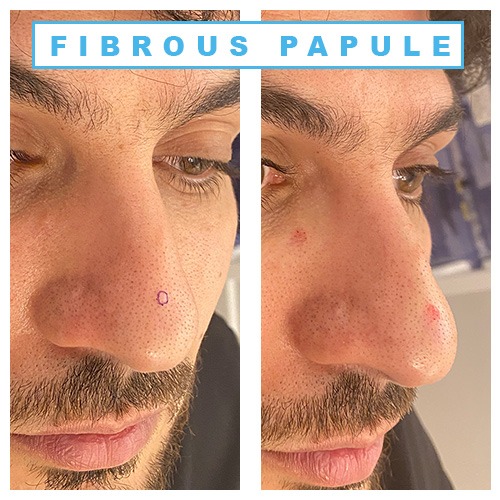
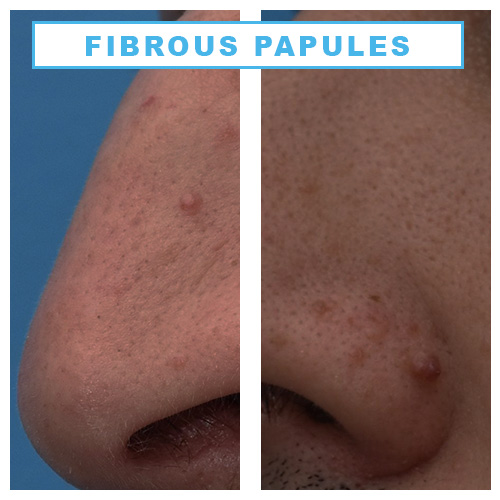
A fibrous papule is a small, benign skin growth that usually develops on or around the nose, although it can occur elsewhere on the face.
It is usually a single, firm, smooth or dome-shaped bump measuring only a few millimetres across. It may be skin-coloured, pink or red and usually causes no symptoms.
Fibrous papules are harmless and do not become skin cancer. They tend to remain present unless they are removed.
When should I see a dermatologist for a fibrous papule?
Specialist assessment is particularly useful when you have a small growth on the nose or face and are not certain what it is, or when you are considering having it removed. An assessment is particularly worthwhile when:
- you are unsure whether the lesion is actually a fibrous papule
- the lesion is new, changing or becoming more noticeable
- it has bled, crusted or changed in appearance
- previous treatment has not removed it completely
- you would like it removed but want to understand the likely scar or cosmetic result first
The nose is a cosmetically sensitive area, so it is important to establish the likely diagnosis and discuss the trade-off between the existing lesion and the mark that may remain after removal.

Scarlett Greenwood

Why getting the diagnosis right matters
Sometimes it is possible for an expert to diagnose a fibrous papule at a clinical examination. However it can be difficult to distinguish a fibrous papule from other growths of the skin such as a mole, tumour of the hair follicle or skin cancers such as basal cell carcinoma. More information on other growths that may resemble fibrous papules can be found here.
A dermatologist can assess the lesion and decide whether its appearance is typical of a fibrous papule. If there is uncertainty about the diagnosis, removal in a way that allows the tissue to be examined under the microscope may be recommended.
This is important because simply destroying a lesion cosmetically would not provide a tissue diagnosis.
Treatment pathway
Initial dermatology assessment
The lesion is examined to assess whether it is a fibrous papule and whether removal is appropriate.
Treatment
A fibrous papule can be scraped or shaved off, or cauterised. It is sent for histological testing if it is not possible to distinguish it from a skin tumour.
Review consultation
A review consultation is optional and can be arranged where appropriate to assess healing, the treatment result or discuss a histology result.
Why do fibrous papules occur?
A fibrous papule contains fibrous tissue, collagen and small blood vessels and is considered a type of solitary angiofibroma.
The exact reason why an individual fibrous papule develops is not fully understood. They usually occur as a single lesion in adults and are not caused by infection or anything that you have done to your skin.
A solitary fibrous papule is benign and has no malignant potential.
How is a fibrous papule treated at Midland Skin?
A fibrous papule can be scraped (or shaved) off or cauterised. It is always sent for histological testing if it is not possible to distinguish from a skin tumour.
What happens during fibrous papule removal?
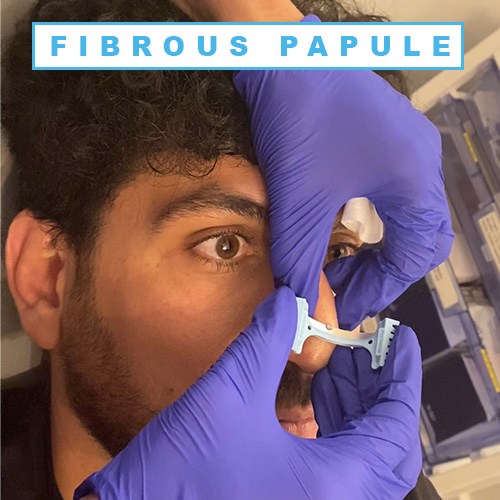
- Two methods are used for removal of fibrous papules.
- Scrape excision. The fibrous papule is scraped/shaved off. The wound is then cauterised.
- Cautery. The fibrous papule is focally burnt off using electrosurgery with a very fine tip.
- A local anaesthetic injection is used.
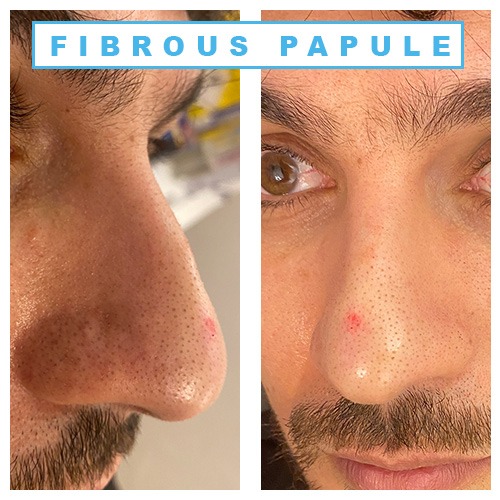
- A very superficial wound results. This is covered with Vaseline, and will scab over and heal over a period of a few days usually between 5 to 7 days. A dressing is not required unless it is in an area that is prone to rubbing or chafing in which case a dressing is used to protect the skin until it has healed.
- Histological testing may be required.
- Fibrous papules may occasionally recur once they have been treated.
- A small scar with a change in texture and skin colour may be noted on close up examination at the location from which the fibrous papule was removed.
Book in with us
Ready to get started? Book a consultation with our team at Midland Skin. Friendly, expert advice tailored to you.
Fibrous papule removal: practical FAQs
Can I have a fibrous papule assessed and removed on the same day?
Selected fibrous papules may be suitable for assessment and removal at the same appointment. If you would like same-day treatment, this should be indicated when you make your enquiry and you will be asked to provide photographs.
Same-day treatment must be offered in advance and cannot be assumed. Not every lesion is suitable, particularly where the diagnosis is uncertain, the location or size means that removal may carry a higher risk of visible scarring or other cosmetic change, or a different treatment approach may be more appropriate. Where there are greater cosmetic considerations, a separate assessment is required before treatment is planned.
Where a same-day procedure has been offered, the initial assessment is included within the first-lesion procedure fee. If the procedure does not go ahead following the assessment, the full initial assessment fee applies.
How does the skin heal following fibrous papule removal?
A small scab will develop in the treated area which will go after 5 days. You will be asked to apply Vaseline four times a day.
What is the aftercare and recovery following fibrous papule removal?
We ask you to avoid heavy exercise or anything strenuous for the rest of the day. The areas that have been treated need to be kept clean and dry. You can cleanse them once or twice a day with water and a cotton pad. People can usually return to an office job straight away. Wounds in areas that are prone to rubbing or chafing are covered with a splash proof dressing.
What are the risks of having a fibrous papule removal procedure?
Will I need a histology test?
Histological testing may be required and will be determined at your assessment.
Is a review appointment required?
A review consultation is optional and can be arranged where appropriate following treatment.
Ashley Cooper
Other skin lesions
Our clinic also offers removal of genital skin tags, moles, cysts, warts and seborrhoeic keratoses, sebaceous gland hyperplasia.
Fees for fibrous papule
Fibrous papule Show pricing
Book ConsultationInitial dermatology assessment
Shave excision (first lesion)
Shave excision (subsequent lesions)
Shave excision – first lesion, with histology
Shave excision – subsequent lesions, with histology
Same-day assessment and treatment
Selected fibrous papules may be suitable for assessment and removal at the same appointment. Where a same-day procedure has been offered in advance, the initial assessment is included within the first-lesion procedure fee shown above.
Not all lesions are suitable for same-day treatment. If the procedure does not go ahead following assessment, the full initial assessment fee applies.
Full details of our same-day procedure pathway are available here.
References used for this article
[References to be inserted]
About the Author
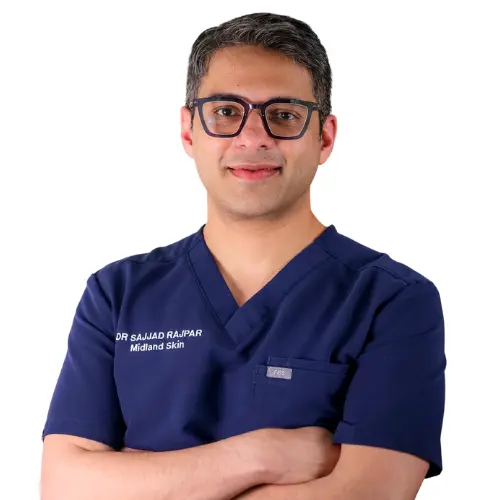
This page has been written and/or medically reviewed by Dr Sajjad Rajpar, Consultant Dermatologist and Medical Director of Midland Skin, Birmingham.
Dr Rajpar is on the GMC Specialist Register in Dermatology and has over 20 years’ experience in clinical dermatology. He provides clinical oversight to ensure the information on this page is accurate, balanced and consistent with current dermatology practice.
Dr Sajjad Rajpar
Date last updated: 25th Aug 2026
Book in with us
Expert, consultant led care in dermatology, skin surgery, eyelid surgery, lasers and aesthetics.
Disclaimer
The content on this website is provided for general information only. It is not, and must not be treated as, medical advice, a diagnosis, or a recommendation for any particular treatment. We make reasonable efforts to keep information accurate and up to date, but medicine and technology change, and content may not reflect the most current evidence, guidance, product information, or individual practice. You should not rely on this website to make decisions about your health or treatment. Always seek personalised advice from an appropriately qualified healthcare professional. Any examples, images, testimonials, and outcome descriptions are illustrative only. Results vary between individuals and no outcome can be guaranteed.


