
What foods to eat if you have acne
If you suffer from acne, you may have some questions about the food you eat, such as:
- Will any foods give me acne?
- Which foods cause acne and pimples?
- Which foods and drinks help with acne?
- What changes can I make to my diet to help acne?
This article explains what the clinical evidence actually shows, and how much difference diet can realistically make.
Key points
- Diet alone rarely clears acne – it is a supporting factor, not a treatment
- High-glycaemic foods – sugary foods, sugary drinks and refined carbohydrates have the most consistent link with acne
- Milk – linked with acne in observational studies, including skimmed milk; yoghurt and cheese less consistently
- Whey protein supplements – reported to trigger breakouts, particularly in gym-goers and adolescents
- Chocolate – small studies suggest it may aggravate acne in some people, but the evidence is mixed
- The best approach – a healthy, balanced diet overall, alongside proper acne treatment
The link between food and acne – the theory
To understand how food might affect acne, it helps to know how a spot forms. Pimples develop when four things happen together:
- Excess sebum production – the sebaceous gland produces too much oil
- Hyperkeratinisation – the hair follicle becomes clogged so the sebum cannot escape
- Cutibacterium acnes – a bacterium normally found on the skin overgrows in the blocked follicle
- Inflammation – the immune system reacts to the blocked, oil-filled, bacteria-laden follicle
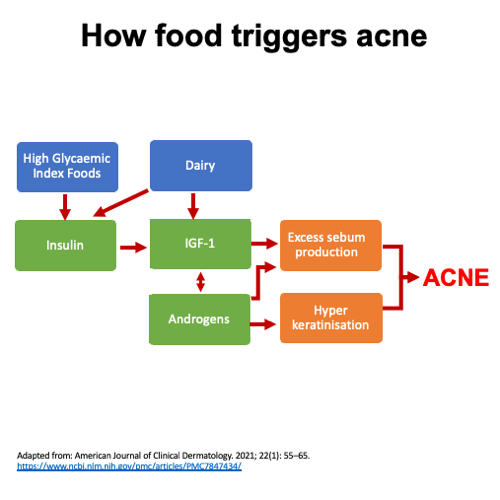
The diagram shows how food could feed into this process. Carbohydrates with a high glycaemic index and dairy products may raise insulin, insulin-like growth factor 1 (IGF-1) and androgen hormones, all of which drive sebum production and blocked pores.
The link between food and acne – the clinical studies
Although there are plausible pathways by which food could aggravate acne, the relationship has not always been borne out in studies. Several show conflicting or inconsistent findings.
This is partly because of how dietary research is done. Many studies rely on people with acne remembering what they have eaten, which is not always accurate. Most are small, short, and include very different groups of patients in different parts of the world. The findings of any single study therefore do not apply neatly to everyone with acne.
This is also why UK guidance (NICE, 2021) does not recommend a specific “acne diet”. NICE reviewed the trials of low-glycaemic diets, found some evidence of benefit, but did not consider it strong enough to recommend over general healthy eating.
However, general trends can be seen, and these can help shape a sensible eating plan.
Carbohydrates and acne
The carbohydrates in our diet are sugars, starch and fibre. Sugars and starch are broken down into glucose, which enters the bloodstream and is used for energy.
When glucose is absorbed, the body produces insulin. If a lot of glucose is absorbed quickly, insulin levels surge. Insulin raises IGF-1 and androgen levels, which can flare acne. The glycaemic index helps to identify which foods cause insulin to spike.
What is the glycaemic index (GI), and how does it affect acne?
The glycaemic index (GI) rates foods from 0 to 100 according to how quickly they raise blood glucose after eating. Pure glucose scores 100. Most fruits, vegetables, nuts, pulses and unsweetened milk have a low GI of around 55 or below.
The lower the GI, the slower blood glucose rises, and the smaller the effect on insulin, IGF-1 and androgens.
Foods with a high glycaemic index include
- Sugar and sugary foods
- Sugary soft drinks
- White bread
- White rice
- White flour
- Potatoes
Foods with a low or medium glycaemic index include
- Pulses
- Wholegrain foods such as porridge
- Most fruits and vegetables
Which carbohydrates to choose for acne
A number of studies, including small randomised trials, have found that a low-glycaemic-load diet can reduce acne severity, and that people with more severe acne tend to eat a higher-glycaemic diet. Of all the dietary factors studied, this is the most consistent finding.
Cutting down on sugary foods, sugary drinks and refined carbohydrates such as white bread, white pasta and white rice, and replacing them with wholegrain versions, legumes and vegetables, is therefore a reasonable change to make if you have acne.
A few precautions: foods with a high GI are not necessarily unhealthy, and not every low-GI food is healthy. Acne seldom clears with dietary change alone, so it is better to focus on the overall quality of your diet than on GI values.
How does dairy affect acne?
Milk has a low glycaemic index, but several studies suggest it may still aggravate acne in some people. Milk contains hormones and growth factors, including IGF-1, and milk proteins stimulate insulin release. Together these may increase androgen activity, sebum production and blocked pores.
Large pooled analyses of observational studies have found an association between milk intake and acne. The link appears at least as strong for skimmed milk as for whole milk, so it is not simply about fat content. The evidence for yoghurt and cheese is less consistent. These studies show an association rather than proof that milk causes acne.
Swapping to a milk alternative is not automatically the answer. Several oat and rice milks have a high GI compared with unsweetened soya, almond, cashew or hemp milk. For most people, reducing the total amount of dairy is more sensible than cutting it out completely.
Should I give up chocolate for acne?
The evidence on chocolate is mixed. Some small, short-term studies found that acne-prone people developed more spots after eating chocolate – including dark chocolate and pure cocoa – while another found an effect from white chocolate but not dark. Because chocolate products vary so much, it is not clear whether cocoa itself, added sugar, milk or a combination is responsible.
Milk chocolate combines a high sugar content with dairy, so it is the most likely to trigger the insulin and IGF-1 pathway. Dark chocolate has a lower GI, but the studies above suggest it is not necessarily “safe” for acne either.
There is no need to eliminate chocolate altogether. If you notice your acne flares after chocolate, cut back. Otherwise, moderation as part of a healthy diet is sensible.
Protein and acne
Good-quality protein is an important part of a healthy diet. The problem tends to arise with protein supplements, particularly whey protein.
Whey is a by-product of cheese production. Because it comes from milk, it acts on the same pathways as dairy, raising insulin and IGF-1. Several reports and small studies have linked whey protein supplements with new or worsening acne, most often in gym-goers and adolescent boys, particularly when the powder is mixed with milk.
If you use protein supplements and have acne, it may be worth switching to a non-whey option such as pea protein, or reducing the amount, and seeing whether your skin improves over a few months.
Fats and acne
Several studies have reported a trend for acne to flare with a higher intake of fried foods and fatty, sugary products. In a French cohort of over 24,000 adults, a “fatty and sugary” dietary pattern was associated with current acne.
Omega-3 fatty acids, found in oily fish, nuts and seeds, may reduce inflammation, but trials of omega-3 supplements for acne have been small and inconsistent. Omega-3 is not an established acne treatment. Choosing unsaturated fats over saturated and fried foods is, however, a reasonable part of a healthy diet.
Which changes to your diet should you make to improve acne?
The relationship between diet and acne is complex and not fully understood. Diet may help you control acne, but it is rarely possible to clear acne with dietary changes alone. Think of diet as a supporting factor, alongside good skincare, stress management and proper medical treatment.
It is never a good idea to delay medical treatment for acne in the hope that a diet will clear it. Active acne can leave permanent scarring, whereas dietary changes take months to have any effect.
If a particular food reliably flares your acne, avoid it. For most people, though, there is no single “good” or “bad” food for acne. It is better to look at your eating pattern as a whole. A healthy diet for acne is not very different from a healthy diet for preventing diabetes, obesity and heart disease.
A healthy diet for acne
- Limit sugary foods and drinks – these have a high glycaemic index
- Swap refined carbohydrates – white bread, rice and pasta for wholegrain versions
- Add fibre, vegetables and legumes – lower GI and more filling
- Reduce large amounts of dairy – particularly milk; there is no need to cut it out entirely
- Avoid large amounts of whey protein – or switch to a non-whey alternative
- Choose unsaturated fats – from fish, nuts and avocado rather than fried and fatty foods
- Keep to your calorie needs – with a balance of carbohydrates, protein and fat
- Give it time – at least 10 to 12 weeks before judging any effect
Dietary changes need to be followed consistently for at least 10 to 12 weeks – the length of the clinical trials – before you can judge whether they are helping. A registered dietitian can help if you find it difficult to make sustainable changes.
One word of caution: cutting out whole food groups is not necessary and can do more harm than good. If you have, or have had, an eating disorder, please discuss any dietary changes with your GP or dermatologist first.
When to see a dermatologist about acne
If your acne is persistent, painful, leaving marks or scars, or affecting your confidence, effective prescription treatments are available and diet should not be the only thing you rely on. A consultant dermatologist can assess the type and severity of your acne and put together a treatment plan.
Find out more about our acne consultations and treatments.
References used for this article
- National Institute for Health and Care Excellence. Acne vulgaris: management. NICE guideline NG198. 2021.
- Meixiong J, Ricco C, Vasavda C, Ho BK. Diet and acne: a systematic review. JAAD Int. 2022;7:95–112. doi:10.1016/j.jdin.2022.02.012.
- Penso L, Touvier M, Deschasaux M, et al. Association between adult acne and dietary behaviors: findings from the NutriNet-Santé prospective cohort study. JAMA Dermatol. 2020;156(8):854–862. doi:10.1001/jamadermatol.2020.1602.
- Baldwin H, Tan J. Effects of diet on acne and its response to treatment. Am J Clin Dermatol. 2021;22(1):55–65. doi:10.1007/s40257-020-00542-y.
- Juhl CR, Bergholdt HKM, Miller IM, et al. Dairy intake and acne vulgaris: a systematic review and meta-analysis of 78,529 children, adolescents, and young adults. Nutrients. 2018;10(8):1049. doi:10.3390/nu10081049.
- NHS. What is the glycaemic index (GI)? nhs.uk
About the Author
This page has been written and/or medically reviewed by Dr Sajjad Rajpar, Consultant Dermatologist and Medical Director of Midland Skin, Birmingham.
Dr Rajpar is on the GMC Specialist Register in Dermatology and has over 20 years’ experience in clinical dermatology. He provides clinical oversight to ensure the information on this page is accurate, balanced and consistent with current dermatology practice.
Dr Sajjad Rajpar
Published: 9th Aug 2021
Date last updated: 26th Sep 2026

Book in with us
Expert, consultant led care in dermatology, skin surgery, eyelid surgery, lasers and aesthetics.


