
Hyperpigmentation and Acne
Consultant dermatologist-led assessment and treatment for pigmentation caused by acne
At Midland Skin we offer specialist acne pigmentation treatment for patients in Birmingham, Solihull, Coventry, Wolverhampton, Worcester and the Midlands.


Quick Facts about acne pigmentation

Best for
Dark marks left by acne

Appointment
Initial dermatology assessment

Assessment
Pigment, redness or scarring

Treatment
Skincare, prescription & procedures

Provider
Consultant dermatologist

Price
See below
Hyperpigmentation and acne
Hyperpigmentation from acne is a common problem in which brown, grey or black marks remain after acne spots have settled. It can affect anyone, but is particularly common and may last longer in people with darker skin tones.
The marks are called post-inflammatory hyperpigmentation. They are not the same as acne scars: pigmentation changes the colour of otherwise flat skin, whereas scarring changes its texture or contour. Some people have pigmentation, redness and scarring at the same time.
At Midland Skin, assessment looks at both the marks and the acne that caused them. Treating active acne is important because every new inflamed spot can leave another persistent mark.
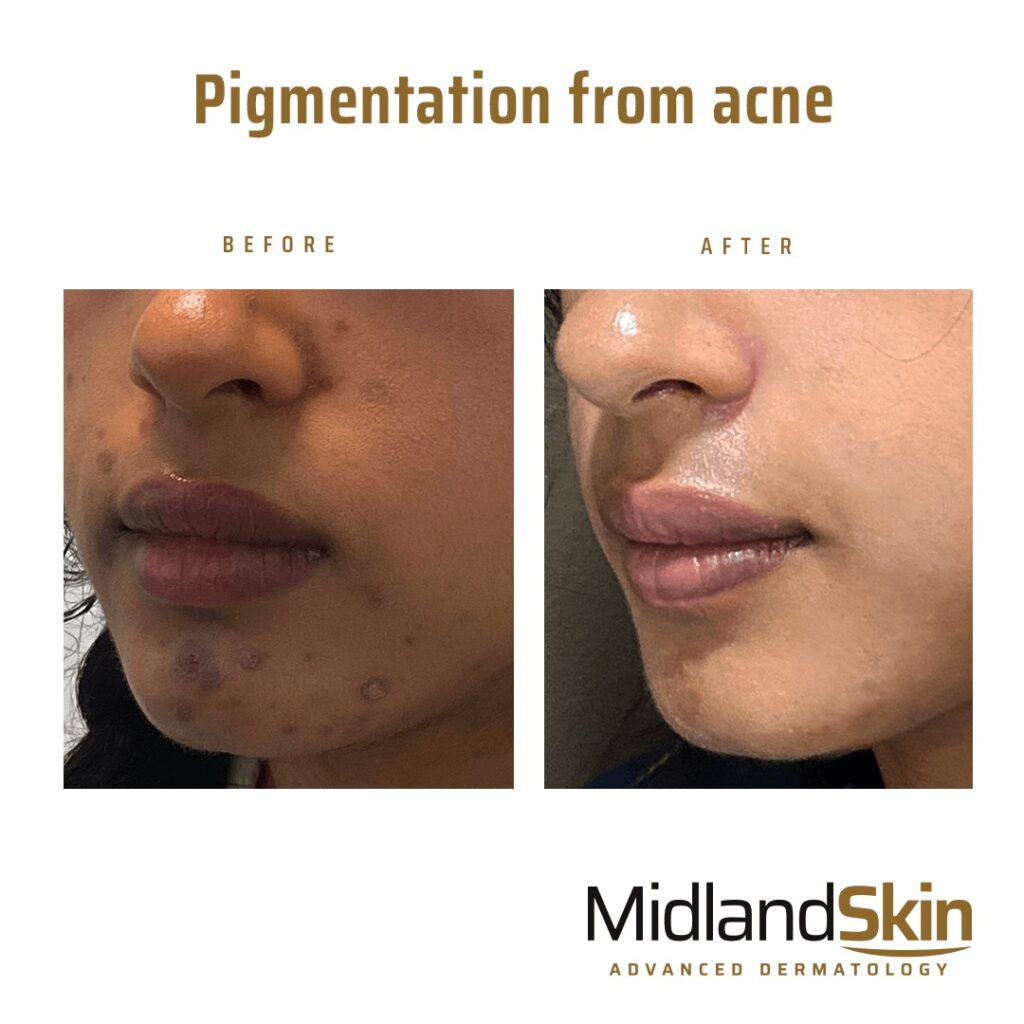
When should I see a dermatologist for acne pigmentation?
Specialist assessment is particularly worthwhile when:
- new acne spots keep leaving dark marks
- pigmentation is persistent or becoming more noticeable
- pharmacy or prescribed treatments have not helped enough
- your skin becomes irritated or darker with treatment
- you are unsure whether the marks are pigmentation, redness or acne scarring
- you may have another cause of pigmentation, such as melasma
- the marks are affecting your confidence or quality of life
- you want advice about prescription treatment, chemical peels or laser
What is hyperpigmentation?
Hyperpigmentation means that an area of skin contains more melanin, the pigment that gives skin its colour. This creates a darker spot or patch. Acne is a common cause, but pigmentation can also follow other forms of inflammation or be related to sun exposure, hormonal changes, medication or another skin condition. Getting the cause right matters because different types of pigmentation need different treatment.

Scarlett Greenwood

Why does acne cause hyperpigmentation?
Acne is one of the most common causes of post-inflammatory hyperpigmentation. When a spot develops, inflammation in the skin can stimulate pigment-producing cells to make more melanin. The red acne lesion may then leave a brown, grey or black mark as it heals.
Some pigment remains in the upper layer of the skin, the epidermis. Inflammation can also cause pigment to sit more deeply in the dermis, where it often appears grey-brown and may take longer to fade.
When pigmentation follows any form of skin inflammation, including acne, it is called post-inflammatory hyperpigmentation.
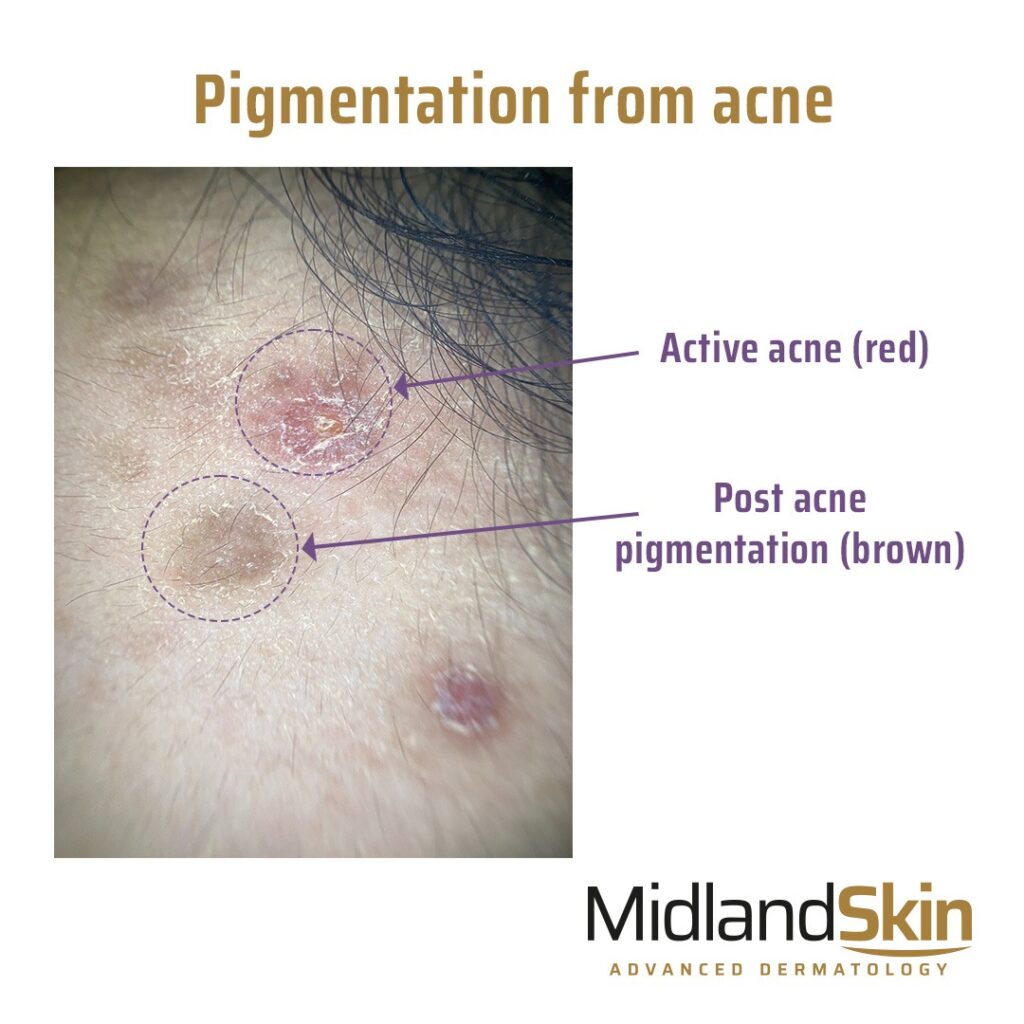
Even mild acne can lead to hyperpigmentation
Pigmentation from acne can be very distressing. Many of our patients tell us that the pigmentation is more challenging to deal with, both physically and emotionally, than the acne that caused it. Even mild acne can leave persistent pigmentation, so someone who develops only one or two deep spots a month may still accumulate marks that last much longer than the spots themselves.
Book in with us
Ready to get started? Book a consultation with our team at Midland Skin. Friendly, expert advice tailored to you.
Who is prone to hyperpigmentation from acne?
Hyperpigmentation from acne can develop in anyone, including people whose acne is relatively mild. It is more common and often more persistent in darker skin tones.
In a 2016 study of people attending dermatologists for acne across seven Asian countries, 58.2% had post-inflammatory hyperpigmentation. Studies in other populations have reported still higher rates, showing how common the problem can be.
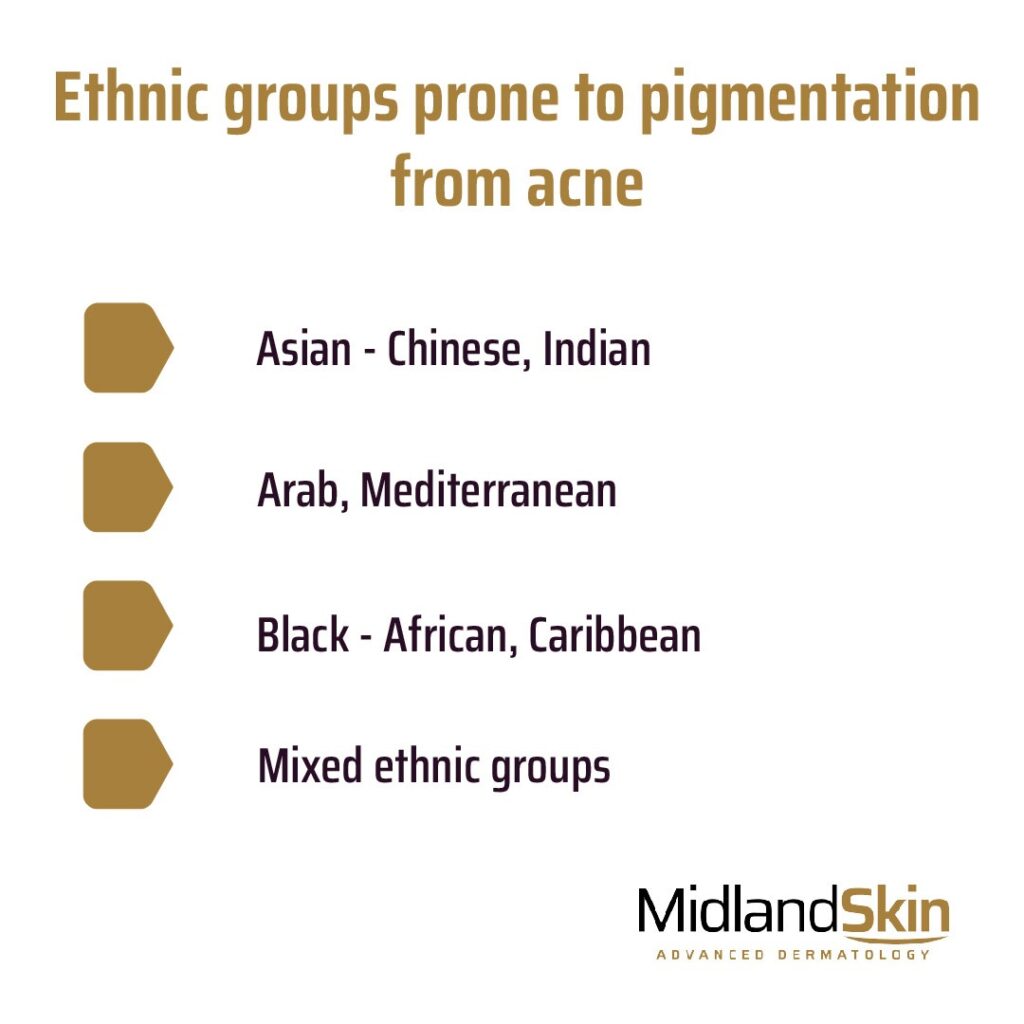
Ethnic groups prone to hyperpigmentation from acne
People from ethnic groups with darker skin tones are particularly prone to post-inflammatory hyperpigmentation. This includes many people with Asian — including Chinese and Indian — Black, Arab, Mediterranean or mixed ethnic backgrounds.
This does not mean every treatment is unsuitable for darker skin. It means the treatment and its intensity need to be chosen carefully to improve pigmentation without creating unnecessary irritation or inflammation.
How long does hyperpigmentation from acne last?
Acne pigmentation may fade, but the time this takes varies with the degree and depth of inflammation, skin tone, sun exposure and whether new acne is still developing.
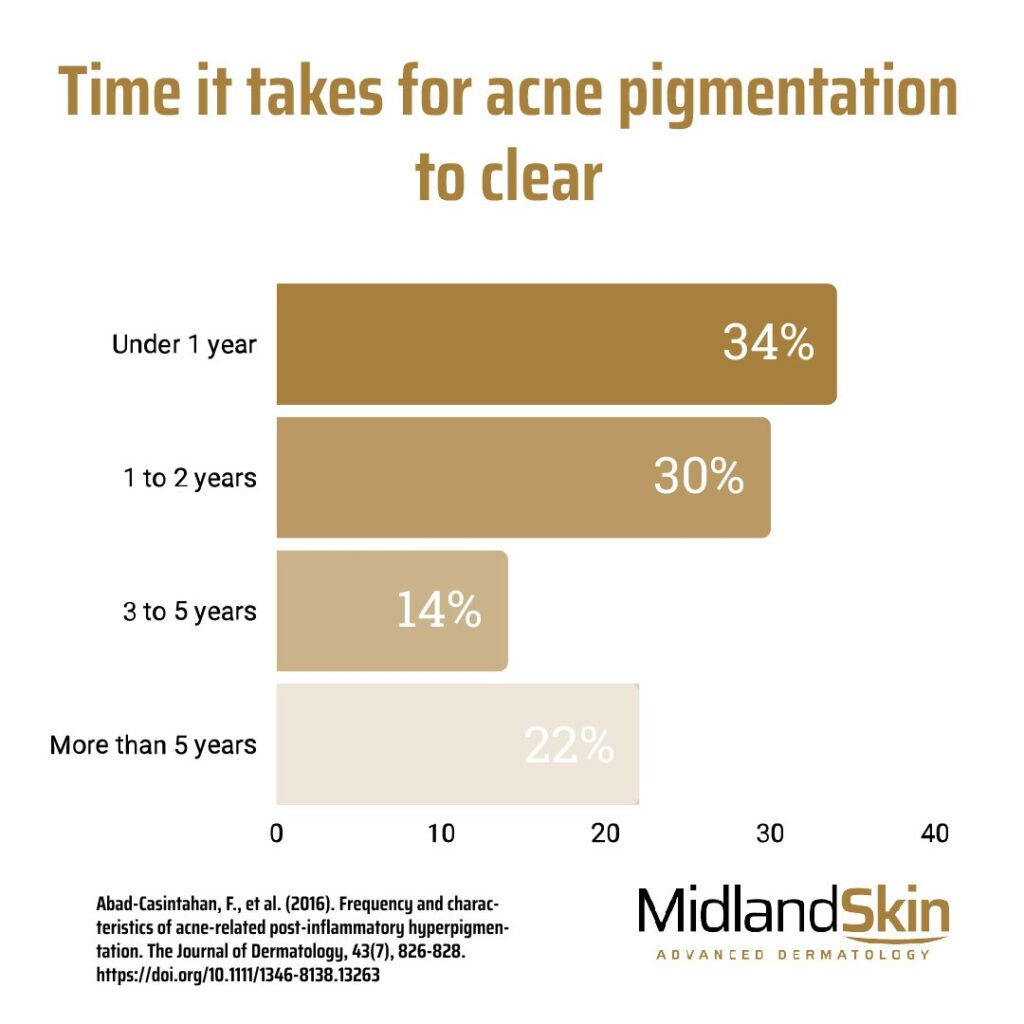
A 2016 clinical study found that acne pigmentation took:
- up to 12 months to clear in 34% of individuals
- 1–2 years to clear in 30% of individuals
- 3–4 years to clear in 14% of individuals
- five years or longer in 22% of individuals
This means pigmentation can be very long-lasting for some people. Treatment is intended to reduce new marks and help existing pigmentation fade more effectively, but improvement is gradual rather than immediate.
Natalie Knight-Wickens
What is the difference between post-inflammatory erythema (redness) and hyperpigmentation from acne?
When acne heals, it can leave red or purple areas that last for weeks or months. This is called post-inflammatory erythema and relates mainly to changes in small blood vessels. Post-inflammatory hyperpigmentation is caused by melanin and appears brown, grey or black.
Many people have both redness and pigmentation at the same time. The distinction matters because vascular laser may be used for persistent redness, while pigment needs a different treatment approach.
What is the difference between acne pigmentation and acne scarring?
Acne pigmentation and acne scarring are different, although it is possible to have both at the same time.
Acne pigmentation is a change in skin colour after acne. The skin remains flat. Acne scarring changes the texture or contour of the skin, creating dips, indentations, pits or raised areas.
Scarring needs a separate assessment because treatments that fade colour do not correct a change in skin structure. Learn more about acne scar treatment at Midland Skin.
What can you do to reduce post-inflammatory hyperpigmentation?
Treat the acne first
The most important step is to treat the underlying acne early and effectively. This prevents new inflamed spots from creating more pigmentation while existing marks are being treated. Depending on your acne, options may include prescription creams, tablets and in-clinic treatments.
RELATED: Acne and acne treatment.
Do not pick
Picking or squeezing acne increases inflammation and makes persistent pigmentation and scarring more likely.
Treatments that target acne and pigmentation together
A treatment plan may use options that control active acne while helping existing marks fade:
- Topical retinoids, including tretinoin, help prevent blocked pores and new acne lesions while encouraging gradual improvement in pigmentation. They are introduced carefully to protect the skin barrier and minimise irritation.
- Azelaic acid helps reduce acne inflammation and excess pigment production. Prescription-strength preparations may be considered where appropriate.
- Other acne treatment, such as benzoyl peroxide or oral medication, may be needed to stop new inflammatory lesions and therefore prevent new marks.
Additional treatments for pigmentation
Once the type and depth of pigmentation have been assessed, additional options may include:
- Sun protection. Sunlight and visible light can make pigmentation darker and slow its improvement. Daily broad-spectrum SPF 50+, together with hats and shade, is an important part of treatment.
- Prescription pigment-reducing creams. Ingredients such as hydroquinone or cysteamine may be used in selected patients to reduce excess pigment production.
- Chemical peels. Carefully selected peels can support the gradual removal of excess pigment and may also help active acne. A course is often needed.
- Laser treatment. For suitable patients, a specialist laser programme can target persistent pigment. The laser, settings and timing are selected for the pigmentation and skin tone following a laser treatment consultation.
Not everyone needs every part of this approach. Your dermatologist will explain which treatments are suitable, what should be prioritised and what improvement is realistic for your skin.
Treatment pathway
Initial assessment
A consultant dermatologist examines your skin and distinguishes pigmentation from redness, scarring and other causes of facial pigmentation.
Your treatment plan
Your dermatologist explains how to control active acne, protect your skin and treat existing marks. You can take time to consider the options before deciding what to pursue.
Treatment and review
Treatment is introduced in stages and reviewed as the acne settles and pigmentation fades. Laser or procedures are arranged separately when appropriate.
Acne pigmentation treatment: FAQs
Who will assess me?
A consultant dermatologist on the GMC specialist register will assess your acne, pigmentation and skin before recommending treatment.
Which appointment should I book?
If you still have active acne, are unsure what the marks are or want a medical treatment plan, book an initial dermatology assessment. If your acne is controlled and you specifically want laser for pigmentation, book a laser treatment consultation.
Can acne and pigmentation be treated at the same time?
Often, yes. Controlling active acne is the priority because new spots can create new marks. Some treatments, including topical retinoids and azelaic acid, can address acne and pigmentation together, while other pigment treatments may be added later.
Will laser remove acne pigmentation?
Laser can be helpful for selected types of persistent pigmentation, but it is not the right first treatment for everyone. Suitability depends on the type and depth of pigment, skin tone, active acne and previous treatment. This is assessed at a laser treatment consultation.
How quickly will acne pigmentation improve?
Improvement is gradual and usually measured over months rather than days. The timescale varies with the depth of pigment, skin tone, treatment used and whether new acne is still developing.
Is acne pigmentation the same as acne scarring?
No. Pigmentation changes the colour of flat skin, while scarring changes its texture or contour. Many people have both, but they need different treatment plans.
Why choose Midland Skin?
- Consultant-led assessment — your diagnosis and medical treatment plan are made by a consultant dermatologist
- Acne and pigmentation considered together — reducing new breakouts is built into the plan
- Experience across skin tones — treatment is adjusted for your skin and risk of further pigmentation
- Medical and procedural options — prescription skincare, chemical peels and specialist laser treatment are available where appropriate
- Accurate distinction between marks — pigmentation, redness and scarring are identified before treatment is planned
Book in with us
Ready to get started? Book a consultation with our team at Midland Skin. Friendly, expert advice tailored to you.
Fees
Acne pigmentation treatment Show pricing
Book ConsultationInitial acne assessment
Up to 25 minutes
Review consultation
Standard, up to 20 minutes
References used for this article
- Taylor S, Elbuluk N, Grimes P, et al. Treatment recommendations for acne-associated hyperpigmentation: Results of the Delphi consensus process and a literature review. J Am Acad Dermatol. 2023;89(2):316–323. doi:10.1016/j.jaad.2023.02.053.
- Elbuluk N, Grimes P, Chien A, et al. The Pathogenesis and Management of Acne-Induced Post-inflammatory Hyperpigmentation. Am J Clin Dermatol. 2021;22(6):829–836. doi:10.1007/s40257-021-00633-4.
- Abanmi A, Al-Enezi M, Al Hammadi A, et al. Survey of acne-related post-inflammatory hyperpigmentation in the Middle East. J Dermatolog Treat. 2019;30(6):578–581. doi:10.1080/09546634.2018.1542807.
- Abad-Casintahan F, Chow SKW, Goh CL, et al. Frequency and characteristics of acne-related post-inflammatory hyperpigmentation. J Dermatol. 2016;43(7):826–828. doi:10.1111/1346-8138.13263.
About the Author
This page has been written and/or medically reviewed by Dr Sajjad Rajpar, Consultant Dermatologist and Medical Director of Midland Skin, Birmingham.
Dr Rajpar is on the GMC Specialist Register in Dermatology and has over 20 years’ experience in clinical dermatology. He provides clinical oversight to ensure the information on this page is accurate, balanced and consistent with current dermatology practice.
Dr Sajjad Rajpar
Date last updated: 24th Sep 2026

Book in with us
Expert, consultant led care in dermatology, skin surgery, eyelid surgery, lasers and aesthetics.
Disclaimer
The content on this website is provided for general information only. It is not, and must not be treated as, medical advice, a diagnosis, or a recommendation for any particular treatment. We make reasonable efforts to keep information accurate and up to date, but medicine and technology change, and content may not reflect the most current evidence, guidance, product information, or individual practice. You should not rely on this website to make decisions about your health or treatment. Always seek personalised advice from an appropriately qualified healthcare professional. Any examples, images, testimonials, and outcome descriptions are illustrative only. Results vary between individuals and no outcome can be guaranteed.


