
Specialist skin surgery consultation
A consultant-led assessment to determine whether surgery is appropriate and plan it properly


Quick Facts about specialist skin surgery consultations

Best for
Concerns that may require surgery

Purpose
Diagnosis, suitability and planning

Treatment
Arranged separately if appropriate

Possible outcomes
Surgery, another approach or no treatment
Consultant
Consultant surgeon

Price
See below
What is a specialist skin surgery consultation?
A specialist skin surgery consultation is an assessment for a skin lesion, lump, growth or other concern that may require a procedure.
This can include moles, cysts, lipomas, benign skin growths, lesions requiring a biopsy, suspected or confirmed skin cancers, recurrent lesions and concerns in cosmetically or anatomically sensitive areas.
The consultation considers the likely diagnosis, whether surgery is appropriate and how any procedure should be undertaken.
Why do I need a consultation if I already know what it is?
Identifying what a skin lesion may be is only one part of deciding whether surgery is appropriate.
For example, a lump that appears to be a cyst may have a different diagnosis, may be inflamed, may not require removal or may need a different type of procedure. Its size, location, previous treatment and relationship to the surrounding skin can all affect how it should be managed.
Your general health, medication, healing history and tendency to develop noticeable scars may also influence whether surgery is advisable and the likely result.
The clinician accepting responsibility for your procedure must assess the concern and plan it properly.
This is the first stage of safe, properly planned surgery—not simply an administrative step before booking a procedure. Previous advice from your GP or another clinic is useful, but it does not replace the assessment by the Midland Skin clinician responsible for your care. Being offered a consultation does not mean that you will necessarily need surgery or that the procedure you initially had in mind will be suitable.
Consultant-led surgical assessment
Midland Skin has several consultant surgeons with different areas of procedural expertise.
Your concern will be assessed by an appropriate consultant. If another member of the team would be better placed to undertake your treatment, this will be explained as part of your care plan.
What happens during the consultation?
Your consultant will review the history of the concern, examine the affected area and discuss what you are hoping to achieve.
- The likely diagnosis
- Whether surgery is necessary or advisable
- Whether this is the right time to operate
- The most appropriate type of procedure
- The likely scar and cosmetic outcome
- Relevant risks, recovery and downtime
- The possibility of incomplete removal or recurrence
- Whether tissue should be sent for laboratory analysis
- Whether further investigation or another specialist opinion is required
- How your health, medication or previous scarring may affect treatment
A medical assistant will be present throughout the consultation. Clinical photographs are a routine and required part of the assessment.
Your skin surgery pathway
Surgical assessment
A consultant examines the concern, considers the likely diagnosis and assesses whether surgery may be appropriate.
Care plan
You receive an individual care plan covering the recommended procedure, likely scar, risks, recovery and fee—or advice that further assessment, another approach or no treatment would be more appropriate.
Procedure and aftercare
If surgery is recommended and you decide to proceed, the procedure is arranged for a separate appointment with the necessary preparation and aftercare.
Balancing the benefits and risks
Potential benefits of surgery
The consultation will consider:
- The likelihood of completely removing the lesion or treating the condition
- The likelihood of any symptoms resolving
- The possibility of cosmetic improvement
The potential benefit depends on the diagnosis, location and extent of the concern, the procedure used and your individual healing response.
Complete removal, cure or a particular cosmetic result cannot be guaranteed.
Risks of a skin surgery procedure
It is important to understand the risks of a procedure and take these into account when deciding whether to have surgery. The consultant will discuss the risks that apply to you. Some examples include:
- Scar formation – a surgical procedure will usually leave some form of scar, and the likely length and orientation can be discussed at the consultation.
- Discomfort – there can be discomfort after some procedures.
- Healing period and downtime – you will need to consider how healing may affect your ability to work, travel, drive and undertake other activities.
- Bleeding – there is a risk of bleeding from a wound, especially during the first 48 hours, and some people may need to take additional precautions.
- Infection – there is a risk of infection following any surgical procedure, particularly during the first week, and this may be increased by factors such as diabetes or immunosuppression.
- Delayed healing – some people may experience slower healing.
- Keloid and raised scars – some people are prone to developing elevated scars, which may require additional treatment.
- Numbness and nerve damage – altered sensation or nerve damage can occur.
- Incomplete removal or recurrence – some concerns can return or require further treatment despite an appropriate procedure.
Other risks may apply depending on the diagnosis, procedure and area being treated.

Scarlett Greenwood

No treatment may be the appropriate outcome
No treatment is an important and entirely valid possible outcome of the consultation.
The consultant may advise against surgery if treatment is unnecessary, the likely benefit is limited, monitoring is more appropriate or the risks, including the potential scar, are disproportionate to the expected benefit.
The consultation may also conclude that further investigation, another treatment or assessment by a different specialist would be more appropriate.
Reaching the conclusion that surgery is unnecessary or inadvisable is part of good medical assessment.
Before your consultation
Please bring or provide:
- An up-to-date list of your medication and allergies
- Details of any blood-thinning medication
- Relevant letters, pathology reports or previous treatment records
- Details of previous surgery or problems with healing or scarring
- Any questions you would like to discuss
Do not stop prescribed medication, including blood-thinning medication, unless an appropriate clinician has specifically advised you to do so.
Specialist skin surgery consultation FAQs
I have already seen my GP or another specialist. Do I still need a consultation?
Yes. The clinician accepting responsibility for planning or undertaking your procedure must perform their own assessment before offering surgery. Relevant correspondence, pathology results and reports can inform the assessment, but they do not replace it.
Will surgery take place at the consultation?
No. This is an assessment and planning appointment, and you should not attend expecting surgery to be performed. If a procedure is recommended, it will be arranged for a separate appointment.
Can you confirm the procedure and its cost beforehand?
We may sometimes be able to provide an indication or guide price from your enquiry or photographs, but the final procedure and fee can only be confirmed after the consultant has examined the concern.
Should I stop blood-thinning medication before the consultation?
No. Continue your prescribed medication unless an appropriate clinician has specifically advised you to stop or alter it. If surgery is recommended, any necessary instructions about medication will form part of your care plan.
Book in with us
Ready to get started? Book a consultation with our team at Midland Skin. Friendly, expert advice tailored to you.
Specialist skin surgery consultation fee
Specialist skin surgery consultation Show pricing
Book ConsultationInitial surgical assessment
The consultation fee covers the consultant’s assessment, examination, clinical photographs, clinical judgement and surgical care plan. It remains payable whether surgery, another treatment or no treatment is recommended. It is separate from, and is not deducted from, the fee for any subsequent procedure. If surgery is recommended, the procedure fee will be confirmed once the required treatment has been established. Fees for surgery include any immediate aftercare that is required, such as wound checks, dressing changes and stitch removal.
About the Author
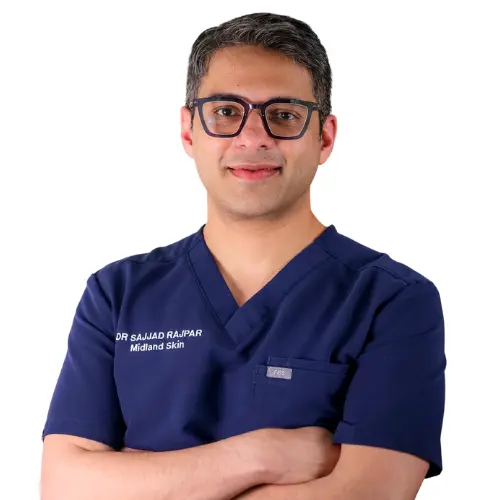
This page has been written and/or medically reviewed by Dr Sajjad Rajpar, Consultant Dermatologist and Medical Director of Midland Skin, Birmingham.
Dr Rajpar is on the GMC Specialist Register in Dermatology and has over 20 years’ experience in clinical dermatology. He provides clinical oversight to ensure the information on this page is accurate, balanced and consistent with current dermatology practice.
Dr Sajjad Rajpar
Date last updated: 29th Aug 2026
Book in with us
Expert, consultant led care in dermatology, skin surgery, eyelid surgery, lasers and aesthetics.
Disclaimer
The content on this website is provided for general information only. It is not, and must not be treated as, medical advice, a diagnosis, or a recommendation for any particular treatment. We make reasonable efforts to keep information accurate and up to date, but medicine and technology change, and content may not reflect the most current evidence, guidance, product information, or individual practice. You should not rely on this website to make decisions about your health or treatment. Always seek personalised advice from an appropriately qualified healthcare professional. Any examples, images, testimonials, and outcome descriptions are illustrative only. Results vary between individuals and no outcome can be guaranteed.


