
Fungal acne treatment in Birmingham
Our Dermatologists will be able to advise you on suitable treatments for fungal acne
At Midland Skin we offer Fungal Acne consultations with a Dermatologist for patients in Birmingham, Solihull, Coventry, Wolverhampton, Worcester and the Midlands.


Quick Facts about fungal acne

Best for
Itchy acne-like spots

Appointment
Initial dermatology assessment

Diagnosis
Clinical assessment ± tests

Treatment
Antifungal treatment

Provider
Consultant dermatologist

Price
See below
What is fungal acne?
Fungal acne is spots caused by Malassezia (formerly known as Pityrosporum). Malassezia are yeasts that are naturally found on everyone’s skin.
Malassezia yeasts can grow in hair follicles, and cause inflammation of hair follicles. This causes spots to develop and this is referred to as fungal acne. Spots may have a white head of pus, just the same as in acne.
The medical name for fungal acne is Malassezia folliculitis. Folliculitis means inflammation of hair follicles.
When should I see a dermatologist for fungal acne?
A specialist assessment can be useful when acne-like spots are persistent, itchy, recurrent or have not responded as expected to acne treatment.
- the spots are small, similar in size and itchy
- the spots affect the forehead, hairline, chest or back
- breakouts began or became worse during antibiotic treatment
- standard acne treatment has not helped
- the problem keeps returning after treatment
- you are unsure whether you have fungal acne, ordinary acne or another type of folliculitis
How do I know if I have fungal acne?
Fungal acne can look very much like ordinary acne, so it can be confusing at times. There are some clues, though.
In fungal acne, the spots are red bumps (papules) or pustules (white heads) of a similar size, usually between 1 to 2 mm. They can occur in waves and may be very itchy — often much itchier than ordinary acne spots. Fungal acne can occur anywhere on the body, but common locations are:
- Forehead, temples and frontal hairline
- Upper chest
- Upper and mid back
In contrast, ordinary acne may cause closed comedones (skin-coloured bumps), open comedones (blackheads), nodules (red lumps), cysts and pustules (spots with a pus-filled top). The spots can also vary in size.

Amy Humphries

The picture may not be as straightforward
The picture is not always clear-cut because fungal acne can be present at the same time as ordinary acne. Fungal acne itself does not usually cause comedones. If closed comedones are present, this may suggest that ordinary acne is also present, particularly on the forehead.
Why getting the diagnosis right matters
Fungal acne can resemble ordinary acne and bacterial folliculitis, and more than one condition can be present at the same time. Treatment for one will not necessarily treat the other.
Antibiotics used for acne do not treat Malassezia and may sometimes encourage fungal acne. A specialist assessment helps establish the most likely diagnosis and decide whether antifungal treatment, acne treatment or both are appropriate.
What are the triggers for fungal acne?
Fungal acne is usually more of a problem in the summer but can occur for no particular reason at any time of the year. However, there are certain triggers:
- Having very greasy skin
- Hot weather that causes sweating
- Wearing tight fitting clothes
- Sweating a lot while you exercise
- Using too much sunblock, moisturisers and make up that block hair follicles
- Having antibiotics for treating acne
What can I do to reduce the chance of getting fungal acne?
- Avoid very hot environments that make you sweat
- Wear loose fitting clothes
- Avoid putting very heavy layers of creams or make up on your face
How is fungal acne diagnosed?
Fungal acne can usually be diagnosed by a dermatologist from the history and appearance of the spots. Additional tests may sometimes be required, such as a skin scraping where material from a spot is examined under a microscope for yeast or bacterial elements. Very rarely, a skin biopsy is required, which may show yeast within the hair follicles.
How is fungal acne treated?
Fungal acne is treated by addressing any obvious trigger factors and with antifungal washes, creams or tablets. The most appropriate option depends on where the spots are, how extensive they are, whether they recur, your general health and whether ordinary acne is also present.
Fungal acne has a tendency to return, so a course of maintenance topical treatment may sometimes be recommended.
Do you treat fungal acne?
We offer diagnosis and treatment for fungal acne. We also treat patients who may have both ordinary acne and fungal acne at the same time.
Treatment pathway
Initial dermatology assessment
A consultant dermatologist examines the spots and reviews their distribution, symptoms, possible triggers, previous treatments and relevant medication.
Diagnosis and treatment plan
The diagnosis is usually clinical. Your plan may include antifungal treatment and treatment for coexisting acne where appropriate.
Review and maintenance
A review assesses your response, whether treatment should be changed or stopped, and whether maintenance treatment may help reduce recurrence.
Book in with us
Ready to get started? Book a consultation with our team at Midland Skin. Friendly, expert advice tailored to you.
Fees
Dermatology consultation Show pricing
Book ConsultationInitial dermatology assessment
Up to 25 minutes
Review consultation
Standard, up to 20 minutes
References used for this article
- Draelos ZD, Barbieri JS, Tanghetti EA, et al. Malassezia Folliculitis Presentation, Diagnosis, and Treatment: A Review of “Fungal Acne”. J Drugs Dermatol. 2026;25(5):427–434. doi:10.36849/JDD.9751.
- Saunte DML, Gaitanis G, Hay RJ. Malassezia-associated skin diseases, the use of diagnostics and treatment. Front Cell Infect Microbiol. 2020;10:112. doi:10.3389/fcimb.2020.00112.
- Pürnak S, Durdu M, Tekindal MA, Güleç AT, Seçkin D. The Prevalence of Malassezia Folliculitis in Patients with Papulopustular/Comedonal Acne, and Their Response to Antifungal Treatment. Skinmed. 2018;16(2):99–104. PMID: 29911526.
About the Author
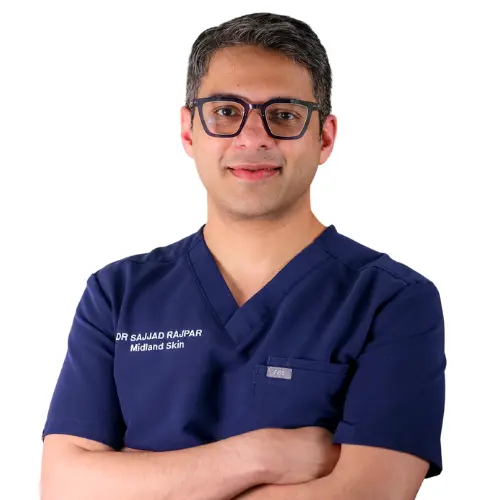
This page has been written and/or medically reviewed by Dr Sajjad Rajpar, Consultant Dermatologist and Medical Director of Midland Skin, Birmingham.
Dr Rajpar is on the GMC Specialist Register in Dermatology and has over 20 years’ experience in clinical dermatology. He provides clinical oversight to ensure the information on this page is accurate, balanced and consistent with current dermatology practice.
Dr Sajjad Rajpar
Date last updated: 24th Sep 2026
Book in with us
Expert, consultant led care in dermatology, skin surgery, eyelid surgery, lasers and aesthetics.
Disclaimer
The content on this website is provided for general information only. It is not, and must not be treated as, medical advice, a diagnosis, or a recommendation for any particular treatment. We make reasonable efforts to keep information accurate and up to date, but medicine and technology change, and content may not reflect the most current evidence, guidance, product information, or individual practice. You should not rely on this website to make decisions about your health or treatment. Always seek personalised advice from an appropriately qualified healthcare professional. Any examples, images, testimonials, and outcome descriptions are illustrative only. Results vary between individuals and no outcome can be guaranteed.


