
Subcision for Acne Scars in Birmingham
Specialist treatment to release and lift tethered acne scars
At Midland Skin, we offer consultant-led subcision for acne scars for patients from Birmingham, Solihull, Coventry, Wolverhampton, Worcester and across the Midlands. Subcision may be used alone or as part of a combined acne scar treatment plan, depending on the types of scars present.


Quick Facts about subcision

Best for
Rolling & tethered boxcar scars

Anaesthetic
Local / tumescent

Sessions
Usually 2-3

Downtime
Usually 3-4 days

Provider
Consultant dermatologist

Price
See below
What is subcision for acne scars?
Subcision is a procedure which releases scars that have become stuck to the deeper tissues and bound down.
When a scar forms, new collagen is produced. Scar collagen is not as supple or as neatly laid as normal collagen. It can stretch from the scar to the deeper tissues, like a web, and pull the surface of the skin down.
This makes the scar look more indented and causes shadows, divots and pits. Breaking these connections helps to lift the scar back up.

How does subcision work?
Subcision works by breaking down the fibres pulling the scar down. The controlled movement beneath the dermis is also thought to stimulate new collagen formation, which can help raise and remodel the scar over time.
Subcision may be carried out independently or as part of a combined acne scar treatment session.
Who is subcision suitable for?
Subcision helps improve scars where the skin is being pulled downwards by scar tissue. It may be worth considering for:
- Rolling acne scars – broad, shallow depressions with sloping edges.
- Tethered boxcar acne scars – scars that are bound down to deeper tissue.
- Scars that stay put – depressions that do not disappear when the skin is stretched or smooth over when you smile.
- Subtle tethering – even relatively minor depressions may have an underlying tethered component.
- Localised or widespread scarring – different techniques can be used for individual scars or larger areas.
- Scars on the cheeks, temples and forehead – the areas most commonly treated.
These features may suggest that subcision could be helpful, but they do not confirm suitability.
How can I tell if I need subcision?
Stretching the skin or looking at how scars change when you smile can provide clues about tethering, but it is difficult to assess acne scars reliably at home.

Which scars does subcision not help?
Subcision is not a suitable treatment for ice-pick scars. It does not treat red or pigmented acne marks, stretched scars, raised scars or keloid scars.
Subcision techniques at Midland Skin
The most appropriate technique depends on the number, location, depth and firmness of the tethered scars. It also depends on the surrounding facial anatomy and whether a small area or a wider field needs to be released.
Cannula subcision
Cannula subcision is often used for smaller or more localised areas. A small opening is made in the skin with a needle. A cannula is passed through this opening to just below the skin and used to separate the bands of scar tissue pulling the scars down.
We have cannulas of different sizes and lengths, and the dermatologist selects the most appropriate one for the area being treated. Cannulas are relatively blunt and are therefore less likely to damage blood vessels and nerves than sharp subcision instruments.
The Taylor Liberator
The Taylor Liberator was designed specifically for broader, full-field subcision. It is slightly wider and longer than disposable cannulas and can release scar tissue over a larger area.
The Taylor Liberator has three slightly blunted tips which can break through scar tissue.
For treatment of the cheeks, a small incision approximately 5 mm long is made within the sideburn area on each side. This usually heals with little visible trace.
The Taylor Liberator is passed beneath the skin in the tissue plane where the skin meets the underlying fat. It may be considered where there is extensive or deeper tethering across the cheeks.
The Nokor needle
The Nokor needle was one of the earliest devices used for subcision. We may use it where an individual scar is particularly hard and fibrotic and a sharper instrument is needed to break through it.
The Nokor needle has a small, sharp blade and is relatively short, so several insertion points may be required. Because it is sharper, bleeding, bruising and other side effects are more common than with blunt cannula or blade techniques.
The dermatologist will recommend a Nokor needle only where its additional sharpness is likely to be useful.
Tumescent anaesthesia
Tumescent anaesthesia uses a larger volume of dilute local anaesthetic. It is generally used when treating broader areas such as both cheeks.
The solution lifts the skin away from the deeper tissues, firms the treatment area and helps reduce bleeding during the procedure. It causes temporary puffiness – sometimes described as ‘chipmunk cheeks’ – which usually settles over two to three days.
The anaesthetic can temporarily reduce movement around the eyes and mouth. Blinking or pursing the lips may be difficult for approximately six to eight hours.
What results can subcision achieve?
Subcision directly releases scars that have become tethered during the acne scarring process. It can therefore improve rolling and tethered boxcar acne scars.
The degree of improvement can be in the range of 10–50%, but results vary considerably between patients and between individual scars. A particular degree of improvement cannot be guaranteed, and occasionally improvement is minimal.
An initial lift may be visible immediately, although swelling can temporarily influence the early appearance. Some scars become visible again as the swelling settles. New collagen formation and scar remodelling take time, and the result is usually assessed after approximately three to four months.
Cannula subcision may need to be repeated for different areas of the face. An area may be treated once, twice or more depending on the severity and extent of the tethering. An average patient may require two to three subcision sessions.
Some scars may remain tethered or become tethered again, making further treatment necessary.
Subcision as part of combined acne scar treatment
Sometimes a course of subcision alone may be the only treatment needed. More often, acne scarring contains several different scar types that cannot all be improved by one procedure.
Cannula subcision is frequently combined with fractional laser resurfacing during the same treatment session. Other treatments, including TCA CROSS, and punch excision may be used to treat other components of atrophic scarring and improve the surface texture. More information on combined acne scar treatment can be found here.
After Taylor Liberator subcision, laser resurfacing is carried out at a later appointment, with a minimum interval of three weeks.
What is the downtime after subcision?
The usual practical downtime is approximately three to four days. Swelling from tumescent anaesthesia normally takes two to three days to settle. It can be more noticeable around the eyes even when the eye area has not been treated.
Bruising may also develop. A small bruise following localised cannula subcision can take two to seven days to disappear, while more extensive bruising may remain visible for longer.
Many patients choose to return to work after three or four days. You may wish to allow longer before an important work or social event.
If subcision is combined with laser resurfacing or another acne scar procedure, the recovery period will be determined by the combined treatment.

What are the risks of subcision?
Subcision is a surgical procedure and has risks. The likelihood of a particular complication depends on the technique, treatment area and extent of the subcision.
Expected temporary effects include:
- Swelling and puffiness.
- Bruising and tenderness.
- Minor bleeding or seepage from an entry point.
- Temporary numbness.
- Temporary weakness around the mouth or eyes following tumescent anaesthesia.
- Small lumps beneath the skin during healing.
Temporary numbness in the subcised areas is common and can last for two to four months. Permanent numbness is very uncommon.
Less common risks include:
- A collection of blood beneath the skin, known as a haematoma, which may require further treatment.
- Infection.
- Persistent inflammatory or collagen nodules beneath the skin.
- Colour change or post-inflammatory hyperpigmentation.
- A visible scar at an entry or incision site.
- Hypertrophic, keloid, raised or indented scarring in tunnelled areas.
- Persistent swelling or lymphoedema.
- Nerve damage causing muscle weakness.
- Persistent numbness.
- Sagging following more extensive tissue release.
Most small lumps settle with time and massage. Occasionally, a persistent inflammatory lump may require a steroid injection. This is not included in the cost of the original procedure.
A particular cosmetic result cannot be guaranteed.
Treatment Pathway
Initial acne scar assessment
A consultant dermatologist examines your acne scars face to face, assesses how they behave when the skin is stretched and during facial movement, and discusses what you would like to improve.
Suitability and treatment plan
The dermatologist determines whether subcision is appropriate, which technique is most suitable and whether other acne scar treatments should form part of the plan. Expected improvement, risks, recovery and alternatives are discussed.
Procedure
Subcision is carried out at a separate treatment appointment under local or tumescent anaesthesia. One or more sessions may be needed depending on the extent and severity of the scarring.
Review
A review appointment assesses your response, considers whether another subcision session is worthwhile and plans any subsequent or combined acne scar treatments.
What happens during subcision?
The treatment area is cleansed and local or tumescent anaesthetic is injected. The injections may sting briefly. Once the skin is numb, you may feel pressure or movement beneath the skin, but you should not feel sharp pain.
A cannula, Taylor Liberator or Nokor needle is passed beneath the selected scars and used to release the fibrous connections pulling them down.
Small cannula or needle entry points may be covered with plasters. Taylor Liberator treatment requires small incisions within the sideburn area.
Following larger-area treatment, you will be asked to apply pressure to the treated areas for one to two hours.
On the day: what to expect FAQs
Who performs subcision at Midland Skin?
Subcision is planned and performed by a consultant dermatologist experienced in assessing and treating acne scarring.
How should I prepare for subcision?
For two weeks before and two weeks after treatment, avoid non-prescribed aspirin and supplements that may increase bleeding, including fish oil, garlic supplements and vitamin E. Tell the clinic if you take aspirin, warfarin, clopidogrel, a direct oral anticoagulant or any other prescribed blood-thinning medication. Do not stop prescribed medication unless the clinician responsible for it has confirmed that it is safe to do so. Your usual skincare products can be continued until the day before treatment and restarted three days afterwards unless you are given different instructions.
What should I do on the day of treatment?
Have a light meal at your usual time. Cleanse your face at home with a gentle foaming cleanser and attend without makeup.
Can I drive home after subcision?
No. Do not drive on the day of treatment. Arrange for someone to drop you off and collect you from the clinic. Tumescent anaesthesia can leave the skin numb and temporarily weaken movements around the eyes and mouth for six to eight hours.
Can subcision be carried out while I am taking Roaccutane or isotretinoin?
Subcision can be carried out while taking isotretinoin in selected circumstances. For most patients, it is performed a few months after isotretinoin has been stopped. Your dermatologist will advise on timing after considering your acne activity, skin, treatment dose and the procedure being planned.
After subcision: recovery and aftercare FAQs
What will I look and feel like immediately afterwards?
The treated area will be swollen from the anaesthetic and may feel numb. The eye and mouth muscles can feel weak or droopy for approximately six to eight hours. Bruising may develop during the following days, and swelling can be particularly noticeable around the eyes. A small amount of anaesthetic fluid may seep from an entry point overnight, so placing a clean towel over your pillow can help protect your bedding.
What should I do for the rest of the treatment day?
Apply pressure to the treated areas as instructed for one to two hours and avoid hot food and drinks while your mouth remains numb. Sleeping reclined at approximately 30–40 degrees, using several pillows, can help reduce swelling. Wrapped ice packs may also help, but ice must not be placed directly against the skin. If you need pain relief, take paracetamol only if it is normally safe for you and follow the instructions provided by the clinic or on the packaging.
How should I care for the entry points?
Entry points may be covered with a plaster. This can normally be removed after 48 hours. Vaseline should then be applied three times a day to any small wounds that remain until they have healed. Avoid applying makeup directly over an open entry point.
When can I wash my face, shower and wear makeup?
On the morning after treatment, cleanse your face using lukewarm water and a gentle cleanser such as CeraVe or Cetaphil. Wash your hands before touching your face and do not rub, scrub, exfoliate or use a cleansing brush over the treated area. You may shower the following day, but avoid forceful shower jets or shampoo running over the treated skin. Makeup can be worn from the following day using clean brushes and applicators, but not over entry points until they have healed. Your usual skincare can normally be restarted after three days.
When can I return to work and exercise?
Many patients return to work after three or four days. Avoid exercise and other activities that cause sweating until the swelling has resolved, usually for approximately three to four days.
Book in with us
Ready to get started? Book a consultation with our team at Midland Skin. Friendly, expert advice tailored to you.
Fees
Subcision Show pricing
Book ConsultationAn initial face-to-face acne scar assessment is required before subcision can be planned. If you also have active acne requiring treatment, a separate acne consultation is required.
Initial acne scar assessment
A separate acne assessment is required for those who also have active acne. Up to 25 minutes
Subcision – Cannula (small area <2cm²)
Subcision – Cannula (one cheek or temple)
Subcision – Cannula (both cheeks or both temples)
Subcision – additional area
Taylor liberator subcision
References used for this article
- Single Session Treatment of Rolling Acne Scars Using Tumescent Anesthesia, 20% Trichloracetic Acid Extensive Subcision, and Fractional CO₂ Laser. Dermatol Surg. 2016. This study involved 114 patients treated using the Taylor Liberator, TCA and fractional CO₂ laser. Because several treatments were combined, its results cannot be attributed to subcision alone.
- Comparison of two methods of subcision Nokor and blunt blade in acne scars treatment. J Cosmet Dermatol. 2019;18(6):1788–1793. This split-face study of 28 patients found comparable improvement with both methods, with fewer complications and greater patient satisfaction using the blunt blade.
- Clinical and Histopathological Evaluation of Different Tools for the Subcision of Atrophic Acne Scars. J Cosmet Dermatol. 2022;21(3):1127–1134. This comparative study found improvement with both needle and cannula subcision, with significantly fewer side effects using the cannula.
- Subcision in acne scarring: a review of clinical trials. J Cosmet Dermatol. 2023;22(3):744–751. The review concluded that subcision is effective for selected atrophic acne scars. Cannula and needle techniques produced comparable efficacy overall, while cannula-based treatment was associated with fewer side effects and greater patient satisfaction.
About the Author
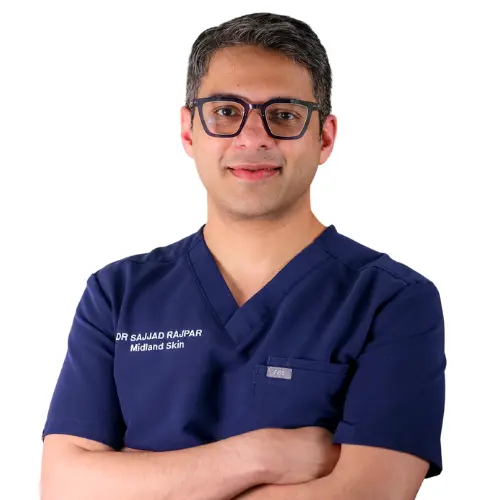
This page has been written and/or medically reviewed by Dr Sajjad Rajpar, Consultant Dermatologist and Medical Director of Midland Skin, Birmingham.
Dr Rajpar is on the GMC Specialist Register in Dermatology and has over 20 years’ experience in clinical dermatology. He provides clinical oversight to ensure the information on this page is accurate, balanced and consistent with current dermatology practice.
Dr Sajjad Rajpar
Date last updated: 22nd Sep 2026
Book in with us
Expert, consultant led care in dermatology, skin surgery, eyelid surgery, lasers and aesthetics.
Disclaimer
The content on this website is provided for general information only. It is not, and must not be treated as, medical advice, a diagnosis, or a recommendation for any particular treatment. We make reasonable efforts to keep information accurate and up to date, but medicine and technology change, and content may not reflect the most current evidence, guidance, product information, or individual practice. You should not rely on this website to make decisions about your health or treatment. Always seek personalised advice from an appropriately qualified healthcare professional. Any examples, images, testimonials, and outcome descriptions are illustrative only. Results vary between individuals and no outcome can be guaranteed.


