
Hair loss assessment and treatment
Dermatologist consultation and treatment for hair loss
Your initial hair loss assessment at Midland Skin is an appointment with a Consultant Dermatologist. It is the starting point for every condition treated in our hair loss clinic, from pattern hair loss and alopecia areata to scarring alopecia and scalp problems.


Quick Facts about your initial hair loss assessment

Best for
Hair loss, thinning, scalp concerns

Appointment
Initial hair loss & scalp assessment

Treatment
Depends on diagnosis

Symptoms
Thinning, shedding or rash

Provider
Consultant dermatologist

Price
See below
What happens during an initial hair loss assessment?
Experiencing hair loss can be very distressing. Your Consultant Dermatologist will ask how the hair loss developed, how it has progressed and whether you have experienced shedding, thinning or scalp symptoms. Relevant medical history, medications, supplements, family history, hair-care practices and previous treatments will also be reviewed.
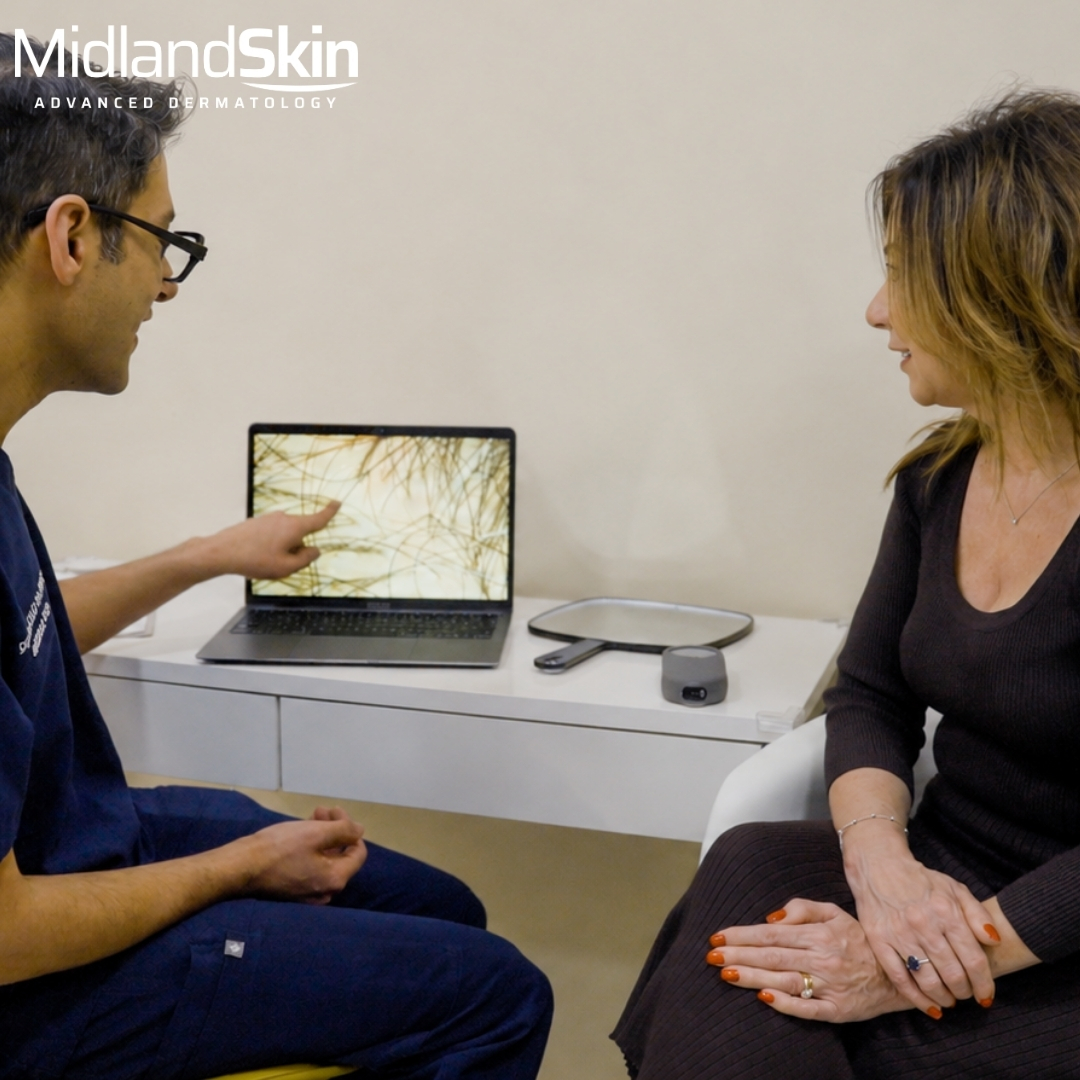
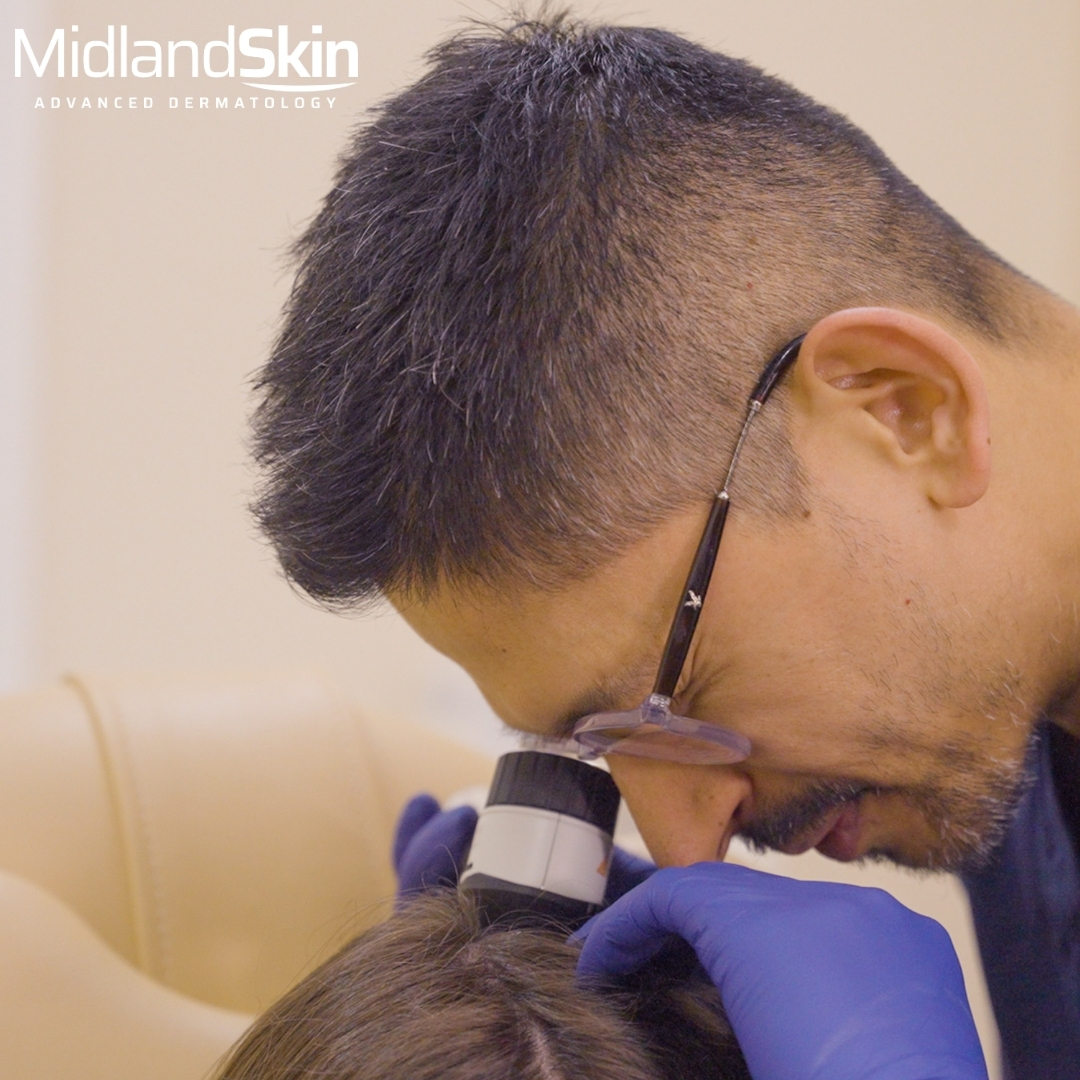
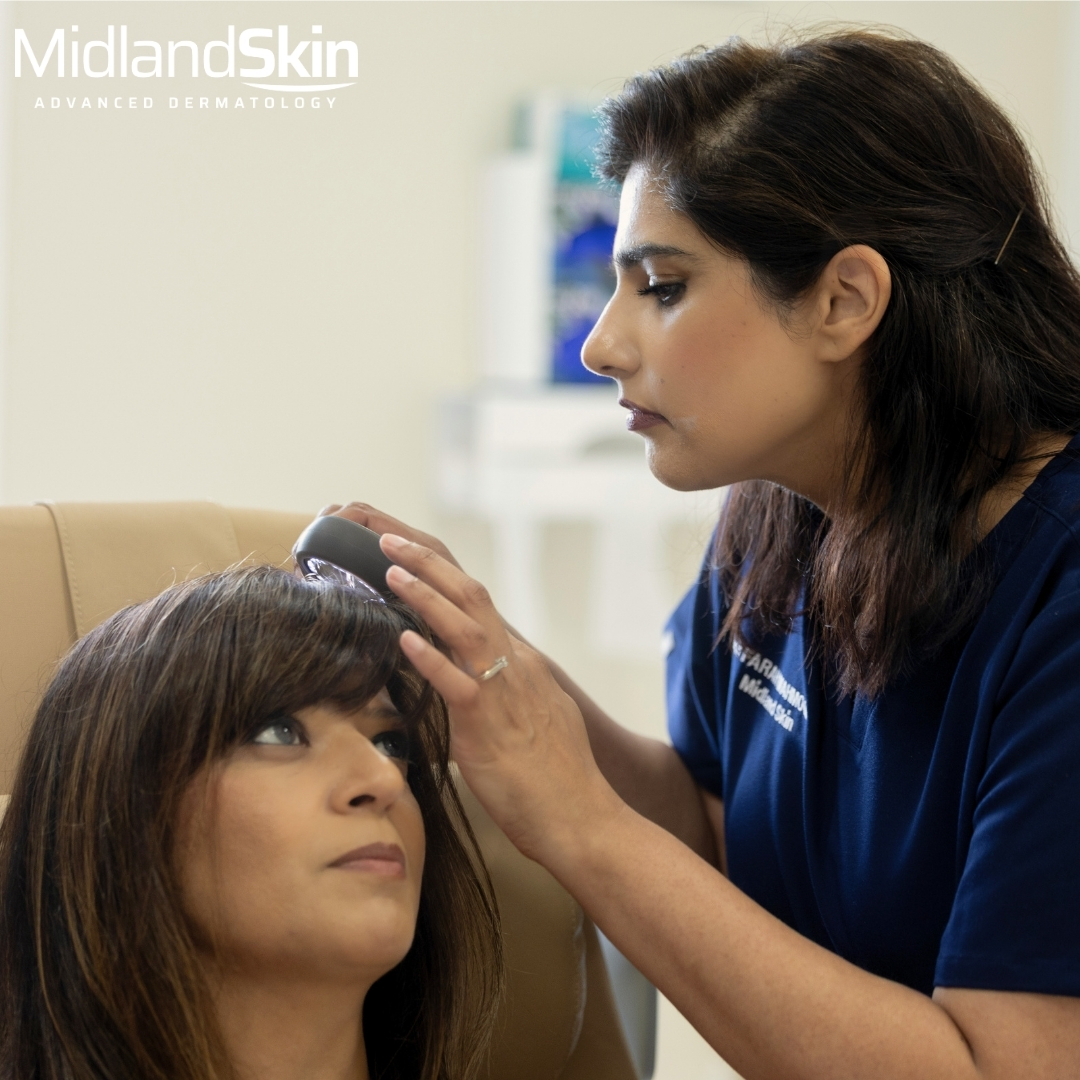
Your hair and scalp will be examined by eye and with a dermatoscope. Examination of the hair and scalp using a dermatoscope is called trichoscopy. It provides a magnified view of the hair shafts, follicle openings and scalp, helping the dermatologist identify changes that may not be visible to the naked eye.
Trichoscopy is painless and does not require your hair to be cut or shaved.
At the end of the assessment, your dermatologist will explain the likely diagnosis and the next steps. Some conditions can be diagnosed at the first appointment; others require blood tests, a scalp biopsy or assessment over time. A copy of the clinical note is sent to you and your GP if you have provided appropriate consents.
Why see a Consultant Dermatologist for hair loss?
A Consultant Dermatologist is a medically qualified doctor who has completed specialist training in conditions affecting the skin, hair and scalp. Dermatology is the only recognised medical specialty training programme that provides comprehensive specialist training in the diagnosis and medical management of hair-loss conditions.
This is different from a non-medical or non-specialist hair or scalp assessment. Although this may provide helpful hair-care advice and support, it cannot provide the same medical pathway of prescription treatment, targeted medical investigations, scalp biopsy and monitoring of systemic medication.
Before committing to supplements, medication, PRP or another hair-growth procedure, it is important to establish what is causing the hair loss and whether the proposed treatment is likely to help.
At Midland Skin, the purpose of the initial assessment is to determine:
- The likely cause of the hair loss.
- Whether more than one factor may be involved.
- Whether any investigations are appropriate.
- Whether medical treatment or a procedure is worthwhile.
- What improvement can realistically be expected.
- How treatment should be monitored.
The Consultant Dermatologist accepting responsibility for your care assesses the condition and recommends treatment only where it is considered appropriate.
When is specialist hair loss & scalp assessment worthwhile?
A hair loss assessment is particularly worthwhile when:
- Hair loss is persistent, progressive or keeps returning.
- You are experiencing increased shedding, thinning or patches and are uncertain why.
- Your scalp is uncomfortable, itchy, painful, spotty, scaly or inflamed.
- Previous treatments, supplements or procedures have not worked as expected.
- You are considering prescription medication, injections or PRP.
- Hair loss has developed during or after menopause.
- You want a medical diagnosis before committing to treatment.
Some forms of hair loss benefit from early medical treatment, making timely assessment particularly important where the condition is progressing.

Kerry Harrison

Why getting the diagnosis right matters
Hair loss is a symptom rather than a single diagnosis.
Different forms of hair loss can appear similar, and more than one condition may occur at the same time. Some are temporary, some require ongoing treatment and others can progressively damage the hair follicles.
The correct treatment therefore depends on establishing what is happening before deciding how to manage it. Starting an unsuitable medication, supplement or procedure may waste time and money without addressing the cause.
Hair loss treatment pathway
Initial hair loss & scalp assessment
Your Consultant Dermatologist reviews how the hair loss developed, relevant symptoms, medical history, medications and previous treatments. Your hair and scalp are examined by eye and with trichoscopy, and clinical photographs are taken as appropriate.
Investigations, where appropriate
Targeted blood tests, microbiology tests, or a scalp biopsy may be recommended if required.
Care plan and treatment
Your dermatologist discusses an individual care plan. Depending on the diagnosis, this may include addressing contributing factors, changes to hair care, prescription topical or oral medication, steroid injections, PRP or treatment for an associated scalp condition.
Review consultation
A review consultation is required to assess your response, review any investigation results, monitor for side effects and decide whether treatment should be continued, changed or stopped. Longer-term management is discussed where appropriate.
Will I need blood tests or a scalp biopsy?
Not everyone with hair loss requires investigations. Tests are selected according to the history, examination and likely diagnosis rather than using the same panel for every patient.
Blood tests may be recommended to assess possible contributing factors such as iron levels, thyroid function or nutritional factors.
In women, hormonal tests may also be appropriate where the history or examination suggests that a hormonal factor could be contributing.
A scalp biopsy may be recommended when the diagnosis remains uncertain or when the result would influence treatment. A small sample of scalp is removed under local anaesthetic and examined by a specialist laboratory.
If an investigation is recommended, your dermatologist will explain why it is needed, what it involves and the additional fee before it is arranged.
How is hair loss treated at Midland Skin?
Treatment depends on the diagnosis – see alopecia areata, female pattern hair loss and male pattern hair loss for what to expect with each. No particular prescription or procedure can be guaranteed before assessment.
Treatment available at Midland Skin may include:
- Prescription topical or oral treatment, including minoxidil, finasteride, dutasteride or spironolactone where appropriate.
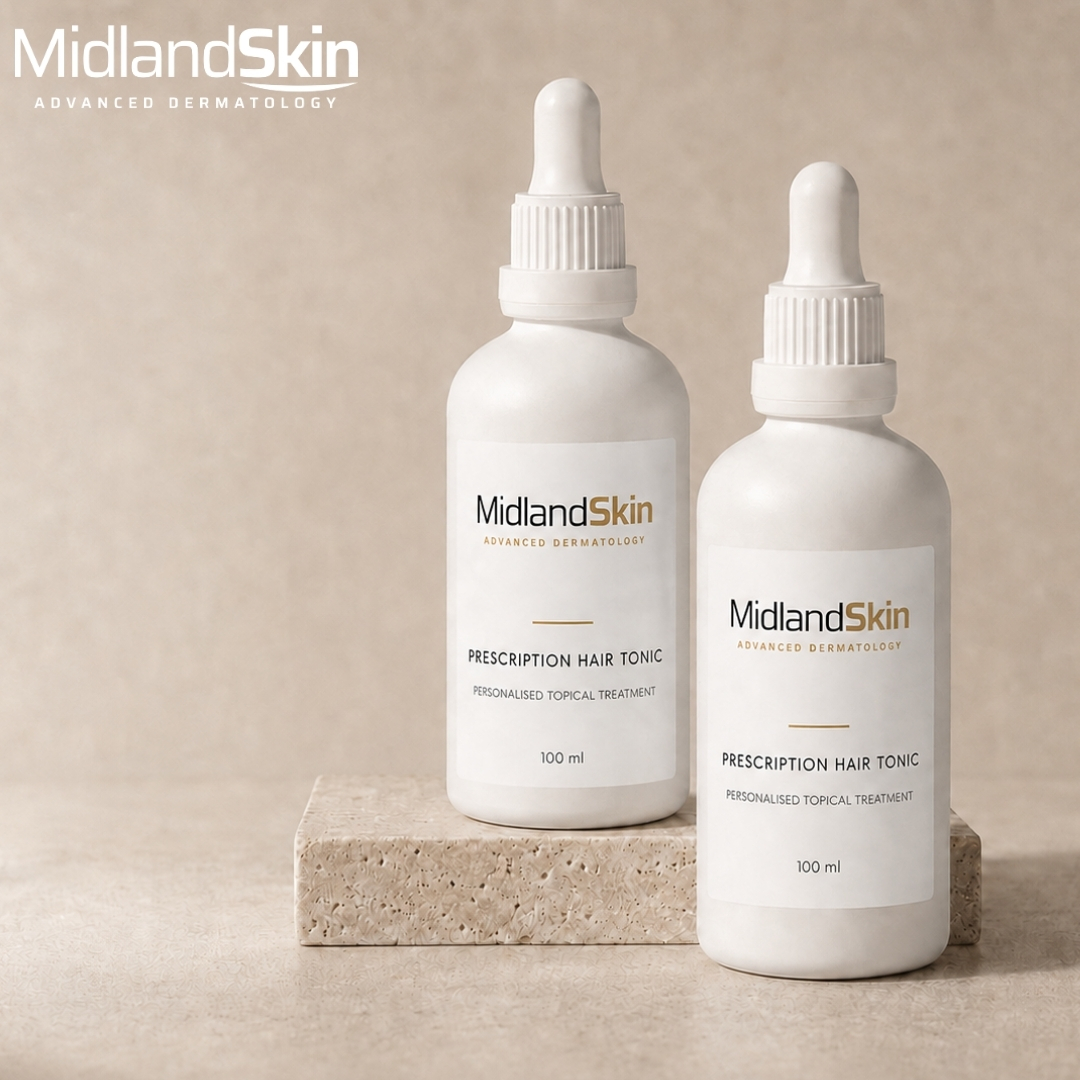
- Individually prescribed scalp foams or tonics with prescription ingredients.
- Steroid injections for selected forms of hair loss.
- Treatment of contributing scalp inflammation or disease.
- Immunosuppressive medication or JAK inhibitors with appropriate screening and monitoring.
- Advice about relevant hair-care practices or contributing medical factors.
- Platelet-rich plasma (PRP) injections for selected patients where the diagnosis and evidence support its use.
Some hair-loss medications are prescribed outside the terms of their UK marketing authorisation. Where an off-label treatment is considered, the reasons, uncertainties, potential benefits and risks will be explained before you decide whether to proceed.
What results can I expect from hair-loss treatment?
Hair grows slowly, so meaningful change is normally assessed over months rather than weeks.
Some treatments are intended primarily to slow further loss or maintain existing hair rather than restore the original density. Continued treatment may be needed to maintain any benefit.
Other forms of hair loss may improve when an underlying trigger is addressed, while some can recur or require longer-term medical control. Hair cannot regrow from follicles that have already been permanently destroyed.
Your dermatologist will explain what treatment is intended to achieve in your particular case. Full regrowth cannot be guaranteed.
Clinical photographs, symptoms and examination findings are considered together at review. If the response is not as expected, the diagnosis and care plan may need to be reconsidered.
Initial hair loss assessment FAQs
Will the doctor use a dermatoscope?
Trichoscopy using a dermatoscope usually forms part of the initial hair loss assessment at Midland Skin. The device magnifies and illuminates the hair and scalp, allowing the Consultant Dermatologist to assess changes that may not be visible to the naked eye. The examination is painless and does not normally require any hair to be removed.
What is the difference between a dermatologist and a trichologist?
A Consultant Dermatologist is a medically qualified doctor who has completed specialist training in diagnosing and treating diseases affecting the skin, hair and scalp. A trichologist has specific training in hair and scalp problems but is not medically qualified. Trichologists may provide hair-care advice and support but refer to medical professionals where prescription treatment or medical investigation is required. An initial hair loss assessment at Midland Skin can include medical diagnosis, trichoscopy, targeted blood or hormonal tests, scalp biopsy, prescription treatment and medical monitoring.
How should I prepare for my appointment?
Please attend with your hair and scalp accessible and dry. Where possible, avoid hair fibres, root-concealing sprays, dry shampoo, heavy oils or styling products that could obscure the scalp on the day of your appointment. Similarly, braids, extensions, a weave or a fixed hair system will prevent examination of the affected area. Please also read our appointment guide before attending.
Will I receive a prescription at my first appointment?
A prescription may be provided when the diagnosis is sufficiently clear and the treatment is medically appropriate. A particular medication cannot be guaranteed in advance. Further information, blood tests or a scalp biopsy may sometimes be required before treatment can be started safely.
Why is a review consultation required?
The review allows your dermatologist to assess whether treatment is working, assess hair loss progression, discuss any side effects or review investigation results. It is also when the dermatologist, together with you, decides whether treatment should be continued, adjusted or stopped and discusses any longer-term management that may be required.
kalpana magecha
Fees
Hair loss consultation Show pricing
Book ConsultationInitial hair loss and scalp assessment
Up to 25 minutes
Review consultation
Standard, up to 20 minutes
Extended review consultation
If more time is required, up to 30 minutes
Hair loss investigations Show pricing
Blood tests
Alopecia/scalp/hair loss biopsy
Hair loss treatments Show pricing
Steroid injection – Small area (up to 5cm²)
Steroid injection – Medium area (5-10cm²)
Steroid injection – Large area (10-15cm²)
Platelet-rich plasma (PRP) – Course of 3
Platelet-rich plasma (PRP) – Course of 3, high dose
Dutasteride mesotherapy – Course of 3
Dutasteride mesotherapy (add-on to PRP)
Per session
References
- American Academy of Dermatology. Hair loss: diagnosis and treatment. Updated 2022.
- Khutsishvili N, et al. Trichoscopy – a valuable tool for identifying conditions with hair loss. International Journal of Dermatology. 2024.
- Harries MJ, et al. British Association of Dermatologists living guideline for managing people with alopecia areata. British Journal of Dermatology. 2025.
- Akiska YM, et al. Low-dose oral minoxidil initiation for patients with hair loss: an international modified Delphi consensus statement. JAMA Dermatology. 2025.
- NICE Clinical Knowledge Summaries. Female pattern hair loss: investigations.
- British Association of Dermatologists. Female pattern hair loss and frontal fibrosing alopecia.
- Yao J, et al. The additive value of platelet-rich plasma to topical minoxidil in androgenetic alopecia. PLOS ONE. 2024.
Book in with us
Expert, consultant led care in dermatology, skin surgery, eyelid surgery, lasers and aesthetics.


