
Seborrhoeic warts (seborrhoeic keratosis)
Specialist dermatology assessment for benign skin growths
At Midland Skin we offer seborrhoeic wart assessment and removal for patients in Birmingham, Solihull, Coventry, Wolverhampton, Worcester and the Midlands.


Quick facts about seborrhoeic warts

Best for
Warty brown skin growths

Appointment
Initial dermatology assessment

Treatment
Removal in clinic
Symptoms
Itchy, catching or unsightly
Provider
Consultant dermatologist

Price
See below
What is a seborrhoeic wart / seborrhoeic keratosis?
Seborrhoeic warts are also known as seborrhoeic keratoses or senile warts. They are harmless growths on the skin which are very common in those over 40.
Small flat seborrhoeic warts can often be seen in middle age, and they become more raised and larger as the years go by. Their size varies from less than one centimetre to several centimetres across. Seborrhoeic warts have a rough surface, and range in colour from a light brown to almost black. They give the impression that they are stuck onto the surface of the skin. Some look like small pigmented skin tags.
Seborrhoeic warts occur most often on the trunk but are also common on the head and neck. Their numbers vary: one person may have just one seborrhoeic wart; others have hundreds of them. Once present, they usually stay, and new ones often appear over the years.
They are benign growths due to a build up of ordinary skin cells. They are not infectious and do not become malignant.
Seborrhoeic keratoses on the trunk
Seborrhoeic keratoses can occur on the trunk especially on the back, chest and under the breasts as well as the waist line. Some people may have hundreds of lesions.
Dermatosis papulosa nigra
In certain individuals, especially those of Asian or African heritage, seborrhoeic keratoses appear as small dark brown or black spots. They can occur over the face and neck. This is known as Dermatosis papulosa nigra.
What are the symptoms of seborrhoeic warts?
Seborrhoeic warts are harmless, but can be a considerable nuisance. They can itch, become inflamed, and catch on clothing. Many people dislike the look of them, particularly when they come up on the face.
Inflamed and irritated seborrhoeic warts
Seborrhoeic warts sit raised above the skin surface, so they are easily caught and rubbed. Friction from clothing, waistbands, bra straps, jewellery, shaving or simply scratching can make a lesion become inflamed.
An inflamed seborrhoeic wart looks quite different from a settled one. It may become red, swollen and tender, develop a crust, weep or bleed, and lose the typical stuck-on warty surface that makes the diagnosis obvious. Some lesions settle on their own once the source of friction is removed; others remain inflamed for weeks.
This matters because an inflamed seborrhoeic wart can closely resemble a squamous cell carcinoma. Both can appear as a red, crusted, tender lump that bleeds easily. An inflamed lesion that is not settling should be assessed by a Consultant Dermatologist, and removal with histological analysis may be advised rather than simple treatment.
Irritation is also one of the most common reasons people ask for a seborrhoeic wart to be removed.
When should I have a seborrhoeic wart checked?
Most seborrhoeic warts are easily recognised and need no treatment. A dermatology assessment is worthwhile when you want certainty about what a lesion is, or when it has started to cause problems.
- The lesion has changed – in size, shape, colour or surface
- It is darker or more irregular than your other lesions
- It bleeds, crusts or will not settle
- It is itchy, sore or repeatedly inflamed
- It catches on clothing, jewellery or when shaving
- It is on the face, scalp or neck – where appearance matters most
- You have a personal or family history of skin cancer
- You want a definite diagnosis before considering removal

Sally Shepherd

Why getting the diagnosis right matters
Seborrhoeic warts are usually straightforward to recognise, but a small number of skin cancers can look very similar – and a seborrhoeic wart can occasionally be mistaken for something more serious, leading to unnecessary worry.
The lesions most often confused with a seborrhoeic wart are:
- Melanoma – some melanomas develop a warty, crusted surface that closely resembles a seborrhoeic wart. These are usually on the trunk and can be picked up on dermoscopy.
- Basal cell carcinoma – a pigmented BCC can mimic a flat or superficial seborrhoeic wart.
- Squamous cell carcinoma – an inflamed or irritated seborrhoeic wart can be difficult to distinguish from an SCC on appearance alone, and biopsy may be needed.
- Pigmented actinic keratosis – superficial sun damage that can look almost identical on sun-exposed skin.
Assessment by a Consultant Dermatologist, using dermoscopy, establishes the diagnosis before any treatment is carried out.
How are seborrhoeic warts diagnosed?
Seborrhoeic keratoses can usually be diagnosed from their appearance by an experienced Doctor. If there is doubt over the diagnosis, then a biopsy is required so that the seborrhoeic wart can be looked at under the microscope.
Treatment pathway
Initial dermatology assessment
Your Consultant Dermatologist examines the lesion or lesions, usually with dermoscopy, and reviews any change you have noticed.
Diagnosis and plan
The diagnosis is confirmed and, if you wish to proceed, the most suitable removal technique, expected healing time and cosmetic result are discussed with you.
Removal or further investigation
Where the diagnosis is clear and same-day treatment has been arranged in advance, removal can be carried out at the same visit. Otherwise treatment is booked as a separate appointment. Where the diagnosis is uncertain, the lesion is removed for histological analysis and the results are discussed with you at a review appointment.
What causes a seborrhoeic wart / seborrhoeic keratosis?
They are benign growths due to a build up of ordinary skin cells. They are strongly age-related. They usually start to appear after the age of 40 years, and most elderly people will have at least a few seborrhoeic warts: some will have large numbers. They are not infectious and do not become malignant.
Are seborrhoeic warts hereditary?
Seborrhoeic warts can run in families and this suggests a genetic basis for them. Many families will have a tendency to develop seborrhoeic keratoses especially on their body.
Are seborrhoeic keratoses caused by sun exposure?
Seborrhoeic keratoses are not caused by sun damage in the way that skin cancers are, and they occur readily on skin that has had little sun exposure. Cumulative sun exposure does appear to play some part, particularly for lesions on the face, scalp and neck, but age and genetic tendency remain the main factors.
Can seborrhoeic warts be removed?
Yes. Seborrhoeic wart removal is one of our most commonly performed procedures, and is carried out under local anaesthetic in clinic. Lesions can be treated anywhere on the body, including the face and eyelids, and whether you have a single lesion or a large number.
Same-day removal is available for suitable lesions, but it has to be arranged before you attend – it is not offered automatically at a standard consultation. If you would like to be considered, submit your details in advance and our team will confirm eligibility with you. Suitability is still confirmed by your Consultant Dermatologist at the assessment itself.
Seborrhoeic keratosis removal – technique, healing, aftercare and same-day treatment
Do seborrhoeic warts come back or spread?
Seborrhoeic warts are not infectious and do not spread from one part of the body to another, or from person to person.
Once present, an individual lesion usually stays unless it is removed. New seborrhoeic warts commonly appear elsewhere over the following years – this is a normal part of the tendency to develop them, not a sign that previous treatment has failed.
A treated lesion occasionally returns at the same site and can be treated again.
Your dermatology appointment: FAQs
Who will assess me?
You will be seen by a Consultant Dermatologist on the GMC Specialist Register, who will examine the lesion or lesions of concern, usually using dermoscopy.
Can my seborrhoeic wart be removed at the same appointment?
Sometimes, but this must be arranged in advance through our same-day procedure service rather than assumed on the day. Our team will confirm eligibility with you before your appointment, and your Consultant Dermatologist confirms suitability at the assessment.
Same-day treatment is generally not appropriate where the diagnosis is uncertain, where a large number of lesions need treating, or where the site carries a higher cosmetic or scarring risk. In those cases treatment is planned as a separate appointment.
What does a biopsy cost and when will I get the result?
If a lesion is removed for histological analysis, there is an additional laboratory cost. This will be confirmed with you before it is arranged, and the result is discussed with you at a review appointment.
What is useful to bring to my appointment?
It helps to bring any photographs showing how the lesion looked previously, details of any treatment you have already had, and a note of anything that has changed. If you have several lesions, it is worth identifying in advance which ones concern you most.
Will I need a follow-up appointment?
If a lesion is sent for histological analysis, you will be reviewed to discuss the result. Where a lesion has simply been removed with a confirmed diagnosis, routine follow-up is not usually required, though wound checks can be arranged where needed.
Book in with us
Ready to get started? Book a consultation with our team at Midland Skin. Friendly, expert advice tailored to you.
Fees
Seborrhoeic wart removal Show pricing
Book ConsultationSeborrhoeic wart removal is available as a same-day consultation and procedure for eligible lesions.
Initial dermatology assessment
Up to 25 minutes
Seborrhoeic keratosis & skin tag – 1 large or 3 small
Seborrhoeic keratosis & skin tag – 2 large or up to 7 small
Seborrhoeic keratosis & skin tag – complex / larger session
Seborrhoeic keratosis & skin tag – groin, face or eyelid
pattie dupree
References used for this article
- Venturi F, Cedirian S, Veronesi G, Scotti B, Baraldi C, Dika E. Seborrheic keratosis-like melanoma: novel insights into clinical, dermoscopic, and reflectance confocal microscopy diagnosis of an atypical melanoma variant. Skin Res Technol. 2025. doi:10.1111/srt.70206
- Differential diagnosis and management on seborrheic keratosis in elderly patients. Clin Cosmet Investig Dermatol. 2020;13:643-649. doi:10.2147/CCID.S267246
About the Author
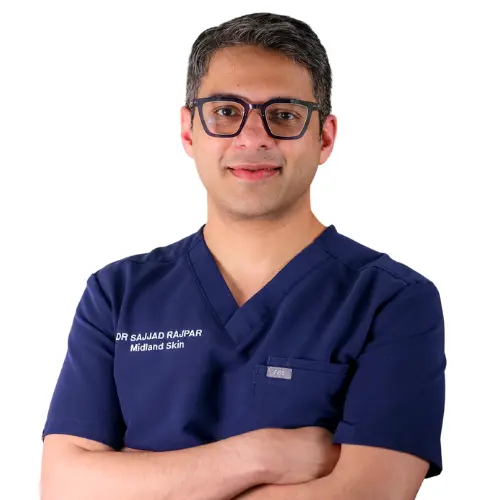
This page has been written and/or medically reviewed by Dr Sajjad Rajpar, Consultant Dermatologist and Medical Director of Midland Skin, Birmingham.
Dr Rajpar is on the GMC Specialist Register in Dermatology and has over 20 years’ experience in clinical dermatology. He provides clinical oversight to ensure the information on this page is accurate, balanced and consistent with current dermatology practice.
Dr Sajjad Rajpar
Date last updated: 26th Sep 2026
Book in with us
Expert, consultant led care in dermatology, skin surgery, eyelid surgery, lasers and aesthetics.
Disclaimer
The content on this website is provided for general information only. It is not, and must not be treated as, medical advice, a diagnosis, or a recommendation for any particular treatment. We make reasonable efforts to keep information accurate and up to date, but medicine and technology change, and content may not reflect the most current evidence, guidance, product information, or individual practice. You should not rely on this website to make decisions about your health or treatment. Always seek personalised advice from an appropriately qualified healthcare professional. Any examples, images, testimonials, and outcome descriptions are illustrative only. Results vary between individuals and no outcome can be guaranteed.


