
Laser Treatment for Surgical Scars
At Midland Skin we offer laser treatment for surgical scars with a Dermatologist for patients in Birmingham, Solihull, Coventry, Wolverhampton, Worcester and the Midlands.


Laser treatment for Surgical Scars and Traumatic Scars
Surgical scars are an inevitable result of any operation involving an incision. While many settle well, others can become red, thickened, stretched, indented, pigmented or a combination of these. Some scars may feel tight or itchy and can cause cosmetic or functional concerns.
Any form of trauma can leave a scar be that a burn, a laceration or other injury. Similar treatments are applicable for traumatic scars as they are for surgical scars.
Surgical procedures that often leave visible or symptomatic scars include:
- Facial procedures – such as skin grafts or local flap repairs
- Breast surgery – including augmentation, reduction, or uplift
- Abdominal surgery – including abdominoplasty and caesarean section
- Limb and joint surgery
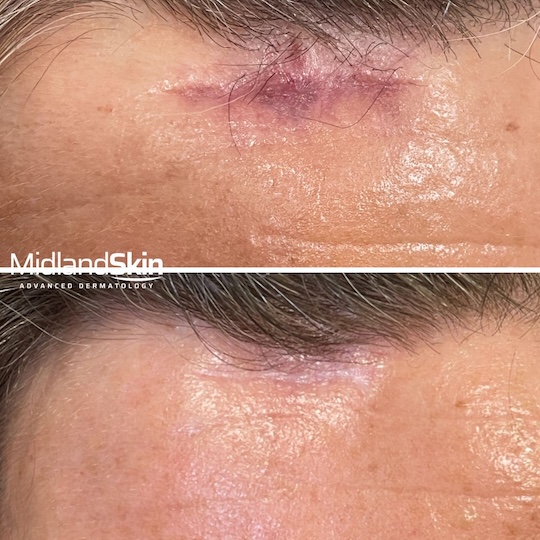
Quick facts about laser treatment for surgical scars [TO UPDATE]
- You need three 45 minute treatments – one every 3 to 4 weeks
- The results get better with time and at one year there is an average reduction in inflammatory spots of 97% according to clinical studies
- There are no harmful side effects
- The treatment is safe in all skin tones and all year round
- You do not need to take long-term tablets or creams
- There can be short-lived purges which can be managed with medications
When to Start Laser Scar Treatment
It was once common practice to wait a year or more before considering treatment for a scar. We now know that earlier intervention, typically starting within days to weeks of suture removal, can positively influence how a scar heals.
Starting treatment early can:
- Soften redness
- Reduce thickening
- Prevent abnormal pigmentation
- Alleviate itching or discomfort
That said, it is never too late to improve a scar. Older scars can still respond well to laser with combination treatments.

Scarlett Greenwood

What Laser and Energy-Based Treatments Can Achieve
- Reduce redness – Vascular lasers target the fine blood vessels responsible for pink or red scars.
- Even out pigmentation – Pigment-selective lasers reduce dark patches; fractional ablative lasers may help where the scar has lost pigment.
- Flatten raised scars – Fractional ablative lasers remodel collagen, helping hypertrophic tissue settle. Where there is keloid formation, adjunctive treatment can be added.
- Lift indented scars – Combined subcision and resurfacing can help sunken areas blend more evenly into the surrounding skin.
What to Expect from Treatment
- Treatment can begin as early as a few days after stitches are removed.
- Sessions are usually spaced 6–12 weeks apart.
- A course of treatments is typically needed for optimal results.
- We select from a range of lasers depending on how the scar is behaving at the time.
- Local anaesthetic may be used, particularly for raised or tight scars. You may be asked to apply topical anaesthetic at home
Lasers and Other Devices Used at Midland Skin
Each scar is assessed individually. A tailored combination of the following may be used:
Ablative Fractional Lasers
- Lumenis Ultrapulse CO₂ (DeepFX/ActiveFX, SCAAR FX)
- Sciton ProFractional erbium:YAG (2940 nm)
- UltraClear 2910 nm laser
Non-Ablative Fractional Lasers
- Sciton Halo (1470 nm + 2940 nm hybrid)
Vascular Lasers
- Cutera Excel V+ (532/1064 nm)
- Sciton BBL
Pigment Lasers
- Lutronic Spectra Q-switched laser
Other Treatments
- Injectable medications: corticosteroids, 5-fluorouracil, botulinum toxin, hyaluronidase
Book in with us
Ready to get started? Book a consultation with our team at Midland Skin. Friendly, expert advice tailored to you.
Additional Scar Management Techniques
Laser treatment is often combined with other measures to support optimal healing:
- Silicone gel or silicone sheeting
- Scar massage
- Compression therapy
Hypertrophic and keloid scars
Sometimes surgical scars can develop features of hypertrophic and keloid scars and these are treated in a similar way. More information on keloid scars can be found here
Realistic expectations and limitations
With the right combination of timing, technology, and technique, most surgical scars can be improved, sometimes significantly. However, as with any medical treatment there is no guarantee and some individuals may not respond a lot or at all. Consequently a guarantee can not be provided.
Key Points for Patients
- A consult is required where your scar is assessed and a treatment plan made taking into consideration your scar features
- Protect healing scars from sun exposure until any pink or brown colour has faded.
- Moisturise and gently massage the area once the skin surface is fully intact.
- Attend follow-up appointments so your treatment can be adjusted as the scar evolves.
- Number of sessions can vary from 3 to 5, to more (sometimes more than 12). Scars can be treated for as long as they appear to be improving.
PRICING EXAMPLE LINK
References used for this article
Further information on dermatitis can be found here:
About the Author
This page has been written and/or medically reviewed by Dr Sajjad Rajpar, Consultant Dermatologist and Medical Director of Midland Skin, Birmingham.
Dr Rajpar is on the GMC Specialist Register in Dermatology and has over 20 years’ experience in clinical dermatology. He provides clinical oversight to ensure the information on this page is accurate, balanced and consistent with current dermatology practice.
Dr Sajjad Rajpar
Date last updated: 10th Mar 2026
Book in with us
Expert, consultant led care in dermatology, skin surgery, eyelid surgery, lasers and aesthetics.
Disclaimer
The content on this website is provided for general information only. It is not, and must not be treated as, medical advice, a diagnosis, or a recommendation for any particular treatment. We make reasonable efforts to keep information accurate and up to date, but medicine and technology change, and content may not reflect the most current evidence, guidance, product information, or individual practice. You should not rely on this website to make decisions about your health or treatment. Always seek personalised advice from an appropriately qualified healthcare professional. Any examples, images, testimonials, and outcome descriptions are illustrative only. Results vary between individuals and no outcome can be guaranteed.


