
Mole removal
Our expert doctors offer same day cosmetic mole removal in Birmingham and Solihull


Mole removal in Birmingham and Solihull
If you are looking for mole removal then our specialist Dermatologists are able to provide you with sound advice and excellent operating skills. Based in Birmingham, we offer mole removal to all those in the vicinity including Solihull and the West Midlands.
Quick facts about Mole Removal treatment
- You need three 45 minute treatments – one every 3 to 4 weeks
- The results get better with time and at one year there is an average reduction in inflammatory spots of 97% according to clinical studies
- There are no harmful side effects
- The treatment is safe in all skin tones and all year round
- You do not need to take long-term tablets or creams
- There can be short-lived purges which can be managed with medications
What to Expect

Title Here
1-2 weeks
Title Here
1-2 weeks
Title Here
1-2 weeks
Title Here
1-2 weeks
Title Here
1-2 weeks
Title Here
1-2 weeks
When should I consider having a mole removed?
There are many reasons why you might want to have a mole removed. Some common reasons are:
- The mole keeps getting red and inflamed
- You do not like how the mole looks
- The mole has grown and has become very obvious and prominent
- The mole is catching and rubbing – for example when you brush your hair, or wear certain jewellery or clothes
- The mole stops you from shaving comfortably
- The mole is an awkward or sensitive area

Scarlett Greenwood

My journey to treat persistent life long acne with Midland Skin team was truly amazing. I had been so scared of the whole process but the Dr put me at complete ease and understood how difficult life had been living with acne. I felt really supported in my treatment, able to ask questions and work together to get most out of the course. This treatment has truly changed my life and I can’t thank the team enough for setting me free after hiding all my adult life! Thank you!
What are medical reasons for mole removal?
Your Dermatologist may also advise you to have a mole removed for medical reasons. If you have been for a full skin mole check then your Dermatologist may have found a mole that needs removing. This is usually because the mole needs to be looked at under the microscope for specialist analysis called a biopsy. Your doctor may suggest a mole is removed if:
- There is a concern that the mole could have become cancerous
- It is a new mole
- The mole has changed – it may have grown, or become darker, or changed in its outline
- The mole stands out from your other moles
- The mole doesn’t look quite right for any other reason
Book in with us
Ready to get started? Book a consultation with our team at Midland Skin. Friendly, expert advice tailored to you.
What is a cosmetic mole removal?
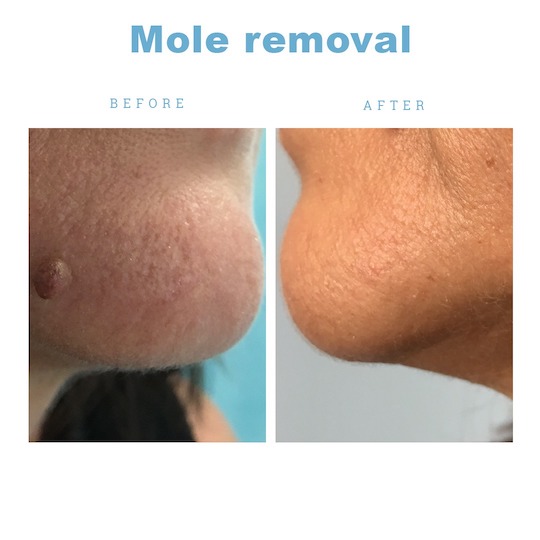
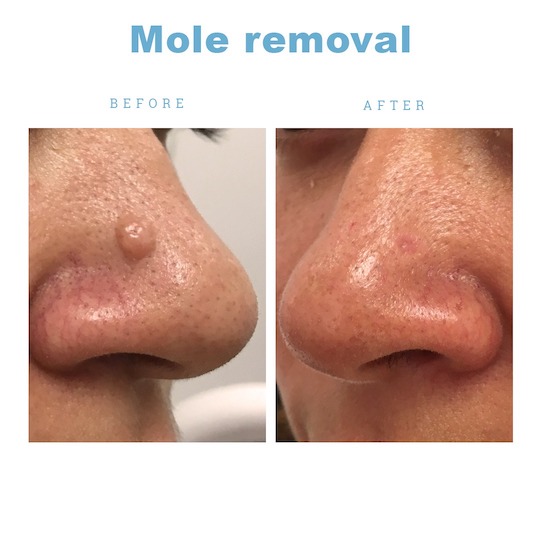
A cosmetic mole removal is removal of a mole because of its aesthetic appearance or because it keeps catching. The mole must look medically harmless when it is assessed by a Dermatologist for a cosmetic mole removal to be possible. About 85% of cosmetic mole removals are by shave excision and 15% are by excision with stitches.
We recommend cosmetic mole removal for raised moles which are stable and not deeply pigmented. We do not recommend or provide removal of flat moles for cosmetic reasons. If you need your moles assessed then we offer a full mole check consultation – this is much like a mole MOT.
What is a medical mole removal?
A medical mole removal is where your Dermatologist has recommended a mole is removed so that it can be assessed for biopsy. 75% of medical mole removals are by excision with stitches and 25% are by shave excision (to a deeper degree that for cosmetic shave excision – this is known as saucerisation).
How is a mole removed in Birmingham?
Moles are removed either by shave excision, laser excision or excision with stitches. We are among the few clinics in Birmingham that specialise in both forms of mole removal.
Watch More to Learn
See all videosWhat happens during a shave excision?
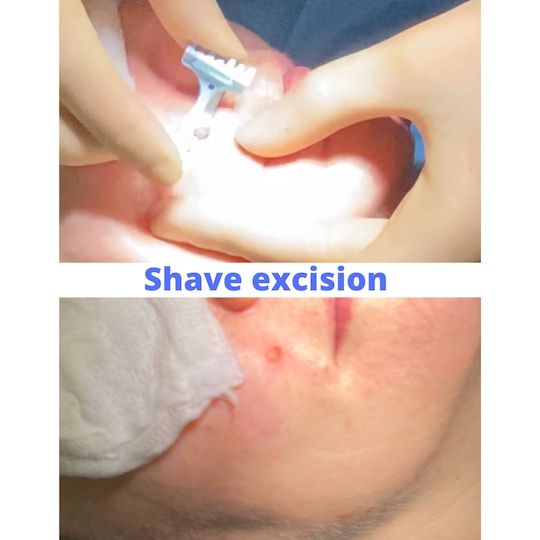
The mole is checked by the doctor with a dermatoscope to ensure it is suitable for shave excision. The mole is numbed with a fine anaesthetic injection. This stings for about 20 seconds and then the area will become entirely numb to anything painful. The raised part of a mole is then removed with a special blade called a dermablade. The edges are then blended to follow the contour as best as possible. The wound that results is the same in out outline as the base of the mole and looks very much like a small graze with a scab. The roots are not removed during a shave excision.
What is the aftercare and recovery following shave excision mole removal?
The wound will take 10-14 days to heal after shave excision. A scab will form over the wound. Once healed, the area may appear red initially and with time this will gradually fade.
Immediately after the procedure, you may have a small plaster over the area or the wound may be covered with Vaseline. If there is a plaster, then you will be asked to keep this on for 48 hours after which you can remove it. The wound can be cleansed twice a day with a cotton pad and lukewarm tap water to gently freshen the area. It is important not to pick the scab off but to let it separate naturally. Applying Vaseline 3 times a day will help soften the scab and let it separate faster. It will take about 10 to 14 days for the scab to separate. It is possible to get the area wet after 48 hours but avoid direct water spraying on the wounds. If the wound is in a sensitive area that keeps rubbing against clothing then it may be best to keep the wound dressed for 10 to 14 days. In this case, remove the dressing daily, cleanse with water and a cotton pad, apply Vaseline and redress.
How quickly can I go back to work and to sports after a shave excision?
You can return to an office-based job immediately after a shave excision. However, we ask you to wait 10 days before considering swimming, watersports, exercise where you will sweat or will cause clothing to rub against the healing wound, saunas and steam rooms.
These are the things you should have ready before your shave excision
It will be helpful to you if you acquire the following in advance of your procedure:
- Circular cotton pads (beauty pads)
- A new pot of Vaseline
- Spot plasters if you have a small wound that will require dressing
- Tegaderm +Pad Film dressing 5 x 7cm – these can be obtained in a pack of 10 or 25 and is useful if you need to dress wounds on the body or limb
What are the benefits of shave excision mole removal?
The vast majority of patients have a straightforward healing period and are very happy with the aesthetic results. The level of satisfaction from this treatment is very high.
Does shave excision cause a scar?
It is important to remember that shave excision is a surgical procedure and it is impossible to cut the skin and not create a scar. A small scar forms where the shave excision was carried out. This is usually slightly paler than the surrounding skin, and flat. Sometimes, as the scar matures, there can be a gentle depression. Some people are more prone to pale depressed scars than others. Once a scar has fully matured, which can take up to one year, it usually blends in very nicely with the surrounding skin.
Book in with us
Ready to get started? Book a consultation with our team at Midland Skin. Friendly, expert advice tailored to you.
What is laser mole removal?
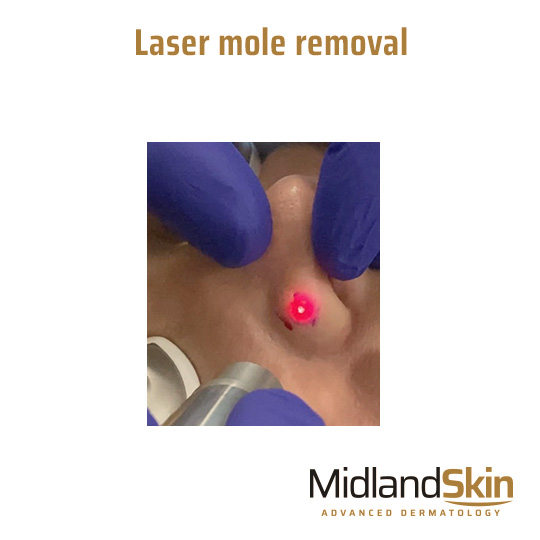
A laser vaporises a mole, layer by layer. We offer the CO2 and Erbium:YAG laser for mole removal, as it is very precise allowing thin layers of the mole to be removed. This means there is less heat spreading to the tissues around the mole. This can result in less scarring and faster healing times in many instances.
What are the risks of shave excision mole removal (and laser or shave mole reduction)?
Shave excision is a minor surgical procedure, but—like all surgery—it carries certain risks. Understanding these possibilities will help you make an informed decision.
- Residual pigmentation – If the original mole contained pigment, some colour can remain within the scar.
- Delayed pigmentation – New pigment may appear in the scar weeks, months or even years later as deeper cells repigment.
- Regrowth of the mole – Around one in ten moles re‑emerge after shave excision or laser treatment. Regrowth can be rapid (within months) or delayed (after several years); a repeat procedure may then be required.
- Bleeding – Oozing or bleeding can occur soon after treatment. Applying firm pressure with a clean cotton pad usually stops it.
- Infection – Bacterial infection is uncommon, but increasing pain, redness, swelling or discharge should be reported promptly.
- Lightening (hypopigmentation) – The scar may heal paler than the surrounding skin, particularly on sites away from the face.
- Depressed (indented) scar – A slight indentation can develop as the wound contracts during healing.
- Temporary redness – Pinkness or redness often persists for several months before fading.
- Post‑inflammatory hyperpigmentation – Some skin types are prone to temporary darkening of the scar, which can take six months or longer to settle.
- Persistent hair growth – Hair follicles lie deeper than the shaved surface, so coarse hairs may continue to grow. If excessive hair is the main concern, full surgical excision with stitches may be preferable.
- Keloid or raised scarring – People who form keloids may develop a firm, raised scar after a shave excision.
Follow‑up care
Most issues, should they arise, can be treated, although any follow‑up procedures are billed separately. If you have concerns or notice unexpected changes after your surgery, please contact the clinic for advice.
Why should I see a Dermatologist for acne and acne laser treatment?
Acne is a complex inflammatory condition of the skin that can scar permanently. It is not a cosmetic or aesthetic issue. Aside from the visible consequences, those with acne can have severe psychological issues because of their acne.
A Consultant Dermatologist is the only recognised specialist for treating acne. A Consultant Dermatologist can help evaluate your acne and offer treatment options that may be suitable – you can learn more about acne treatments here.
Each individual with acne requires a unique treatment tailored for their acne, factoring in lifestyle variables, hormones, response to previous treatments, other medical concerns, severity and level of scarring, family history, areas of the body affected and so on. No two people with acne are the same, and Aviclear laser is one part of the puzzle which may or may not be appropriate for you.
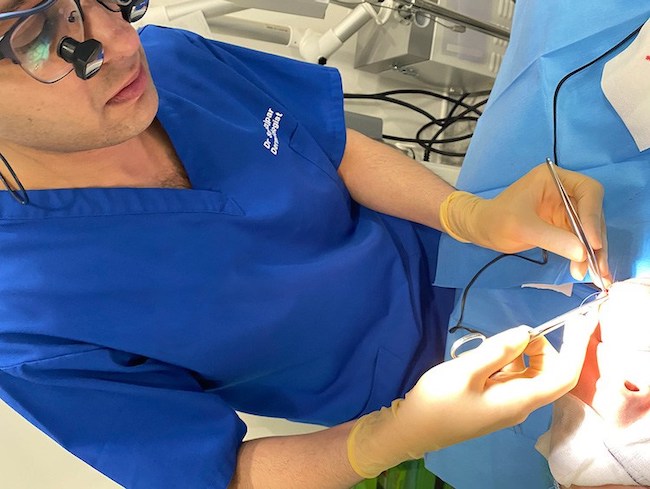
What is mole excision with stitches?
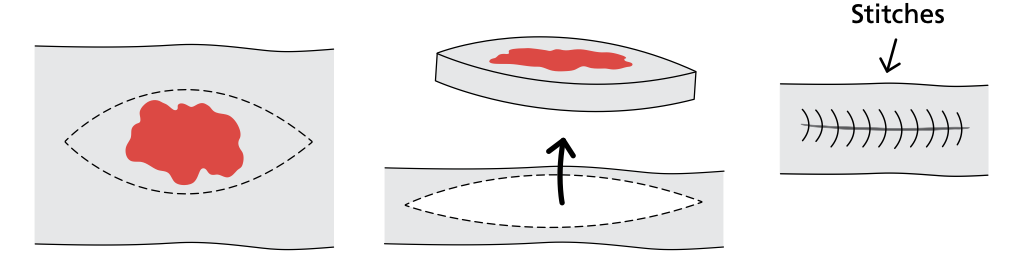
This procedure is done if it is important for the roots to be removed. This might be the case if it is a very fleshy and deeply pigmented mole, if there are a lot of hairs growing through it, or if the mole is an area of the body where a stitched wound may be more suitable thank a shave wound. In this procedure, an ‘eye’ shape of skin is cut out and the wound is stitched. This leave a straight line scar. The scar is placed in natural skin creases and lines to camouflage it. The scar is about 3 to 4 times as long as the width of the mole being removed. This procedure is also carried out under local anaesthetic.
What are the risks of a mole excision with stitches?
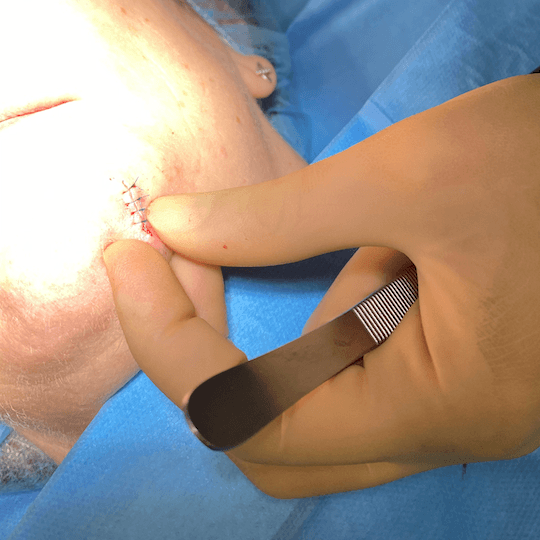
A scar results, which is usually a straight or curved line, which may be red initially but will fade with time. Sometimes scars can stretch, and occasionally some people develop lumpy scars. There can be temporary numbness around the scar line. We ask you to rest for a couple of days after your procedure and to avoid exercise for about 14 days following a skin excision with stitches.
Ashley Cooper
I had a fantastic experience with Dr Rajpar. I suffered with acne for over 20 years and had tried everything to try and help, without success. During the consultation he listened to my concerns and we came up with a treatment plan. Within 4 months my skin was completely acne free! We had regular check ins to ensure I was responding well to the treatment and to discuss any concerns. I am now at the end of my treatment and my skin has never looked better. I highly recommend Dr Rajpar for any skin concerns.
Which is better for mole removal: shave, laser or elliptical excision with stitches?
There is no single “best” technique for every mole. The ideal approach depends on the type of mole (colour, depth, hair‑bearing or not), its location, your skin characteristics and, importantly, your personal preference. These factors are discussed in detail during your consultation.
- Shave excision / laser reductionQuick, no stitches and usually excellent cosmetic results for small, raised, skin‑coloured moles. A 2021 randomised study found higher patient satisfaction and smaller scars than elliptical excision, but an 11 – 12 % regrowth rate and more positive margins.
- Elliptical excision with suturesRemoves the entire mole (including its roots) with a narrow margin, allowing full histological examination and giving the lowest chance of regrowth. It does, however, leave a linear scar that needs stitches for 5 – 7 days.
- Laser removalNo scalpel, minimal bleeding and useful for superficial pigmented or multiple lesions. Because the tissue is vaporised, histology is not possible and the chance of recurrence is similar to shave excision.
If a mole were to recur after shave or laser treatment, it can almost always be removed later with an elliptical excision—though this is only rarely necessary.
Your consultation is very important where your doctor will discuss these points with you and agree the technique that best matches your skin, the mole in question and the cosmetic result you wish to achieve.
Book in with us
Ready to get started? Book a consultation with our team at Midland Skin. Friendly, expert advice tailored to you.
Removal of flat moles
lat moles are removed if there is a medical reason. In certain instances flat moles can be removed with laser. However the as the aim is to limit any degree of scarring related to depth, flat moles have a higher risk of recurrence.
How can I book a mole excision?
You will be invited for a skin surgery consultation to discuss if a mole excision procedure is suitable and which kind of procedure might be suitable for you. You will then have an understanding of the risks and benefits of a procedure, following which you can make a decision on when to have the procedure.
What are the prices?
Fees for mole removals and mole check consultations can be found here.
Other skin lesions
We offer removal of warts, seborrhoeic keratoses, skin tags, genital skin tags, milia, cysts and lipomas as well.
Conflict of interest and disclaimer
This information is based on the views of a UK Consultant Dermatologist (a doctor who is on the specialist register for Dermatology, the equivalent of which is ‘Board certified’ in the USA) who has supervised many patients successfully with acne over 20 years of practice. This information is intended for patients of this Clinic and under our care only. No part of this document should be construed as medical advice to those not under the care of this Clinic and under our care. Practices vary nationally and internationally, and we do not wish to contravene advice you have been provided by your own physician.
References
Camini L, Manzoni APD, Weber MB, Luzzato L, Soares AS, Bonamigo RR. Shave Excision Versus Elliptical Excision of Non‑pigmented Intradermal Melanocytic Nevi: Comparative Assessment of Recurrence and Cosmetic Outcomes. Dermatologic Surgery. 2021;47(2):e21‑e25. doi: 10.1097/DSS.0000000000002666. PMID: 32932273.
Book in with us
Pellentesque arcu cras cursus nascetur felis id sem gravida. Tellus lobortis eu erat in pellentesque ultrices. Egestas nunc iaculis massa turpis nulla.
Watch More to Learn
See all videosReceive more information
on Aviclear
If you’re interested in learning more about Aviclear (be that booking a consultation, getting further treatment information, prices etc) please leave your email address below and a member of our team will be in touch.


