
Seborrhoeic keratosis removal in Birmingham
Same-day removal of seborrhoeic keratoses under local anaesthetic


Quick facts about seborrhoeic keratosis removal

Best for
Seborrhoeic keratoses anywhere
Anaesthetic
Local anaesthetic

Duration
15-30 mins

Recovery
7-10 days

Consultant
Dermatologist

Price
See below
What is a seborrhoeic keratosis?
A seborrhoeic keratosis is a common, benign skin growth that becomes more frequent with age. Seborrhoeic keratoses can appear anywhere on the body except the palms and soles. They are typically brown, tan or grey, with a warty or rough surface that looks as though it has been stuck onto the skin. They range in size from a few millimetres to several centimetres.
Seborrhoeic keratoses are not infectious and are not caused by the sun. They are entirely benign but can cause cosmetic concern, become itchy or inflamed, or catch on clothing and jewellery.
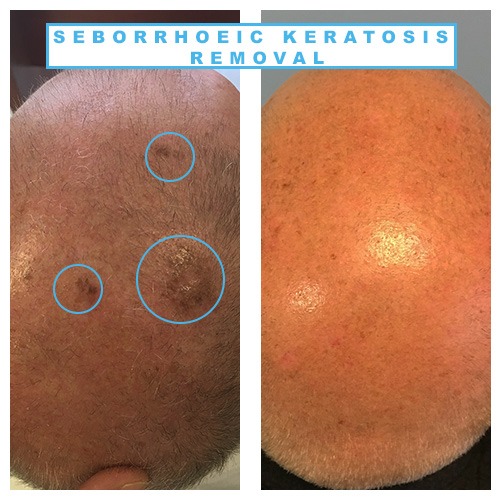
Seborrhoeic keratosis removal videos
Laser removal of seborrhoeic keratosis
When should I consider removal of a seborrhoeic keratosis?
Removal of a seborrhoeic keratosis can be considered if:
- a Consultant Dermatologist advises removal for histological analysis because the diagnosis is uncertain
- the lesion is causing cosmetic concern, particularly on the face, scalp, neck, back, chest and groin area
- the seborrhoeic keratosis is becoming itchy, inflamed or catching on clothing or jewellery
- the lesion has changed in appearance and warrants assessment
Skin lesions that can look like seborrhoeic keratosis
Seborrhoeic keratoses are clinically distinctive, but other lesions can look similar, and it is important to have a clinical assessment before treatment. Lesions that may sometimes look like a seborrhoeic keratosis include:
- Melanoma – a pigmented skin cancer that may appear similar to a dark or irregular seborrhoeic keratosis; always requires assessment by a Consultant Dermatologist
- Basal cell carcinoma – a pigmented BCC can mimic a flat or superficial seborrhoeic keratosis; biopsy may be required to distinguish them
- Mole (melanocytic naevus) – generally smoother in texture and more evenly pigmented than a seborrhoeic keratosis
- Skin tag (acrochordon) – a soft, flesh-coloured pedunculated growth, distinguished by its consistency and lack of a warty surface
- Wart (viral verruca) – can appear warty like a seborrhoeic keratosis but is caused by HPV infection; surface shows characteristic interrupted skin lines
- Pigmented actinic keratosis – this is a form of superficial sun damage which can look like a seborrhoeic keratosis
- Sun spots – can sometimes look like flat seborrhoeic keratosis
- Birthmarks such as epidermal nevus and congenital moles can also look like seborrhoeic keratosis sometimes
Treatment Pathway for Seborrhoeic Keratosis Removal
Initial Consultation
You meet your Consultant Dermatologist to confirm the diagnosis, discuss the procedure, and plan treatment. For straightforward clinically typical seborrhoeic keratosis, treatment can usually take place at the same appointment as part of our same-day procedure service.
Milia Removal
The area is cleansed and numbed with a small local anaesthetic injection. Each seborrhoeic keratoses is then removed. The procedure takes 10 to 30 minutes and no stitches are required.
Aftercare
You leave the same day with a small graze like wound at each site. Keep the area clean and apply Vaseline three times daily. The wounds heal within 5 to 14 days

Scarlett Greenwood

Seborrhoeic keratosis removal on the face and eyelid
The face is a common site for seborrhoeic keratosis removal. Lesions on the face and eyelids can be treated using the same techniques with minimal downtime.
Dermatosis papulosa nigra
Dermatosis papulosa nigra is a condition in which certain skin types develop multiple small seborrhoeic keratoses and skin tags on the face and neck. It occurs most commonly in individuals of Afro-Caribbean, South Asian, Filipino, Middle Eastern and South American heritage. It is treated in the same way as seborrhoeic keratosis removal.
Book in with us
Ready to get started? Book a consultation with our team at Midland Skin. Friendly, expert advice tailored to you.
Seborrhoeic keratosis consultation
If you are interested in seborrhoeic keratosis removal, you will attend a specialist skin surgery consultation. Your Consultant Dermatologist will assess the lesion or lesions of concern, confirm the diagnosis, and discuss treatment options with you, including the expected downtime and cosmetic results.
Occasionally a seborrhoeic keratosis may resemble a skin cancer such as melanoma or basal cell carcinoma. If there is any clinical uncertainty, your Consultant Dermatologist will advise on the most appropriate management — which may include histological analysis at an additional cost.
What happens during seborrhoeic keratosis removal
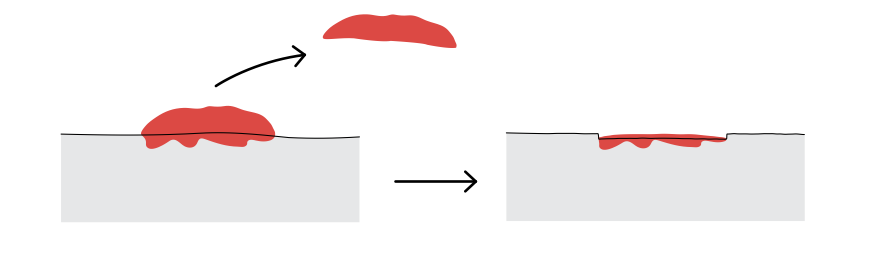
The area is numbed with a local anaesthetic injection. The seborrhoeic keratosis is then removed using a combination of hyfrecation (cautery) and curettage (scraping), leaving a superficial wound that is covered with ointment. A dressing may also be applied. Stitches are not required.
The procedure typically takes 15 to 30 minutes depending on the number of lesions treated.
Seborrhoeic keratoses can also be treated with cryotherapy (liquid nitrogen freezing) or laser, where these are more appropriate for the lesion and site. Your Consultant Dermatologist will advise on the most suitable technique at your consultation.
Same-day consultation and treatment
Seborrhoeic keratosis removal can often be carried out at the same appointment as your consultation. If you are interested in a same-day consultation and procedure, please submit your details here and a member of our team will confirm eligibility and arrange an appointment for you. This applies whether you have one lesion or several.
For patients with more than seven seborrhoeic keratoses, or lesions in complex areas, treatment sessions can be arranged after consultation. Large numbers of lesions can be treated including to extensive areas such as the back, chest, and abdominal regions over multiple sessions. This can be discussed with you at your consultation.
Is seborrhoeic keratosis removal available on the NHS?
Please enquire with your NHS provider regarding the availability of seborrhoeic keratosis removal. The procedure is not routinely funded on the NHS for cosmetic indications.
Healing and aftercare
Seborrhoeic keratosis removal is a superficial procedure. Healing time depends on the site treated and the size of the lesion:
- Face – approximately 5-7 days
- Body – approximately 10-14 days
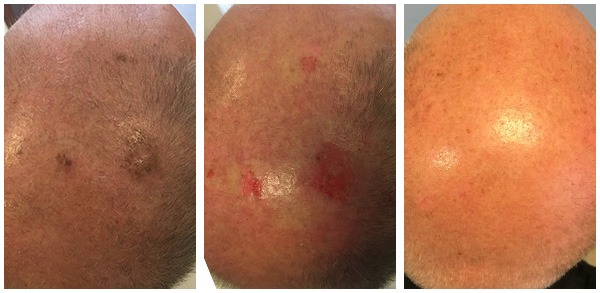
The wound forms a scab, which separates naturally. It is important not to pick the scab. Once it has separated and new skin has formed, the area will initially look pink before fading to match your normal skin colour.
Wound care
If the wound has been covered with ointment only, apply Vaseline two to four times per day and cleanse daily using warm water and a cotton pad.
If a dressing has been applied, remove it after 48 hours, then cleanse with a cotton pad and warm water, apply Vaseline, and re-dress. Repeat every 24 to 48 hours until the wound has healed.
Joshua Burrows
What are the risks of seborrhoeic keratosis removal?
Seborrhoeic keratosis removal is generally safe and achieves a high level of patient satisfaction. The main risks to be aware of are:
- Infection – uncommon; follow aftercare instructions carefully to reduce this risk
- Scarring – the treated area heals with a scar, which may appear slightly lighter or darker than the surrounding skin
- Post-procedure redness – this can be noticeable for several weeks in some patients
- Recurrence – occasionally a seborrhoeic keratosis returns and requires repeat treatment
Ashley Cooper
Fees for seborrhoeic keratosis removal
Seborrhoeic keratosis removal Show pricing
Book ConsultationSeborrhoeic keratosis & skin tag – 1 large or 3 small
Seborrhoeic keratosis & skin tag – 2 large or up to 7 small
Seborrhoeic keratosis & skin tag – complex / larger session
Seborrhoeic keratosis & skin tag – groin, face or eyelid
Seborrhoeic keratosis removal is available as a same-day consultation and procedure for eligible lesions.
About the Author
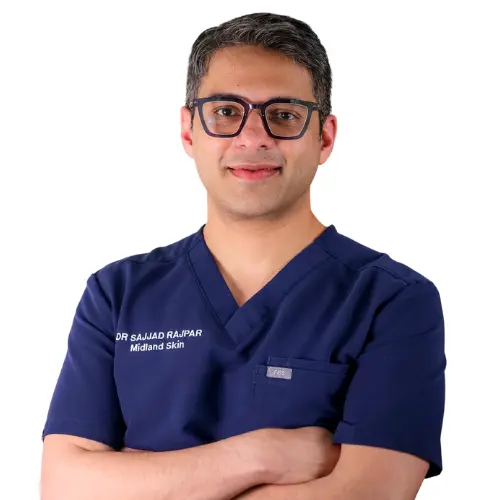
This page has been written and/or medically reviewed by Dr Sajjad Rajpar, Consultant Dermatologist and Medical Director of Midland Skin, Birmingham.
Dr Rajpar is on the GMC Specialist Register in Dermatology and has over 20 years’ experience in clinical dermatology. He provides clinical oversight to ensure the information on this page is accurate, balanced and consistent with current dermatology practice.
Dr Sajjad Rajpar
Date last updated: 16th Jun 2026
Book in with us
Expert, consultant led care in dermatology, skin surgery, eyelid surgery, lasers and aesthetics.
Disclaimer
The content on this website is provided for general information only. It is not, and must not be treated as, medical advice, a diagnosis, or a recommendation for any particular treatment. We make reasonable efforts to keep information accurate and up to date, but medicine and technology change, and content may not reflect the most current evidence, guidance, product information, or individual practice. You should not rely on this website to make decisions about your health or treatment. Always seek personalised advice from an appropriately qualified healthcare professional. Any examples, images, testimonials, and outcome descriptions are illustrative only. Results vary between individuals and no outcome can be guaranteed.


