
Fractional laser systems explained: CO₂, Erbium YAG, UltraClear, Halo and MDF compared
If you’ve started researching fractional laser resurfacing, you’ve probably noticed that “fractional laser” isn’t one treatment — it’s a family of treatments delivered by very different devices. CO₂, Er:YAG, UltraClear, Halo, MDF: the names don’t tell you much, the wavelengths even less, and most clinic websites list whichever one they happen to own.
If you’re still weighing fully ablative against fractional, start with Choosing between fully ablative and fractional laser resurfacing. What follows is a guide to the five fractional systems we use at Midland Skin, and how we choose between them.
The three categories of fractional laser
All fractional lasers work on the same principle: instead of treating the entire skin surface in one pass, they create a grid of microscopic treatment zones (MTZs) with untreated skin between them. The untreated skin acts as a healing reservoir, which is why fractional treatments recover far faster than fully ablative resurfacing. What differs between systems is how each MTZ affects the skin.

Ablative fractional laser
Each microscopic column of skin is removed (ablated), with a thin margin of surrounding tissue heated (coagulated). The combination of physical removal and thermal stimulation produces the strongest collagen response, making ablative fractional the most effective option for deeper concerns — etched lines, acne scars, surgical scars and significant sun damage. Recovery is typically 7–10 days.
Non-ablative fractional laser
Thermal energy is delivered into the dermis without removing the surface skin. The healing response and new collagen formation are driven by heat alone, which means recovery is faster and downtime shorter — typically 2–5 days of redness — at the cost of a milder result per session.
Non-thermal fractional laser
A third, newer category neither ablates nor coagulates the surface. Ultra-short acoustic pulses create plasma just below the skin — a process called laser-induced optical breakdown (LIOB) — which stimulates collagen and rejuvenation without thermal injury.
The five fractional laser systems at Midland Skin
Lumenis UltraPulse — fractional CO₂ (10,600 nm)
The UltraPulse is the workhorse ablative fractional CO₂ laser and remains the gold standard for deeper resurfacing. It produces robust ablation with a fixed coagulation zone around each MTZ, which gives a strong collagen response and meaningful tightening alongside resurfacing.
Best for: deeper acne scars, etched lines around the eyes and mouth, surgical scars, significant sun damage, periorbital rejuvenation.
Recovery: 7–10 days.
Sciton ProFractional — fractional Er:YAG (2,940 nm)
The ProFractional uses an erbium wavelength that is more strongly absorbed by water than CO₂, giving very precise ablation with minimal heat. The depth and density are independently adjustable, and a coagulation setting can dial in additional heat when more remodelling is wanted.
Best for: acne scars, fine lines, delicate areas where heat needs to be controlled, patients who want more precision and less thermal effect than CO₂.
Recovery: 5–7 days.
UltraClear — fractional 2,910 nm erbium
UltraClear is a newer erbium platform sometimes described as “cold ablation” because it can deliver fractional treatment with minimal collateral heat. The amount of thermal effect is fully tunable, so the same device can be set up for a quick rejuvenation pass or a deeper resurfacing treatment.
We are one of very few UK clinics offering this wavelength.
Best for: patients who want adjustable depth and recovery, full range of skin types, treatment of pigmentation and texture in a single platform.
Recovery: 3–7 days, depending on settings.
Halo — hybrid fractional (2,940 nm + 1,470 nm)
The Halo is unique in combining an ablative erbium wavelength (2,940 nm) and a non-ablative wavelength (1,470 nm) in a single pass. The ablative channel resurfaces the epidermis while the non-ablative channel heats the dermis, giving a result that sits between traditional non-ablative and full ablative treatments — but with much shorter downtime than CO₂.
Best for: mild-to-moderate rejuvenation, tone, texture and pore size; patients who want a noticeable result without significant social downtime.
Recovery: 3–5 days. See our dedicated Halo laser page for more detail.
Spectra MDF — Multi-Depth Fractional (non-thermal)
The MDF uses picosecond-style pulses to create plasma just below the skin surface, triggering collagen stimulation without thermal injury. Because there’s no heat and no ablation, the post-treatment appearance is very mild and recovery is the fastest of any fractional treatment.
Best for: sensitive skin, melasma-prone skin, darker skin types where thermal risk is a concern, maintenance treatments, patients who cannot tolerate any visible downtime. See our dedicated Spectra MDF page.
Recovery: 1–2 days.
Comparison at a glance
| System | Wavelength | Category | Best for | Recovery |
|---|---|---|---|---|
| UltraPulse CO₂ | 10,600 nm | Ablative | Deep scars, etched lines, sun damage | 7–10 days |
| Sciton ProFractional Er:YAG | 2,940 nm | Ablative (tunable thermal) | Precision work, delicate areas | 5–10 days |
| UltraClear | 2,910 nm | Ablative (tunable thermal) | Adjustable depth, all skin types | 3–10 days |
| Halo | 2,940 + 1,470 nm | Hybrid ablative + non-ablative | Mild–moderate rejuvenation, low downtime | 3–7 days |
| Spectra MDF | Picosecond | Non-thermal | Sensitive skin, melasma, no downtime | 1–2 days |
All five can be used across the full range of skin types when settings are tailored appropriately, though the risk of post-inflammatory hyperpigmentation is higher in darker skin types and requires careful planning.
How we choose between them
In practice, the choice between these five systems comes down to a small number of clinical factors:
Depth of the concern. Surface texture, mild pigmentation and early lines respond well to ablative, non-ablative and hybrid systems like Halo or MDF. Deeper acne scars, etched perioral lines and significant sun damage usually need an ablative fractional approach — most often CO₂, sometimes Er:YAG or UltraClear at higher settings.
Skin type and pigmentation risk. Darker skin types (Fitzpatrick IV–VI) carry a higher risk of post-inflammatory hyperpigmentation with thermal treatments. UltraClear and MDF are often preferred here because the thermal load is lower or absent. CO₂ can still be used in darker skin, but with adjusted settings.
Downtime tolerance. A patient who cannot take a week off work is poorly served by full-density CO₂. Halo, UltraClear at low settings, or MDF give meaningful improvement with 1–5 days of visible recovery.
Area being treated. Periorbital and perioral skin tolerate erbium and CO₂ well. The neck, chest and hands are thinner, less forgiving, and usually treated with lower-energy or non-ablative approaches.
Prior treatments and skin history. Recent isotretinoin, a history of keloid scarring, melasma, or active acne all change the calculus. So does what’s been tried before — a patient who has already had three sessions of a milder device and plateaued may need to step up to ablative fractional.
Maintenance vs primary treatment. A primary scar revision course often involves CO₂ or UltraClear at meaningful depth. Annual maintenance afterwards is often better suited to Halo or MDF.
Worked examples
To make this concrete, here is how those factors play out for a few representative patients:
- 29-year-old male, skin type III, seeking maintenance and brightness: Halo, CO₂ or UltraClear at moderate settings.
- 33-year-old female, skin type I, early eyelid ageing: two sessions of fractional CO₂ around the eyes, with lighter resurfacing across the rest of the face.
- 24-year-old male, skin type V, with rolling and boxcar acne scars: CO₂, UltraClear or Er:YAG as the primary approach, often combined with subcision and TCA CROSS.
- 49-year-old female, skin type IV, seeking rejuvenation with limited downtime: UltraClear at light settings, Halo, or MDF combined with BBL for tone.
- 62-year-old female, skin type II, lines and diffues sun damage: Any of the fractional ablative systems will be suitable at moderate to high parameters.
In most cases there isn’t a single “right” answer — there’s a range of reasonable options, and the conversation at consultation is about matching the device to the patient rather than the other way round.
Next steps
If you are considering fractional laser resurfacing, the most useful next step is a consultation with a consultant dermatologist who can assess your skin in person, discuss what you are hoping to achieve, and recommend the most appropriate system. Having access to all five fractional platforms under one roof means we can match the treatment to you rather than fitting you to whatever device the clinic happens to own.
About the Author
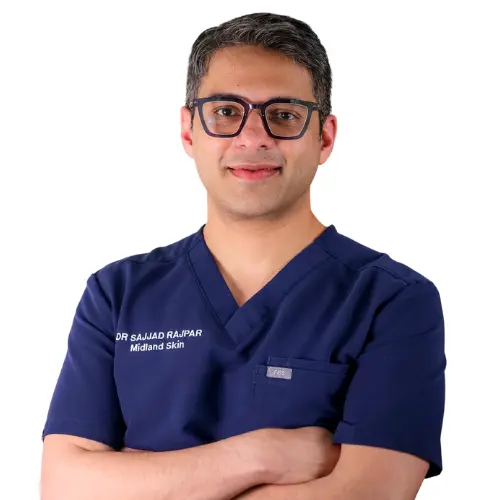
This page has been written and/or medically reviewed by Dr Sajjad Rajpar, Consultant Dermatologist and Medical Director of Midland Skin, Birmingham.
Dr Rajpar is on the GMC Specialist Register in Dermatology and has over 20 years’ experience in clinical dermatology. He provides clinical oversight to ensure the information on this page is accurate, balanced and consistent with current dermatology practice.
Dr Sajjad Rajpar
Date last updated: 10th May 2026
Book in with us
Expert, consultant led care in dermatology, skin surgery, eyelid surgery, lasers and aesthetics.


