
[vc_row type=”in_container” full_screen_row_position=”middle” scene_position=”center” text_color=”dark” text_align=”left” top_padding=”50″ overlay_strength=”0.3″ shape_divider_position=”bottom” shape_type=””][vc_column column_padding=”no-extra-padding” column_padding_position=”all” background_color_opacity=”1″ background_hover_color_opacity=”1″ column_shadow=”none” column_border_radius=”none” width=”2/3″ tablet_text_alignment=”default” phone_text_alignment=”default” column_border_width=”none” column_border_style=”solid”][vc_column_text css=”.vc_custom_1748960640589{padding-bottom: 30px !important;}”]
What are keloid scars?
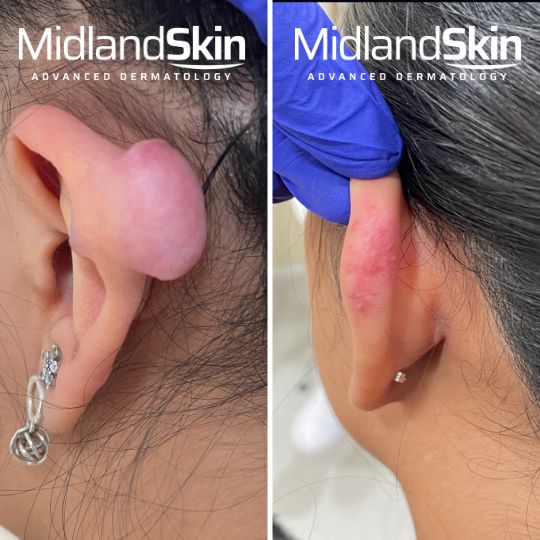
A keloid is an overgrown, raised scar that extends beyond the original wound. Unlike typical scars, keloids can continue to enlarge over months or even years.
Keloid scars can cause pain and itching.
They often feel firm or rubbery and may appear shiny pink-purple on lighter skin, or dark brown on darker skin.
Common sites include the chest, shoulders, jawline, and ear lobes.
[/vc_column_text][/vc_column][vc_column centered_text=”true” column_padding=”no-extra-padding” column_padding_position=”all” background_color_opacity=”1″ background_hover_color_opacity=”1″ column_shadow=”none” column_border_radius=”none” width=”1/3″ tablet_text_alignment=”default” phone_text_alignment=”default” column_border_width=”none” column_border_style=”solid”][nectar_btn size=”large” button_style=”regular” button_color_2=”Extra-Color-2″ icon_family=”default_arrow” url=”/contact-us” text=”Make an appointment for keloid scar” margin_top=”45″][nectar_btn size=”large” button_style=”regular” button_color_2=”Accent-Color” icon_family=”default_arrow” url=”tel:+441212854540″ text=”Call us now” margin_top=”45″][/vc_column][/vc_row][vc_row type=”in_container” full_screen_row_position=”middle” equal_height=”yes” content_placement=”top” scene_position=”center” text_color=”dark” text_align=”left” top_padding=”50″ bottom_padding=”0″ overlay_strength=”0.3″ shape_divider_position=”bottom” shape_type=””][vc_column column_padding=”no-extra-padding” column_padding_position=”all” background_color_opacity=”1″ background_hover_color_opacity=”1″ column_shadow=”none” column_border_radius=”none” width=”1/1″ tablet_text_alignment=”default” phone_text_alignment=”default” column_border_width=”none” column_border_style=”solid”][vc_column_text]
Why do keloid scars form?
Several factors contribute to keloid formation:
- Abnormal healing pathways. Overactive fibroblasts produce excessive collagen causing scars to expand.
- Genetics and skin type. Keloids are more common in individuals with Black or Asian origin.
- Mechanical tension and trauma: Scars in high-tension areas, or wounds complicated by infection or delayed healing, are more likely to form keloids.
How common are keloid scars?
Keloid scars affect approximately 0.1–0.4 % of the general UK population, but the incidence can be much higher, up to 16 %, in individuals with darker skin types.
What causes keloid scars?
Keloids may occur after trauma or burn, surgery, ear piercing, acne or other injury to the skin. Sometimes keloid can appear spontaneously.
Keloid Scar Treatment at Midland Skin
While there is no cure for keloid scars, or licensed treatment, certain treatments can be effective at reduce keloid symptoms and volume.
The most effective results are usually achieved by combining treatments tailored to your scar’s size, location, and behaviour.
The treatments offered for keloid scars are listed below.
First-line options
| Treatment | Notes |
|---|---|
| Intralesional corticosteroid injection | Given every 4–6 weeks. Around 50+% improve; recurrence rates range from 9–50 %. |
| Vascular laser ± steroid injection | Helps reduce redness and can improve response to injection. |
| Silicone gel or sheeting | Worn ≥12 hours daily for at least 2–3 months. Supports other treatments. |
| Compression therapy | Such as custom made ear pressure splints. |
Second-line and adjunct options
| Treatment | Notes |
|---|---|
| 5-Fluorouracil (5-FU) ± steroid injection | Dual therapy injection into the keloid can improve flattening and pigmentation. 5-FU is a chemotherapy medication. |
| Fractional CO₂ or vascular laser | Studies show improved texture and colour using lasers alone. |
| Triple therapy (ablative fractional laser ± 5-FU ± steroid) | Combining laser with medications improves outcomes. Treatment is repeated every 4–12 weeks. |
| Quadruple therapy (vascular + ablative fractional laser ± 5-FU ± steroid) | For more resistant keloids. Combination laser with medications improves outcomes. Treatment is repeated every 4–12 weeks. Botulinum toxin and hyaluronidase may also be added to the mixture. |
| Surgical excision + adjuvant therapy | In selected cases, such as ear keloids, surgery is combined with compression and steroid injection or laser-based combination therapy. Excision alone is not offered as it carries a high risk of recurrence. |
Keloid Scar Consultation
An initial consultation for keloid scar includes:
- Discussion of your concerns and previous treatments
- Examination of the keloids and clinical photography
- Advice on whether any further investigations are needed (e.g. biopsy or blood tests)
- A discussion of whether the keloid scar can be treated, treatment options, likely outcomes, downtime, aftercare, and cost
- A written care plan summarising the recommendations and pricing
- A copy of the clinic note is sent to you and your GP
- Further details are available in our appointment guide

Frequently Asked Questions
Can I just have the keloid scar cut out?
Surgery alone is not usually recommended, as recurrence rates are high, often with the keloid returning larger than before.
In certain cases, such as ear-lobe keloids, surgery may be considered, but always with additional treatments like compression with a custom ear split, steroid or chemotherapy injections or laser.
Surgery with post-operative radiotherapy (within 24–72 hours) is another option, although we do not offer radiotherapy at Midland Skin.
Will the scar disappear completely?
Keloids cannot usually be removed entirely. Treatment aims to flatten, soften, and fade the scar, while relieving symptoms such as itching and discomfort. Unfortunately, there is no guarantee a particular treatment will be effective or that the keloid will not recur after successful treatment.
What is the difference between hypertrophic and keloid scars?
Hypertrophic scars are raised, red marks that stay within the original wound margins. Keloids, by contrast, grow into the surrounding normal skin and can keep enlarging for months or years. Keloid scars are usually firmer, more conspicuous, and may be itchy or sore. Hypertrophic scars often flatten with time, whereas keloids rarely improve without active treatment. We treat both keloid and hypetrophic scars.
I am having ear keloid surgical excision, and I have been told I need a custom made ear compression splint?
If you are having ear surgery for keloid removal, you will need a custom made ear splint that is worn for up to 24 hours a day for 12 months. A custom made splint is comfortable and painless to wear and reduces the risk of keloid scars recurring. You will be referred to a specialist centre in the West Midlands for a splint to be created bespoke to your ear.
What will the cost of treatment be?
Bespoke pricing is provided after a full assessment and depends on the number, size, and type of keloid and the treatment plan recommended. Different medications and laser treatments have different costs associated with them.
If I make an appointment will you guarantee you will remove my keloid scars?
A guarantee can not be given as treatment responses vary between individuals. If first line treatments do not work you will be offered second line treatments. Treatment is aimed at reducing keloid symptoms and volume. Complete removal is not a realistic expectation.
Do you treat all keloid scars?
There are instances that certain keloid scars or patients may not be suitable for the treatments we offer and this will be advised at your consultation. Where feasible, onward referral for an opinion on treatments we offer will be offered.[/vc_column_text][/vc_column][/vc_row][vc_row type=”in_container” full_screen_row_position=”middle” equal_height=”yes” content_placement=”top” scene_position=”center” text_color=”dark” text_align=”left” top_padding=”50″ bottom_padding=”0″ overlay_strength=”0.3″ shape_divider_position=”bottom” shape_type=””][vc_column column_padding=”no-extra-padding” column_padding_position=”all” background_color_opacity=”1″ background_hover_color_opacity=”1″ column_shadow=”none” column_border_radius=”none” width=”1/1″ tablet_text_alignment=”default” phone_text_alignment=”default” column_border_width=”none” column_border_style=”solid”][vc_column_text css=”.vc_custom_1748960717556{padding-bottom: 0px !important;}”]
What should I do next?
Contact us here to arrange a keloid scar consultation where you can discuss your needs with a doctor has expertise in keloid scar treatment. Our fees for consultation can be reviewed here.
[/vc_column_text][/vc_column][/vc_row]


